“Taking issues and situations and problems and going to root components; understanding how the problem evolved – looking at it from a systemic perspective and not accepting things at face value.
It also means being curious about why things are the way they are and being able to think about why something is important.”
Annmarie Neal’s definition of “critical thinking,” as reported in Tony Wagner’s The Global Achievement Gap, p. 16. Neal is VP Talent Management at Cisco Systems.
Training to Be an Innovator
In working to be a student of innovation, I have come to believe that I must practice the five skills of disruptive innovators, as defined by Dyer, Gregersen, and Christensen in The Innovator’s DNA: observing, questioning, experimenting, networking, and associating. (Of course, these traits mirror the phases and stages typically described in “design thinking,” too.) For me, this practice takes several different forms. As just one example, keeping an observation journal has proven to be a transformative exercise that continues to develop fascinating habits-of-mind muscle. Just like a person purposefully training in running or cycling develops fitness and musculature, by purposefully training in observation and questioning, as well as in the other skills, I know I am developing fitness and musculature as an innovator and design thinker.
Such observation journaling and innovation training, I believe, exist as critical foundations and pillaring for faculties and students who are serious about developing the Seven Survival Skills that Wagner details in The Global Achievement Gap:
- Critical Thinking and Problem Solving
- Collaboration Across Networks and Leading by Influence
- Agility and Adaptability
- Initiative and Entrepreneurialism
- Effective Oral and Written Communication
- Accessing and Analyzing Information
- Curiosity and Imagination
An Example from the Field
Thanks to my training, I walk through my surroundings and communities differently now. My senses are sharper and I am more intentional about my awareness.
Not long ago, on one of my morning walks with Lucy (my pointer-hound mix), I was stopped in my tracks by these signs:
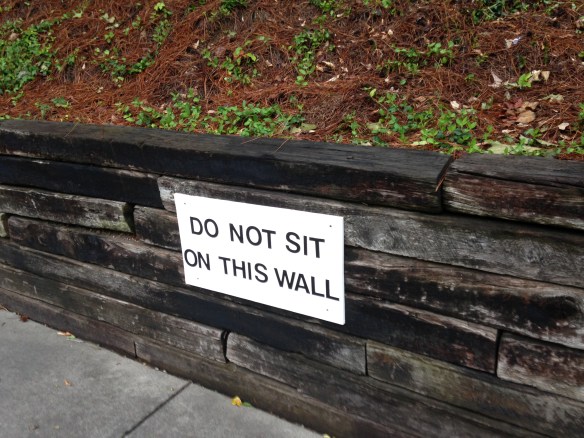
Along this railroad-tie wall, there are several of these signs. The wall is located on Howell Mill Road, near the I-75 ramp at Northside and W. Paces, in Atlanta, GA. The wall is immediately adjacent to a MARTA bus stop:

As has become my practice, I act on my curiosity in such situations by 1) snapping a picture or two with my phone, 2) sending the images to an email composer, 3) recording a few questions or ideas, and 4) sending the email to be uploaded to a blog I keep for observation journaling.
What was/am I curious about?
- Why don’t “they” want people to sit on this wall?
- Are the bus-stop users sitting on the wall because they are tired, wanting to take a break, etc.?
- Has the wall failed or fallen because of previous sitters? Did the place of business behind the wall have to spend money to replace a wall in the past?
- What are the bus-stop users supposed to do… where might they sit?
- What’s it like to have to use Atlanta’s public transportation, for those that might not have a car, for convenience, like I have?
- Would I want to sit down – even on that wall – if I rode a MARTA bus every day?
- What happens when it rains? When it’s bloody hot!? When it’s freezing cold.
- What other solutions to the problem could be tried? Have any others been tried?
- What did that wall and those signs cost? What would a wall with integrated seats and head cover cost? Would adding benches be that much to spend?
And I could just go on and on.
It’s only fair for me to divulge that I have been significantly influenced by the 2012-13 First Graders at my school – Mount Vernon Presbyterian School. While I don’t know any of last year’s First Graders, I do practice networking and associating, too, and I followed the blog of the iDesign Lab at MVPS. Last year, before I joined MVPS and MVIFI (Mount Vernon Institute for Innovation), the First Graders took on a design challenge related to the bus stops in Sandy Springs. There are numerous posts demonstrating the D.E.E.P. method of design thinking (Discover, Empathize, Experiment, Produce) – here’s just one showing some of the prototypes after spending quite a bit of time in the discovery and empathizing modes, and after creating Point-Of-View statements and HMW (How Might We…) declarations.
So, if I were as smart as an MVPS First Grader, supported by my teacher and @SciTechyEDU, then I might spend more time at that bus stop, near those signs, and interview some of the people who are regularly there. I might ask for an interview with a MARTA official, one of the people that manages the business behind that wall, etc. Then, I might develop some POVs and HMWs. All of this involves a great deal of in-context, relevant communication, critical thinking, etc. (some of the essential Cs of 21st C or Modern or Timeless learning, depending on which “label camp” you belong to for these essential skills and habits of mind).
Next, I might begin prototyping various solutions based on my insights gathered during my discovery and empathizing. I imagine lots of creativity here as I build and experiment. I could return to the MARTA office, business, bus-stop site and get feedback on my designs. I imagine I would have used quite a bit of mathematics, physics, sociology, etc. during this experimenting and prototyping stage. Perhaps even some history, economics, engineering, foreign language. More communication skills, too. All very STEM, STEAM, and STREAM, if you ask me.
Of course, in “regular school” these subjects would be more siloed than they are in the experience I am describing. Like dinner plates of different colors, they would occupy their distinct places on the table. However, in my field-study example here, the plates have been smashed and the colored shards have been re-organized and glued as a different-kind-of-beautiful mosaic. Same number of total-size pieces (theoretically) as existed when they were whole plates of one color, but now they are mosaically bonded with pieces of various colors. Same amount of total school time might be involved, regardless of whether we scheduled by departments or in an integrated manner, but the time would be more mosaically organized with the integrated approach. My engagement and motivation in this kind of mosaic, difference-making environment might also help me to remain captivated, involved and experiencing Csikszentmihalyi flow for longer than just 45-55 minutes. Of course, different days of the week might be organized differently, depending on what our needs and purposes were as we undertook such challenges as curriculum.
Finally, after presenting my project results and solution to a board of experts, so to speak, I might partner with MARTA or the business or the bus-stop regulars or the surrounding community to realize the solution we developed together. Great opportunities for collaboration, creative expression, leading by influence, entrepreneurialism, etc.
Feeling pretty motivated and invested by now, I might be at a different level of understanding and wisdom about citizenship, civic engagement, and difference-making.
Another Interesting Thought (To Me)
Within a 2-mile radius of this bus-stop-railroad-tie-wall-shouting-signage location, there are about seven schools – some being independent/private and some being public. Meaning that it would not be that challenging to think of a “curriculum,” or “unit,” or “lesson,” or “experience” that could involve student and adult learners engaging in similar design-thinking, project-based, and innovation-training exercises. I am NOT meaning to sound critical of these schools in any way. Some of them, perhaps all of them, are already practicing such mosaic learning and community engagement to develop the Cs and the Seven Survival Skills. My point is that schools have possibilities – infinite possibilities – for such exercises and engagement in their immediate and close-by surrounds. Perhaps the most underutilized learning spaces for schools are our own campuses and immediately surrounding communities.
A Final Note
Rigor (I prefer Vigor – see Amy Purcell Vorenberg’s article in Independent School, “School Matters: Rigor vs. Vigor”, Spring 2008) may not equate to volume of material covered or pace of coverage. Rigor (Vigor) may equate to real-world context that challenges student learners to approach real issues in more integrated, holistic ways and seek solutions to problems that don’t just have one answer or an easily identified one. What’s more, the desire to make a difference and the efficacy to know that one can make a difference are such strong motivators that I have seen countless people – young and old – choose to put themselves into unbelievably rigorous (vigorous) situations because they care and they feel a certain locus of control.
The bus-stop example above is just that – one example. There are countless others. You could/will think of many that would appeal to you more. For me, though, this example lives at an intersection of real-life practices – my training in innovation and design through observation journaling AND the capacities of First Graders (who could have been 5th graders or 11 graders or no graders) to engage in real-life problem solving with their community.
How are you being a student of innovation? How are you engineering practices and creating opportunities for your colleagues and students to develop and grow in the Cs and Seven Survival Skills?
If we are not intentional, it just won’t happen. We need to shift culture.
“The question, as we move from an industrial economy that cherishes compliance to a connected economy that prizes achievement, is this: Are we supporting this shift with a culture that encourages us to dream important dreams? What do we challenge our achievers to do? When do we encourage or demand that they move from standardized tests and Dummies guides to work that actually matters?”
Seth Godin, “The Achieving Society,” The Icarus Deception, p. 22.




 it's about learning