Synergy 8 Update – Week 3

Last week in Synergy 8, our team of 26 established and integrated our triad of foundational course-communication tools – Schoology, Posterous, and WordPress. After all, a learnopolis needs an infrastructure for advanced communication. Additionally, we began utilizing and practicing our #1 tool in Synergy – the observation journal. In the upcoming weeks, our team observations will allow us to develop projects of our choosing that address community needs about which we are curious…and about which we care.

This week, on Monday, August 29, we began Synergy with this short piece:

We wanted to use a compelling hook for enlisting the students in a prototypical project. By engaging this project as an “alpha project” for this semester’s Synergy 8  team, we could “learn by doing” within the context of a project – a project started by last year’s Synergy 8 crew. After watching the video, we coached the team through a process of determining methods and action steps for researching the perceived problem of keeping Malone Dining Hall clean. Based on the team’s gamestorming, we focused on four possible methods: 1) direct observation of Malone, 2) interviews with homerooms regarding KP, 3) interviews with Malone staff and director Robert Nash, 4) student body survey.

On Tuesday, we used Poll Everywhere to explore how we might operationalize our teams. Based on the results, we decided to jump into a “spontaneous lesson plan shift.” If we were playing football…we called an audible. We used the results to walk through eight mediated journal prompts created on the fly. We explored graphical analysis and numeracy, and we examined some misconceptions about what the Poll Everywhere data were telling us. The data revealed some teamwork issues, too, and the team members proposed solutions to the issues. We then implemented a solution and retook the Poll Everywhere survey.

Now, the Synergy 8 team is distributed in sub-teams, and we are working to develop the action steps needed to implement our community problem-solving. Before jumping in too deep, though, we paused to read Dan and Chip Heath’s Switch chapter on “Finding the Bright Spots.” We believe there is so much to learn from the example of Dr. Sternin and the Vietnamese-nutrition project. Now we plan to:

1. Enlist the community as partners in the problem-solving process, instead of swooping in and acting like we have all the answers.

2. Study the bright spots of what’s working and strategize how we can do more of that good stuff.

3. Empower the community to sustain the change needed to improve the situation.

Through this alpha project – the KP Challenge – we are addressing a serious community issue, we are bridging the work begun in Synergy 8 2010-11, and we are modeling a project process that can frame future projects that we undertake in Synergy 8. All the while, we are integrating content and skills that are typically distributed and segregated among various “departments.” We are engaged in a scientific process, we are collecting and analyzing data, we are discussing human psychology and sociology, we are drafting persuasive pieces and developing interview questions and protocols.

I cannot wait to see what tomorrow brings!
Synergy 8 Beginnings – Day 1 and Day 2 Recap

As a student for many years, I can remember the general trend of the first day of classes. As a whole, most of my teachers distributed a handout with numerous rules and expectations. We were told what kind of notebook to carry, how to organize it, how much quizzes and tests counted in our averages, what not to do in class, etc.

As a counselor at Camp Sea Gull, we learned that first impressions are powerful. Captain Lloyd used to say that it takes only minutes to form a first impression but days and weeks to change or alter that first impression.

DAY 1

In Synergy, Jill Gough and I wanted to facilitate a careful and thoughtful first impression of what the course would be focused on. Our first class period is only 15 minutes long because of the orientation design of our first days of school. In that quarter hour, we hoped to inspire our 24 teammates – all 8th graders – to know that Synergy was about empowering us to be the change we wish to see in the world. So…we began with Kiran Bir Sethi’s 9 minute TED talk:

In the minutes that remained, we asked the student learners to reflect on why we would begin the course with such a video “act 1.” Several piped up and said, “Because we can do things to make a difference.” “This class is about applying our subjects to making a difference in the world.” “We are just kids, but we can act to change things that we see need changing.”

A successful beginning!

DAY 2

On day 2, we began with the Marshmallow Challenge (see Tom Wujec TED talk). Shortly after the class, we cut this 5 minute video:

The student learners wrote some responses in a mediated journal, and the focus centered on the importance of prototyping and engaging in an iterative process of trial, error, success, improvement, revision, retrial.

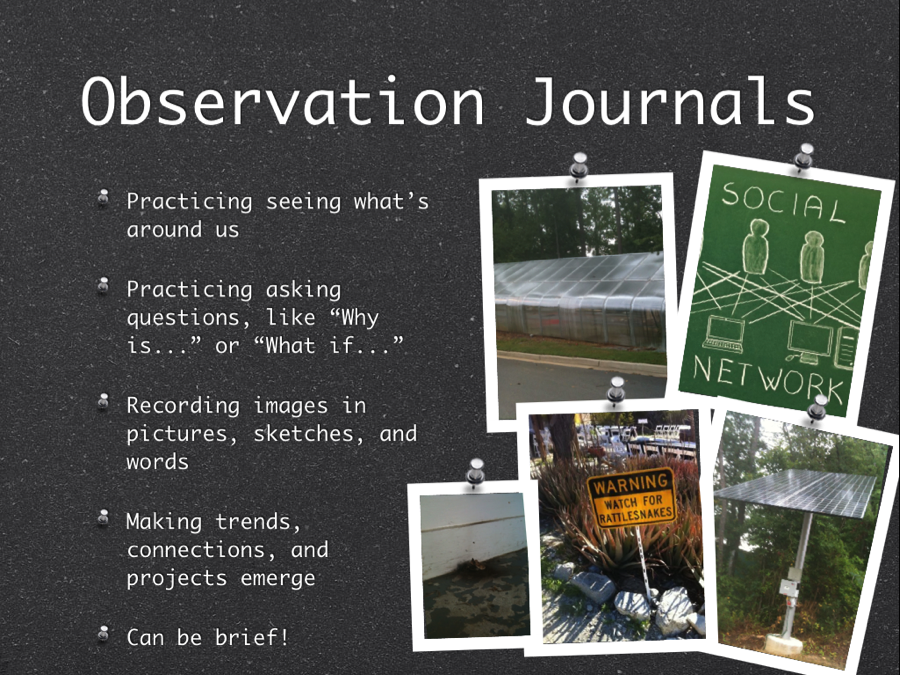
Next, we explained that our team would engage in a common practice and habit of observation journaling. To kick off this tool-explanation session, we employed Jonathan Klein’s TED talk:

Students briefly reacted to the power of visual imagery and using images (text, sketch, or picture images) to drum up awareness, reaction, and discussion. This was our jumping off point for beginning the powerful habit of recording our observations in a kind of regular diary about what we see and what causes us to question.

Jill and I then demonstrated a method that we both use to keep our observation journals – a great e-mail based blogging system called Posterous. Jill “postered” an observation journal of me postering” an observation journal: http://jplgough.posterous.com/observations-synergy

Finally, before we had to depart, we provided the students with the private access code to our class Schoology site – our primary means of digital communication and archiving for the Synergy community.

From my seat, it was a great beginning with a team of 26 people full of the “I Can” bug…ready to engage the iterative process of prototyping…so that we can take charge and use our images and voices to make a difference in this world. I still don’t know what kind of binder we should use, but that seems relatively insignificant. And we have weeks to overcome that first impression about notebooks and binders!

Update on TEDxKids@BC Excitement!

On May 13, I posted about the excitement that a couple of eighth graders expressed about the possibility of engaging with TEDxKids@BC. One person commented on that post – Goran Kimovski, who is with TEDxKids@BC. THANK YOU, Mr. Kimovski. If nothing else even happens, I appreciate you taking time to comment, communicate, and excite! Such is a bedrock of learning, isn’t it?
.
Over the past weekend, a veritable flurry of communication exchanges occurred among the two eighth-grade learners, Ms. Gough, and me (Ms. Gough and I are part of the Synergy 8 team with these two eighth graders). After about 13 prototypes of a formal communication to Mr. Kimovski, here is what the eighth graders sent…
Dear Mr. Kimovski,
    We would first like to thank you for responding to Mr. Adams’s blog post in such a quick and inviting manner. Secondly, we would like to submit a proposal for the TEDxKids conference. Please let us know what would be the best way to do that, whether it be sending our thoughts to you via email or submitting some sort of application. We’d love to talk to you via skype; anytime from 2:40 to 3:30 EST is fine on our end, what time works for you? Below is a summary of our ideas and thoughts for this conference.
    School that cultivates a love of learning:
– increased student discussion less teacher lecture
– improvement and retention rather than  learning for test and grades
– incorporating technology to reach all learners
    Over this academic year, we believe that we have grown as students and in our beliefs of what makes up good schooling and what school ideally should look like. Also, as participants of a prototype course, called Synergy, we had the opportunity to explore the concept of “ideal school” further. We would like the opportunity to let others know about what we, as students, feel about this important issue of education, and the evolution that’s necessary to better serve the needs of learners.
Thanks once again,
T. S. and S. Z.
If for no other reason (and there are many!), I am thankful for social networking media used for educational purposes. Connecting learners with passionate, critical topics for exploration and discovery and possibility…that’s what is required for innovation and improvement.
.
What are you excited about? With whom are you connecting? With whom are you exchanging ideas and possibilities? Who is on your team to help push the change and improvement we desire in the world? How are you spreading ideas? What ideas are you catching that others are spreading?
Get connected. It’s about learning!

TEDxKids@BC and a dollop of Synergy feedback!

Assessment comes in so many shapes and sizes! Recently, I received some unexpected feedback about Synergy 8 – an interdisciplinary, community-issues, PBL class that Jill Gough and I created and piloted with eighth graders this past fall semester.

Earlier this week, as I was reading in my GOOGLE RSS feed reader (I use Feeddler on iPad), I discovered a call for speakers for TEDxKids@BC. Being a huge fan and supporter of TEDx and David Wees, I tweeted the blog-post-call-for-speakers. Thinking specifically of two or three Synergy “grads,” I called their attention to the tweet with a mention. Via direct messaging, two of the Synergy team members scheduled a face-to-face to discuss possibilities, and then one followed up with an email showing her initial brainstorming about a proposal to speak at TEDxKids@BC. I am pasting the email below, with permission:

Sent: Thursday, May 12, 2011 11:09 AM
To: Jill Gough; Bo Adams
Subject: tedx kids ideas:
tedx kids ideas:
What should school look like?
(use synergy experience as example)
– discussion and question centered
– students as teachers too
– self assessments
– improvement and retention vs. Grades
– technology integrated
– find out what students and teachers think school is and what it should be/what they want it to be
Class room environment:??? (don’t rly know, this might be a totally irrelevant or repetitive tangent…)
– respect
– student involvement instead of teacher lecturing (students as teachers too)
– using technology to appeal to all kinds of learners and learning styles
– teach how they learn, and what they want to know not just for test
– cultivate a love of learning and subject (may be far out there)
Bisous 🙂
Live, Laugh, Love
Sent from my iPhone
“Ideas worth spreading” indeed! Fourteen years old, this Synergy thinker is. Can you feel the ripples she might be causing in the way we think about education and school in the 21st century?! Whether she makes it all the way to a TEDxKids@BC talk this go-around or not, “BRAVA!” to her for taking the risk and forwarding her thinking. Ms. Gough and I are behind her all the way!

Reflecting from aFAAR

In the Junior High, tis the season of conducting Student Course Feedback and, for some, it seems, completing Peer Visits – two of the five components of our Faculty Assessment and Annual Review (FAAR) process. Additionally, a third component of our formative assessment plan – Admin Observation – has been occurring all year. After seeing the note “re-review and process Synergy 8 SCF” on our respective to-do lists for months, Jill Gough and I have finally spent five meetings of second period reviewing and reflecting on our Synergy 8 student course feedback (SCF). Not only did we re-review the feedback to reconsider how things went during the first-semester course, but we also revisited the data in May so that we could pre-plan more effectively for the next iteration of Synergy 8. As we returned to the SCF and discussed the results, we remembered connections in the data that linked to things we read in our peer visit summaries and admin observation notes. We were reminded that student course feedback does not exist by itself. The components of our FAAR process are not intended to be isolated, siloed pieces of professional learning. They can be wonderfully integrated and whole. Also, they are not intended to be summative or evaluative – they are not judgmental pieces of professional evaluation. They are meant to be formative…lenses through which we can view our teaching and learning so as to grow and develop as educators…so that we can adjust our course.

What’s more, by reviewing and reflecting together, we enhanced our field of view and gained richer understanding from the blend of each other’s varied perspectives and reactions. During each of the five periods that we engaged in this collaborative work, we would independently review the data and write to the prompts on the narrative summary tool (“option #2”) for reflecting on one’s SCF – one reflective prompt at a time. Then, we would read and discuss each other’s responses. While this took more time than working through the reflection alone, we both believe we benefitted immensely from the writing, sharing, and dialoguing. We missed things in our individual reflections, but very little fell through any cracks by canvassing the feedback as a team of critical friends.

To share our system of feedback, we decided to use an online, cloud-storage, sharing tool called “Box.” By using Box, we could design some simple webdocs that literally show and archive the connections among the feedback and reflections. Box has a number of great features, including the ability to tag documents post comments. To view our Box-stored system of feedback, please visit the “Synergy 8 – FAAR” folder.

Soon, our next collective endeavor will be to prepare our 2011-12 Goals and Self-Assessment (a fourth component of FAAR). Because we co-facilitate Synergy 8, we intend to employ the critical friends process again as we continue to prepare for our next team of Synergy learners. The manner in which we reviewed and reflected on our system of feedback has set up and primed our ability and enthusiasm to enhance the Synergy experience for the upcoming school year.

In addition to our course-specific questions, we are also engaged in thinking about some critical learning questions for ourselves and our FAAR process (and they may be good questions for you, too):

  • Can you learn more deeply reviewing feedback with a colleague? How can we assist each other in learning more deeply?
  • Have can we build a common understanding of the needs of our learners?  How can we find a richer understanding of ourselves as teammates and co-facilitators?
  • Do you have a team of critical friends? What feedback are you collecting and considering so that you can grow?
  • Would you learn more by sharing the results of your feedback with another for reflection and co-interpretation?  How will we grow and learn together if we are not sharing our struggles and our successes?
  • What have we learned from this process that we can facilitate for our younger learners next semester? How can we model and implement a richer reflection and critical friends system as part of the course?
NOTE: This post is cross-posted at Jill Gough’s Experiments in Learning by Doing.