Dumber or Just Different?

This week, a colleague at school circulated the email below to a large number of faculty. The content of the inquiry has caused me to really think about some things. Here are a few of them:

  • Kudos to this educator for soliciting dialogue about an important learning issue! I love that instincts were to create a space for discussion and collaboration.
  • Thanks to this educator (and others who designed the PD day) for identifying a way to use in-service time for self-identified interests and innovations!
  • Could the texts we are asking students to read be part of the issue…rather than the length of the texts?
  • Years and years ago, was a similar message part of a tribal campfire discussion? “Villagers, we are having a harder and harder time getting children to tell stories around the campfire. Their oral memories are terrible! They want to look at these things called books. What should we do?” [please excuse the reductionist, less-than-accurate historical detail here]
  • Don’t people who write long books do so by examining small dollups of thinking? Don’t writers of long texts do so by writing smaller dollups of writing?
  • I read a lot of “sound bites” that I categorize with modern day tools so that I “study” an issue intensely from a number of different, inter-connected perspectives. When we think about a printed, long text, isn’t that exactly what we have access to via the words that the author decided to record – all the synthesized thinking that went into the recording of the text?
  • Why do we educators sometimes assume that just because the “kids don’t do it in school, they must not do it?” I am certain that our students are choosing to read and immerse themselves in some longer, richer texts…not because they are assigned in school, but because they are interesting outside of school.
  • Let’s search for the “both/and solution.” Students – all learners – should be able to do both/and…learn in sound bites and backchannels, as well as in longer, deeper texts, as well as…

Dear Colleagues,

Some of you may have seen Bob Ryshke’s recent posting of Mark Bauerlein’s article on thoughtful reading, “Too Dumb for Complex Texts.”  In a similar vein, I offer you a short blog post called “Are We Really Becoming More Stupid?”  Make sure you read the response, too:

http://www.prelude-team.com/blog/2010/10/05/are-we-really-becoming-more-stupid

The post and the response encapsulate neatly two different arguments about the way we (or some of us?) read today. 

My own experience in class over the last 2-3 years has been that of an increasing student unease with spending time with texts or even passages, and I have been wondering whether it is some way related to a rapidly emerging digital culture that privileges sound-bites, personal opinion (not informed judgement), and multi-tasking.  We have even seen some of our faculty peers engaging in technological multi-tasking by tweeting each other during presentations (so-called “back-channeling”).

I would be very interested in participating in a collaborative discussion with some of you about encouraging our students to read slowly and deeply — to give complex texts enough time to breathe.  The next in-service day looks like the perfect time to do this.  Let me know if you’re interested, and let’s start working on a reading list and/or an agenda for the day.

Finally, I thought of this TED talk…
Using Technology to Humanize the Classroom: Khan’s Model

At TED 2011, Salman Khan gave the talk inserted below in video. Under the video is a link to the library of Khan Academy lessons on YouTube (notice the sheer volume of videos and the topics covered…all for free).

Browse the Khan Academy library.

[Added 3-12-11 @ 7:36 a.m.]
Joe Bower offers some contrasting views of Khan Academy.

Thinking Out Loud: Tribes

In the old paradigm of writing and publishing, a writer essentially worked to have all of his or her ideas formed and packaged before publishing. Such was required – all of the thinking on paper had to be relatively complete before it went to press, experienced the magic of publication, and landed on a shelf.

With blogging, as well as with other social media, the power of the printing press has been democratized to the masses. For some, that is frightening. I often hear choruses of “Anybody can get something on the Internet now. Used to be only experts could express their ideas onpaper. Now any yokel can press publish.”

For me, getting to think out loud is exciting and empowering. Sure, sometimes thinking out loud means that a blog post possesses that feeling of “unfinished-ness.” However, it is this unfinished-ness that excites me. By thinking out loud, I can amplify my current thinking and incorporate others’ thinking – if they will just take the risk to think out loud, too, and share. WE are smarter than me. Steve Johnson’s “coffee house” has a better chance of materializing if we are congregating and sharing our thinking. With a growth mindset, I worry not about what people will think of my unfinished, unrefined, unpolished post. I want to grow. Growing requires sticking your neck out. It’s not about looking silly. It’s about learning.

Of course, I am not telling you readers anything you don’t already know. Rather, I am simply finishing a preface to what I really want to write about this morning – but, gloriously, my thinking is not finished on this next topic. By sharing some initial thoughts, those thoughts stand the chance of being read and amplified by a Jonathan Martin, a Lyn Hilt, a Bill Ferriter, a John Burk, a Jill Gough, an Anna Moore, or a colleague that I have yet to meet – either in reality or in virtual space. I can leverage my PLN if I will just risk letting them in to my thinking.

So…

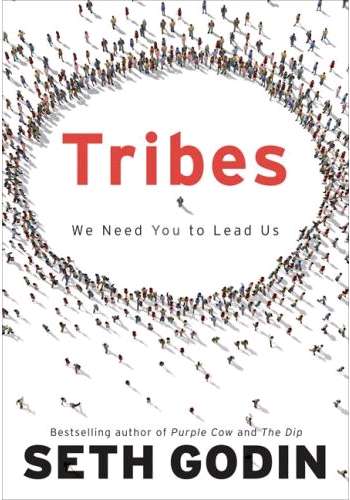
This morning I am re-reading Seth Godin’s Tribe. Many of you may know that I am a stack reader – I will digress if I explain that strategy of my reading. I could just highlight some passages and take some notes, but then those highlights and notes would only benefit me. Additionally, those highlights and notes could not be amplified by others whose thinking could magnify my own. So…I am recording some ideas here – unfinished, unpolished ideas. Here’s to the potential of amplification. If nothing happens to these ideas, I am no worse off. However, if even one reader chooses to comment, question, argue, or postulate, then my thinking can be improved.

  • On page 83 of the hard-copy of Tribes, Godin writes, “When you fall in love with the system, you lose the ability to grow.” Many people probably think that I love PLCs. They would be wrong. I love learning. I think schools and education should be ALL about learning. Over the last century or two, I worry a bit that schools may have fallen in love with the system of efficient operations and teaching. I have faith in people as learners, but I do believe that learning is a social activity. If teachers do not have time together – job-embedded time, not just their own time – then it is too easy to get in a repititious rut of teaching the same things, the same ways. To explore, experiment, wrestle with ideas…we need fellowship, time to think out loud, a tribe with whom to work. I am not in love with the system of PLCs. I am in love with learning. Show me a system that promotes learning better, and I will follow.
  • Folks who are not really studying PLCs seem to fall into the trap that PLCs ARE the meetings, the structures, the frameworks. PLCs are about the principles of learning. Call them whatever you want, structure them however you want…as long as the focus is on deep, mearningful learning. In our PLCs at Westminster (at least most of the current, formalized PLCs), we put things through four filters: 1) what should be learned?, 2) how will we know if learning is happening?, 3) what will we do if learning is not happening?, 4) what will we do if the learner already knows this? These questions guide all learning – student, adult, teacher, admin. ALL LEARNERS.
  • Godin uses pp. 79-85 to explore an extended metaphor comparing and contrasting faith and religion. Godin remarks, “Faith is critical to all innovation. WIthout faith, it’s suicidal to be a leader, to act like a heretic.” We MUST believe in the work and the change we are bringing about. Preserving the pre-existing structures, the worked-in-the-past frameworks, is not leadership. It’s management. Leadership revolves around learning. Learning is, by definition, about change. Leading and learning cannot love the status quo – to do so would admit that we have achieved all that we can achieve. We are as good as we can get.

More later. My thoughts are unfinished…

Godin, Seth. Tribes. New York: Penguin Group, 2008.

Bringing into Focus: Work at Unboundary

This week, through some email exchange and a face-to-face meeting, I was able to adjust the focus ring and sharpen my view on my sabbatical work at Unboundary. By splicing together a few of the email threads, I explain here a bit more about my intentions and excitements regarding this amazing sabbatical opportunity I am afforded.
 
Thank you. And thanks to all of the team that is helping this happen. The re:purposed plan sounds ideal! Here is my bullet summary/restatement to make sure I am on same page…
* my primary “internship” will be around Unboundary’s evolution work. [Tod: The modification would be that, as appropriate and possible, I’d like to involve you in the work going on around the evolution of Unboundary itself. I think engaging with that work, combined with what you’ll observe of our work with clients, you’ll get a sense of how Unboundary is harnessing design thinking to help companies and organizations rethink their purpose and pursue higher trajectories.]
 
* my secondary work will be around TEDxAtlanta – Creativity. [Tod: Jenn Graham will know to pull you in on TEDxAtlanta, as will Dawn Gahan. I think you know Jenn well from your time on the TEDx stage; Dawn is our central nervous system — Traffic Director — and knows everything that is happening in the office at all times.  Three people will share the lead on “immersing” you: those people are David Cannon, who is  executive director of creative intelligence; Chuck Reece, who is creative director of content; and Jamey Aiken, who is creative director of design.]
 
* the one other variable in the mix is Logan Smalley’s work on TED ED.
In three short weeks (my other sabbatical time will be spent researching and visiting other schools), I think this is a great portion size on my plate. Further, I think the learning in these two domains may prove perfect for what I hope to exchange among Unboundary, education and Westminster.
[Screenshot of Unboundary website:]

Embracing Differences

Today, a culminating event occurred in the Junior High School – an event that is an important part of a bigger effort and critical project. Today, we experienced the “Embracing Differences” culmination. Yet, it feels wrong to call it a culmination. It is more like a new beginning, a new start, a new chance to move beyond tolerance…to move beyond acceptance…to move to embracing our differences.

For months, students in Mrs. Woods’ and Mrs. Curtis’ art classes have been engaged in producing works of art that expose student feelings about drawing the line against prejudice. Other students participated in the “Power Over Prejudice” workshops. Together, they helped open a student exhibit at Oglethorpe University.

After an advisement session last Friday, today students participated in the “Dots” activity. The advisors used the following resource to facilitate the activity.

Then, we moved into an assembly with a special visitor. I hope you can find 20 minutes to watch the video below, which captures two advisement groups during the Dots, as well as key pieces of the assembly. I am so proud of our students, our advisors, our diversity coordinators (Lalley, Reina, and Jones), our art teachers, our Glenn Institute and Ms. Schoen. What a fine example of project-based learning. More importantly, though, what a fine example of Embracing Differences!