Creating time and space to scale innovative practice #EdChat Radio @TomWhitby @BlairTeach @AngelaMaiers

Regular readers here know that I listen to a small library of curated podcasts as I walk my dog Lucy in the early morning. It’s part of my personal learning plan.

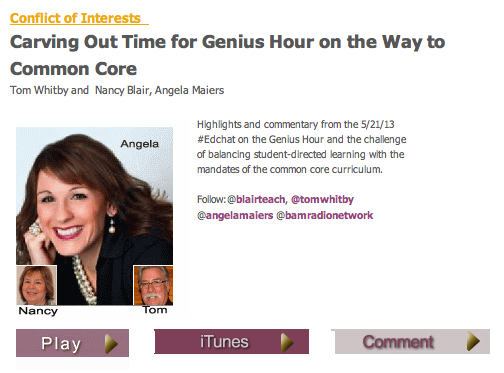
Many of you may be way ahead of me on this recommended listen, but I recently added Tom Whitby (@TomWhitby) and Nancy Blair’s (@BlairTeach) #EdChat Radio podcast to my queue. In 10-12 minutes Tom and Nancy recap the recent topic of discussion from that week’s #EdChat, and they include a visitor or interviewee to add additional perspective and commentary.

For me, it’s quickly become a #MustListen. The sessions are concise catalysts for critical topics in education and learning. Check it out.

This week’s slot with Angela Maiers (@angelamaiers) about “20% time” and “Genius Hour” is a fantastic thought provoker about cultivating learner curiosity and creating intentional space and time for scaling innovative practices.
#MustRead Shares (weekly)

Posted from Diigo. The rest of my favorite links are here.

Learning architecture #dtk12

And the problem is that, like a lot of design professions, we got fixated on the idea of providing a particular kind of consumer product, and I don’t think that needs to be the case anymore.

Alastair Parvin: Architecture for the people by the people, TED

Clothed in the vestments of “architecture,” at its core, this talk is more universally about design thinking. And while I know that I have trained myself to suffer/benefit from the affliction/blessing I call “How-Does-This-Apply-To-School-And-Education?,” Parvin’s talk has profound implications for those in education who are willing and able to think about our design challenges for Education 3.0.

How have we in education gotten fixated on the idea of providing a certain kind of structure and experience called “school?” How might we examine and re-examine those fixations and “lead up” to what could be better for our learners and our citizenry?

How are you willing or not willing to rethink what we do as “school?” How might we use our knowledge and wisdom as learning architects to reconsider what we do and how we do it?

#MustRead Shares (weekly)

Posted from Diigo. The rest of my favorite links are here.

Time on Task and “Learner-centered”

Time on Task and “Learner-centered”

I had an “aha” moment today. While doing a deep re-study of Tony Wagner’s _Creating Innovators_, I’ve been tweeting some notes, insights, and questions. Andrew Carle answered back and pointed to the “lie” behind our “learner-centered” language. For me, this short string is a major R&D area!

  1. In school, time blocks somewhat predetermine tasks. What if tasks/objectives determined time blocks? #RealLifeEd #CIStudy #SchoolStructure
  2. @boadams1 From my last decade of pushing for that, the main inst. roadblocks are equity, for both subjects and Teachers (workload).
  3. @boadams1 neither insurmountable. But they reveal the lie behind our “learner centered” facade.
  4. @boadams1 impossible to be learner centered when you hire adults for N hours of Y subject, 45 min at a time … and then look for Ss agency.
  5. @tieandjeans My last half-decade shows same insights as you shared. Thank you! I could not agree more. Your 3 tweets are at heart of issue.
  6. Curators of “lessons” exercise > meta-cognition. We need to make time & space for Ss curation. IF we want #creativity #innovation / #CIStudy
  7. Love this paragraph. Harkens the real root of “education.” #CIStudy amzn.com/k/KsQmBLbJSRml… Beverley explained further, “It is a compe…
  8. How’s our balance in schools among “succeed tasks” and “explore tasks?” #CIStudy amzn.com/k/I86DmuHlQ8Oh… So many kids are so programme…
  9. Another “balance” to explore: delivering content vs creating opportunities. How might we know our pedagogical balance in schools? #CIStudy
  10. “CQ [curiosity] PQ [passion] > IQ” Friedman via Wagner #CIStudy #SchoolStructure amzn.com/k/wFLhTpItSsSe… “CQ [curiosity] plus PQ [pa…
= = =
Note: I’m learning how to export Storify to WordPress. I’ll get better at it. Anyway, I share this collection of tweets in hopes of inviting more people into this reflection, discussion, and R&D.
How might we move forward on the big ideas of “student-centered” and learner-centered?” As long as the teachers are the primary curators of departmentalized content knowledge, how will we get to the type of Edu 3.0 learning environments that seem essential for transforming “content-delivery systems” into “creativity-and-innovation facilitation labs?”