Synergy2Learn, #EduCon 2.4, #Synergy8 – Questions are the way points on the path of wisdom

How are you engaging learners in community-issues problem solving? Is your school contemplating and implementing more project-based learning? Do you find it challenging to dig into high-quality PBL? Do you wish you could share stories (like around a campfire) about how to utilize real-world issues to guide instruction, curriculum, pedagogy, and learning? Wish you were elbow-to-elbow with a tribe engaged in a project about PBL?!

On Saturday, January 28, Jill Gough and Bo Adams will be facilitating a conversation at EduCon 2.4: “Synergy – Questions are the way points on the path of wisdom.” We hope you can join the conversation. We plan to 1) share our stories about Synergy 8, 2) elicit others’ stories about how they engage in deep-level PBL at their schools, and 3) ask and respond to a big “What if…” question – What if we built a network of people who were taking on the challenges of community-issues problem solving with adult learners and student learners alike?

We might even start a blog to help connect us all…Synergy2Learn. Let’s build something together…It’s About Learning and Experiments in Learning by Doing!

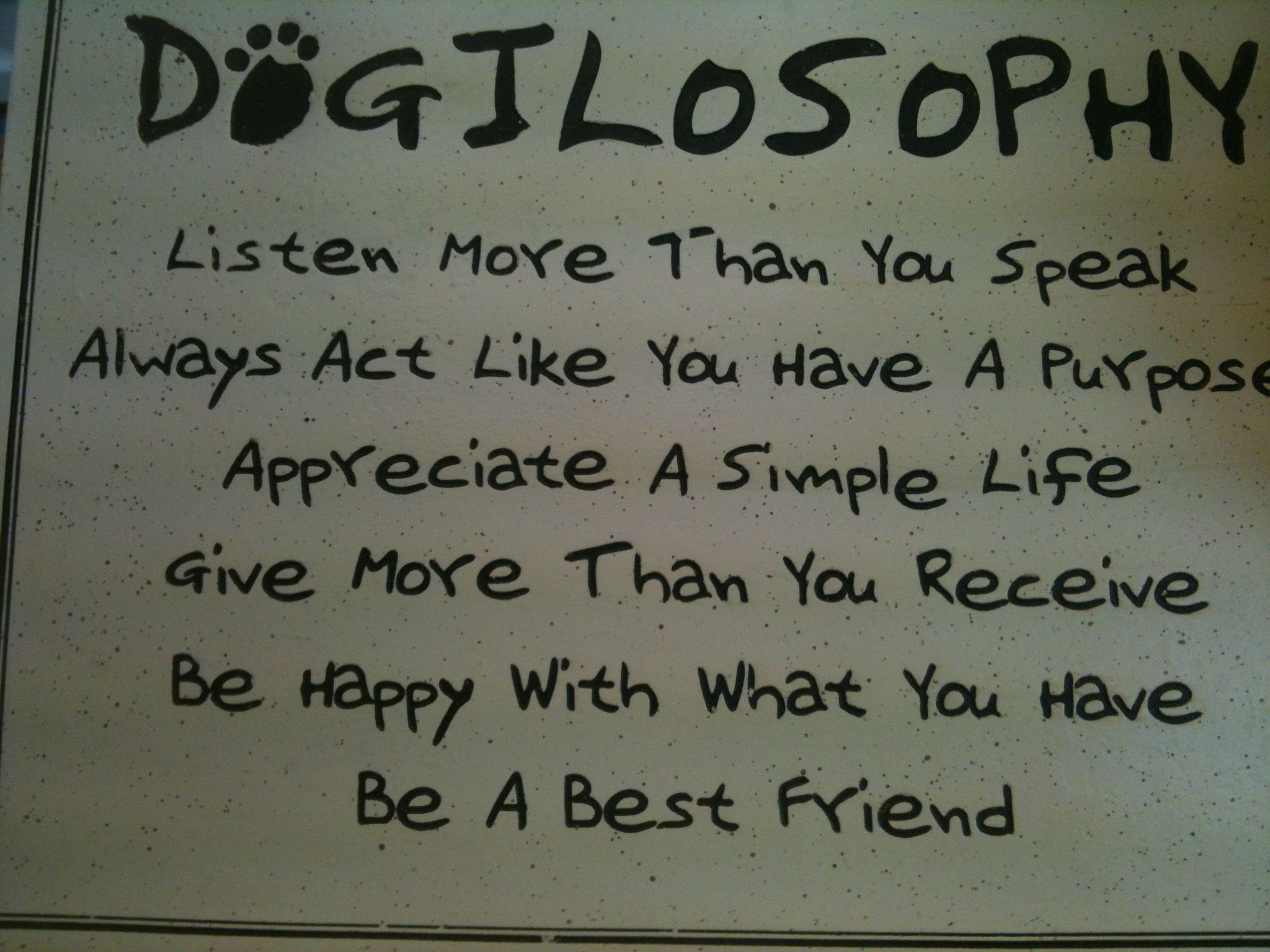
Dogilosophy

On Monday, January 16, my entire family accompanied our dog Lucy to her first day of obedience training at K9Coach. What a fabulous experience we enjoyed, and what a great session of #FSBL (father-son-based learning).

As we entered the facility, we eyed this very emotionally intelligent sign:

Seemed like a #mustpost to me!

“The School Day of the Future is DESIGNED”

The School Day of the Future is DESIGNED

February 22, 2011 | 11:11 AM | By , from KQED & NPR Mind/Shift: How we will learn.

All of these innovative models are showing us that incredible results, and experiences are possible when we design the school day with the needs of the student in mind. The historic “one-size-fits-all” model of set periods of time with groups of somewhere between 20-30 kids lined up in rows and one teacher in the front of the room orchestrating the conversation…. well, Sage on Stage, Chalk and Talk, and Spray and Pray might just have met their match.

The school day of the future will be unpredictable, inconsistent, and designed to be wildly relevant for the learner, their engagement, and their development. – By Sandy Speicher

[Thanks to @centerteach for sending me the link to this article.]

#PBL example, courtesy of “Mr. Daisey and the Apple Factory” on This American Life

Last Sunday, January 8, NPR broadcast a This American Life episode entitled, “Mr. Daisey and the Apple Factory.” I was mesmerized as I listened to this expose of an electronics factory as told by a self-described “worshiper in the cult of Mac.” The story caused me to think about a great many things. I certainly thought of a powerful PBL possibility…

What if student learners tracked the production and “story” of a product of their choosing? What if they selected an electronic device, an article of clothing, a favorite object, a drop of water from their home faucet, a unit of electricity from a school light bulb…and what if they worked to discover the back story of this product, object, or unit of energy? What would they discover? What could be learned? Would they learn some history? Some math? Some science? Some anthropology, sociology, and economics? Some English and foreign language? Some critical thinking? Some creativity? Some writing? Some literacy and numeracy? Some ecology? Some justice? Some…

The possibilities are endless.

#PBL example, courtesy of “Kid Politics” on This American Life

Today on This American Life, NPR is rebroadcasting an episode entitled “Kid Politics.” During my walks with my dog Lucy, I have listened to “Kid Politics” twice so that I could contemplate and think about the act-one story detailing the Reagan Library fieldtrip that at least some would see/hear as a “capital P” project-based learning example. While the story is fascinating and thought provoking, I believe that the trip to the Reagan Library is a simulation resting close to the “lowercase p pbl” end of the spectrum (see “Contemplating pbl vs. PBL” blog post that explains this categorization method for curriculum/instruction innovation).

I am hoping that some of you will listen to the NPR episode and let me know what you think about the Reagan Library simulation as a pbl vs. PBL. (I am really curious what @jonathanemartin would say…seems a great continuation of our BIE Common Craft video dialogue.) In the podcast story, what gets to me is the game-show sound effects of a “right-answer bell” and a “wrong-answer buzz.” When students in the simulation here these Pavlovian noises, I wonder what gets imprinted about having thoughts of their own.

Now, is this simulation a potentially powerful way for students to study the Grenada-invasion history? Yes. Is this simulation probably more fun and exciting to the students than merely reading about the event in a textbook? Yes. But the simulation does not cross the threshold of pbl vs. PBL, in my opinion. And it’s mostly because of that darn bell-buzz sound effect – the facilitators clearly are gearing for right and wrong answers. Are they teaching history or creating opportunity for critical thinking and original ideas? If they are trying to do both, I wonder if they are measuring their success at each objective.

Capital P PBL involves students in relevant, real-problem, community projects that don’t possess preconceived solutions. Capital P PBL does not merely place students in simulations so that they can re-enact what adults have already done. Again, I am not saying that I think the Reagan Library experience is worthless. In fact, I would love to participate in the simulation that is described in the “Kid Politics” episode of This American Life. I think the simulation is a powerful way for students to study the history and bring it to life with real drama, real emotion, and real reaction. But I hope that these students and their teacher used such a simulation as a jumping off point for a debrief that seemed a must after those reporters and Presidential staffers mingled in the same room. I hope that this jumping off point provided a springboard for students to engage in their own critical decision making…about a current issue…amongst an authentic audience.

What do you think?