Creating time and space to scale innovative practice #EdChat Radio @TomWhitby @BlairTeach @AngelaMaiers

Regular readers here know that I listen to a small library of curated podcasts as I walk my dog Lucy in the early morning. It’s part of my personal learning plan.

Many of you may be way ahead of me on this recommended listen, but I recently added Tom Whitby (@TomWhitby) and Nancy Blair’s (@BlairTeach) #EdChat Radio podcast to my queue. In 10-12 minutes Tom and Nancy recap the recent topic of discussion from that week’s #EdChat, and they include a visitor or interviewee to add additional perspective and commentary.

For me, it’s quickly become a #MustListen. The sessions are concise catalysts for critical topics in education and learning. Check it out.

This week’s slot with Angela Maiers (@angelamaiers) about “20% time” and “Genius Hour” is a fantastic thought provoker about cultivating learner curiosity and creating intentional space and time for scaling innovative practices.

Reflections on #NAISAC13 – Part II. The message was clear. Now we must act.

After a few days of reflecting on #NAISAC13 (the National Association of Independent Schools’ Annual Conference 2013), I am hopeful!

From the general sessions that NAIS curated, I cannot imagine that there could be much confusion about core message – schooling and education are experiencing a grand revolution, and NAIS schools can be leaders or left behind in this revolutionIt’s a choice.

Jim Collins reprised his strong thoughts on Good to Great and Great by Choice. He was clear that level 5 leadership builds “enduring greatness through a paradoxical blend of personal humility and professional will.” He reminded us that mediocrity comes more often from chronic inconsistency than resistance to change. He implored us – new initiatives piled on are not the answer. Rather, knowing who you are, discerning with creativity what you can do of greater value than anyone else, and remaining disciplined about marching to that highest trajectory of yourself are the x factors of great success. Finally, Collins stressed that organizations must preserve their core values while adapting their practices on the march to greatness. The big problem, though, is that many organizations confuse their values and their practices. So, clarity of purpose and identity and character is a must.

Heads of school such as Nishant Mehta (soon to be a head of school at The Children’s School in Atlanta; currently at Alexandria Country Day School), Bill Taylor (St. George’s in Memphis), Matt Glendinning (Moses Brown School in Rhode Island), Jonathan Martin (former head at St. Gregory Preparatory School in Tucson), and Brett Jacobsen (Mount Vernon Presbyterian School in Atlanta) shared their stories with us about the work that school leaders must do to innovate school cultures and to reposition the practices of schools so that we are immersing learners in experiences that will help them grow as communicators, innovators, creative contributors, critical thinkers, collaborators, and solutions finders. Along with acclaimed journalists, consultants, and educators like Suzie Boss, Ken Kay, Chris Thinnes, and Grant Lichtman, the messaging in the workshops was as consistent and clear as that in the general sessions – the world is changing at an ever quickening rate, and we must re-imagine schools and implement transformation so that our learners can be in more project-based, design-oriented, community-engaged, and world-relevant organizations.

There were countless connecting threads emphasizing the importance and power of networked approaches to school transformation. Ken Kay explained the professional learning community EdLeader21, composed of 111 school districts and independent schools. Suzie Boss recapped her research, in her book Brining Innovation to Schools (see here, here and here), on the stellar models across the country of schools transforming for the demands of our times. Grant Lichtman shared his findings from visiting 64 schools in 12 weeks, looking for exemplars of school innovation. He detailed that schools that struggle with change tend to grapple with anchors, dams, and silos. Schools that embrace innovation model dynamism, adaptability, permeability, relevance, self-correction, and creativity. Grant challenged the notion that school innovation was just about looking forward, and he said that his findings could be summarized on one word – Dewey. The essence of school transformation calls on the tenets of the progressive education movement. Outgoing president of NAIS Pat Bassett echoes similar chords every time he speaks, too. Just look at his TEDx talk on the “Big Shifts” and paste those up next to a synopsis of progressive education.

Terarai Trent inspired us to never give up on a mission to help all people connect with the education that they deserve as human beings.

Cathy Davidson closed the conference with a final keynote that reinforced several pillars holding up an overarching theme: kids today know that there is a significant mismatch between school and the way we learn in real life. In more detail, she emphasized five main ideas:

  1. Rethink liberal arts as a start-up curriculum for resilient global citizens.
  2. Move from critical thinking to creative contribution.
  3. Make sure what you value is what you count.
  4. Find creative ways to model un-learning.
  5. Take institutional change personally.

At least for my experience at #NAISAC13, there was great consistency and conviction in the messages. In fact, to me, the different voices were essentially singers in the same chorus.

To help me reflect this week, I reviewed ALL of the tweets from #NAISAC13. I packaged my own story of those tweets in a Storify. [View the story “NAISAC13” on Storify]

I’d be interested to hear other people’s primary take away, but mine was clear: schools must change, and in ways that empower students to be creative contributors and interested innovators and caring citizens.

http://annualconference.nais.org/Pages/default.aspx

The printed theme of #NAISAC13 was “Revolutionary Traditions: Think Big, Think Great.” But I believe we’ve been thinking about this stuff long enough. Revolutions require more action, move movement, more doing. The theme was not “resolutions,” but “revolutions.” The place was Philadelphia.

In reality, I think NAIS and the leaders gathered there communicated an even more powerful and hopeful theme: “Act Big, Be Great.” I’m so grateful for those who are DOING so.

= = =

And this from an email sent by NAIS after the conference:

Dear Colleague,

Thank you so much for joining us in Philadelphia for the 2013 NAIS Annual Conference. The spirit and great attitude of everyone in attendance will certainly spark our imaginations to revolutionize our schools – and the future of education.

Looking for more information to continue learning and brainstorming? Here’s just a sampling of what you’ll find on the NAIS Annual Conference website as we continue to update it during the next two weeks:

  • JPGs of the graphic recordings that the artists illustrated during the general sessions and featured workshops;
  • Interviews with many of the conference speakers;
  • Workshop handouts/presentations;
  • Articles about the general session and featured workshop speakers;
  • Videos of Sekou Andrews, Danah Boyd, Soumitra Dutta, and Alexis Madrigal;
  • And more!

Check the site regularly as we continue to add new materials.
How’s your honeycomb? Collecting pollen and making honey #professionallearning

Many – maybe all – schools send teachers to conferences. This practice seems important (otherwise, why do we do it, right?). It’s like collecting pollen for the hive. Curious, ambitious teachers venture out to conferences – ASCD, Learning Forward, NAIS, EduCon, SXSWedu, Solution Tree, etc. – to learn and grow. To collect pollen for the hive.

How does your school work to transform that collected pollen into honey? How do you set up and maintain your “honey production system?” How’s your honeycomb?

Do the teachers …

  • Tweet tidbits of learning and links to resources gathered during the conference experience?
  • Storify the highlights from multiple Twitter accounts active during the event?
  • Share blog posts about what they learned?
  • Create a podcast or short summary video to distribute like a radio or TV show back at the hive?
  • Teach demonstration lessons based on what was learned and invite others to observe?
  • “Dance” in order to share with the other bees where the best pollen is so that more can go to the same source and collect more?
  • Present at a faculty meeting or facilitate a workshop to spread the new knowledge and knowhow acquired?
  • Work in PLCs (professional learning communities) to transform the collected pollen into honey practices across the school?

Or does considerable pollen remain unused or underutilized once the resource is returned to the hive?

How’s your honeycomb? How are you making that honey for the nourishment of the full faculty, student body, parents, and others?

Many schools have extraordinary practices for making honey, and many teachers share the collected pollen purposefully and proactively. To do otherwise would be a terrible waste of resources and opportunity.

[Cross-posted to Connected Principals on Dec. 30, 2012]

#EdCampAtl – a great step for educators and learners working to transform school

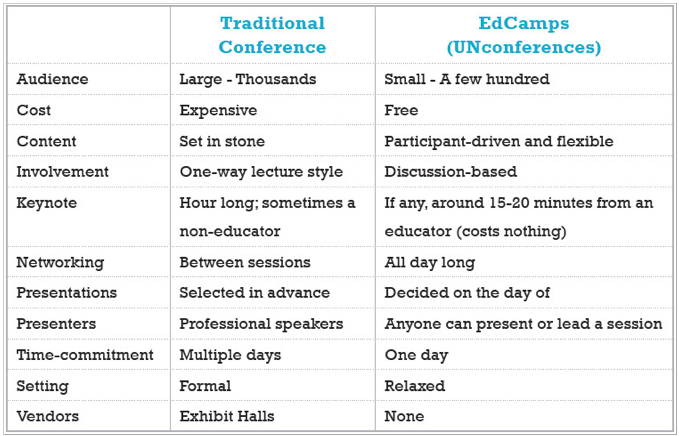
On Saturday, September 8, 2012, I attended EdCampAtl (@EdCampAtl and #EdCampAtl on Twitter). At the EdCampAtl website, one can see a table or matrix comparing the structure of a traditional conference with the workings of an EdCamp. Without a doubt, the organizers of EdCampAtl did an amazing job at delivering the system and ethos of the EdCamp “unconference.”

Nikki Robertson (@NikkiDRobertson) and Wanda McClure (@Wanda McClure) were the primary organizers, and they gathered a team they called the Fab5 to organize and host the event. These people are educators who answered the call, “If not now, then when? If not me, then who?” Realizing that no EdCamp existed in Atlanta, they set out to make sure that this city offered such an experience for interested learners. For six and a half hours on a Saturday (and countless hours before), they facilitated the gathering of teachers and administrators who want to make a difference in the education arena. And they did so with a format that allowed for democratic, spontaneous, informal participation.

As the day began, we organized a board of session topics and offerings. There were no forms to complete before the conference. There were no acceptances or denials of session offerings prior to conference day. There was simply a blank slate for a room of educators to fill. It was up to us to make certain that we had sessions worth attending. We ended up with three, hour-long blocks that housed about seven sessions in each block. As people participated in the sessions, if they were not getting everything they needed or if they became interested in another session being discussed on the Twitter hashtag, then they could leave a session to attend another…no offense taken by the session facilitators because it’s not about the facilitators. It’s about the learners (not that facilitators aren’t learners, too).

At the beginning and end of the day, the unconference organizers had arranged for two, short, video-conference sessions – one with Skype and one with Google+ Hangouts – so that EdCamp-ers could see these tools in use, and so that we could benefit from three educators who were not physically present for the day. What a great way to demonstrate that physical presence does not have to be a limiting factor to the school day and one’s learning environment.

After lunch, a “Smackdown” event occurred. For an hour, there were 30, two-minute highlights in which anyone could take the microphone and the computer or doc-cam to show an edtech tool for the classroom or learning studio. We were carpenters sharing our favorite tools…so as to create a better toolbox for the collective. I’m not sure where the name comes from, but a Smackdown is essentially adult Show-n-Tell, which there should be more of in school!

Overall, I enjoyed the day immensely. I feel indebted to those who made such a day possible. Re-read the table at EdCampAtl to get a sense of why I might feel this way. 

I see this movement as a powerful step in the direction of widening the possibilities of the school spectrum. Nevertheless, many of my usual questions remain…

  1. How will the educators who attended create systemic change in the schools to which they return? They gathered some superb pollen on Saturday, but now they have to go back to their schools and make honey with their home hive. How will they do this? Will they have the support they need?
  2. The topics at the event seemed very tactical in nature, and they were technology heavy. I think that is the history of the EdCamp events, as I understand them. As these devoted educators return to their respective schools, will their new learning, excitement, and growth cause them to inadvertently widen the gap that might exist between them and the teachers who continue to teach in the same way that they have taught for 25 years – the same lessons, repeated annually, 25 times? Are schools considering a pedagogical master plan that orchestrates a high-level coordination among these learning and transforming efforts?
  3. Are we stuck in the habit of teacher-student organization? In the three morning sessions that I attended, there was a fairly traditional structure within the sessions. And I helped facilitate two of the three sessions, so I am pointing a finger at myself, too. But there was a typical pattern of one or a few people doing 80-90% of the talking and the “audience” listening. Are we such creatures of habit that this methodology seeps into our way of working – even in a venue of progressive educators? I could have kicked myself at the Smackdown. The “app” I wish I had used in the sessions I helped facilitate is the brain-based, human app of stopping at about 10 minute intervals to have people turn to a neighbor and discuss what they are learning and staying curious about. The ones doing the talking are usually the ones doing the learning, and I did not do a good job at facilitating in such a way.
  4. Are we facilitating such EdCamp-like moments for the students in our schools? What if, on at least some days, we created a blank-slate board on which students could post what they wanted to learn and facilitate? What if we more spontaneously and democratically and informally grouped students based on what they wanted to learn and understand better? What if Show-n-Tell remained a part of school well beyond elementary school?

Yes, I am so appreciate and grateful for Nikki, Wanda, and the other EdCampAtl organizers for stimulating and provoking such learning and thinking in me. Now, I have to do my job to systematize and share – to spread the good work. To help make the honey for the entire, collective hive.

[This post has also been published on the EdCampAtl blog.]

An idea worth spreading – Grant Lichtman visiting with 50 schools re: future of schools & schools of the future #EdJourney @GrantLichtman

This from Grant Lichtman (@GrantLichtman)…

Dear Colleagues,

As you know, over the next three months I will be meeting with hundreds of educators at more than 50 leading independent, charter, and public schools around the country, each with a unique story to tell about how they are evolving their organizations to meet the challenges of a rapidly changing world.

I hope you will help leverage this opportunity for professional connections with fellow educators around the country who share common interests.  How?  It is really simple.   Share this link to my blog, The Learning Pond, or #EdJourney on Twitter with a few colleagues or collaborators. My blog posts will have active links to people, places, and programs that might be of interest. Here are three examples before I even leave San Diego, of schools that are doing some really interesting work:

Groundbreaking New Pilot at Dallas Townview Magnet School

This is What School Innovation Looks Like

Middle School Hunger Game: Check It Out

I am fortunate to be visiting some of the most exciting schools in America, and I hope to widely distribute those seeds of knowledge. Thanks for helping to share, learn, and grow!

Regards,

Grant Lichtman

http://learningpond.wordpress.com

Twitter @GrantLichtman