If school is supposed to prepare students for real life, then why doesn’t it look more like real life?

If school is supposed to prepare students for real life,
then why doesn’t school look more like real life?

For more than a decade, this question has lived at the heart of my research and practice as a professional educator. While I worked at Unboundary, we created a Brain Food devoted to exploring this question.

A number of educators and school transformation agents connect to this question through an entire branch of educational practice known as “authentic learning.” At the end of January, #EdChat Radio featured the topic of authentic learning on an episode. And Dr. Brett Jacobsen, of Mount Vernon Presbyterian School and the Mount Vernon Institute for Innovation (where I work), recently interviewed Dr. Yong Zhao for his podcast “Design Movement,” and much of their conversation connects with this topic of authentic learning.

Given the habits formed by decades of industrial-age, delivery-based pedagogy, though, educators must explore and experiment with different structures in order to make room for more authentic learning – learning that is meant to serve a greater purpose than only a grade in a grade book and a future locker-clean-out session in late May or early June.

Exploring such new structures can be challenging for schools. In fact, some structures point to entirely different paradigms for schools – like “giving an education” rather than getting an education, taking a course, or whadya-get-on-that-test assessment.

Some school people imagine such paradigm shifts would lack structure – that it would be too free form, loosey-goosey, or soft-skills heavy. This is really a false set up for thinking about the structural-shift needs of schools in transformation. How “loosey-goosey, really, is your project work and real-world problem solving in your career and life?

As Tony Wagner says in Creating Innovators, it’s not a choice between structure and no structure to allow for more authentic learning. It’s a choice to build a different structure for School 3.0 – one that allows for student-learners to explore their passions and real-world purposes while engaged in challenges that exist in the world and yearn to be defined and solved. Structures that empower learners to engage in more authentic learning flows.

Creating Innovators - Structure

But how do educators make such shifts and create different structures? I believe one way we do this is to explore avenues and portals to empower students to engage in real-world problem solving. Instead of only organizing the curriculum – the track of learning – around subject-siloed disciplines, at least part of the curriculum could be organized around exploring and venturing into authentic, real-world problem solving as organizers of product-and-process-oriented work.

In my own life and work, I’ve explored opening such portals through #fsbl and #Synergy. Much of this work involves immersing oneself and other learners into the Innovator’s DNA traits – observe, question, experiment, network, and associate – through the methodology of observation journaling and curiosity-curated curriculum.

Of course, other ways exist to open those portals and explore into those worlds of authentic learning and real-life problem solving. Here are but a few inspirations and possible ways in…

#GoExplore

Resources for engaging in real-life solution seeking:

Open IDEO
http://www.openideo.com/

Open IDEO is an open innovation platform for social good. We’re a global community that draws upon the optimism, inspiration, ideas and opinions of everyone to solve problems together.

http://www.openideo.com/content/how-it-works

NPR – All Tech Considered: Innovation
http://www.npr.org/blogs/alltechconsidered/195149875/innovation

An exploration of interesting ideas that solve problems, introduce new experiences or even change our world.

Do Something
http://www.dosomething.org/

DoSomething.org is the country’s largest not-for-profit for young people and social change. We have 2,439,780 members (and counting!) who kick ass on causes they care about. Bullying. Animal cruelty. Homelessness. Cancer. The list goes on. DoSomething.org spearheads national campaigns so 13- to 25-year-olds can make an impact – without ever needing money, an adult, or a car. Over 2.4 million people took action through DoSomething.org in 2012.

http://www.dosomething.org/about

Choose2Matter
http://choose2matter.org/

Choose2Matter is a call to leadership and an accelerator to connect individuals and communities with a conscience. It combines technology, innovation and mentorship to solve problems that matter. It’s an important opportunity for business, brands, and communities to join forces in the causes and issues most important to those they lead and serve.

What has been inspired by students, has led to the official launch and creation ofCHOOSE2MATTER – a crowd sourced, social good community.

http://choose2matter.org/about/our-history

50 Problems in 50 Days
http://50problems50days.com/

I’m on an adventure – to explore the limits of design’s ability to solve social problems, big and small. To do this I attempted to solve 50 problems in 50 daysusing design. I also spent time with 12 of Europe’s top design firms.

Peter Smart

Innocentive
http://www.innocentive.com/

InnoCentive is the global leader in crowdsourcing innovation problems to the world’s smartest people who compete to provide ideas and solutions to important business, social, policy, scientific, and technical challenges.

http://www.innocentive.com/about-innocentive

TED Prize
http://www.ted.com/prize

The TED Prize is awarded to an extraordinary individual with a creative and bold vision to spark global change. By leveraging the TED community’s resources and investing $1 million dollars into a powerful idea, the TED Prize supports one wish to inspire the world.

Ideas for Ideas
http://www.ideasforideas.com/

Introskabelon-for-web

Paper or plastic? Work that blurs the lines between school and real life. #Synergy #iDiploma

If school is supposed to prepare kids for real life, then why doesn’t school look more like real life?

This question lives at the heart of my research for the past decade. This question largely drives my work.

Many people ask me, “So, Bo, what do you mean by ‘real life?'”

Well, one aspect of blurring the lines between school and real life involves reimagining the kind of work that students engage in during their school experience. What if more of the student work had real-life application? What if more of the student work were aimed at targets well beyond the grade-book columns and end-of-year locker clean outs?

For example, what about the question, “Paper or plastic?” You know – at the grocery store. How should we respond to that question at the conveyor-belted check-out counter? (If, of course, we don’t bring our own reusable bags.)

From that question, a group of student designers and solution seekers might find themselves on a path leading to the investigation of the refrigerator and the crisper drawer.

“What?!” You might ask. What if student-learners actually worked on product design for such things as refrigerators, water boilers, etc.? What if students really knew the best answers to “Paper or plastic?”

Watch this TED talk from Leyla Acaroglu, and you might just see what I’m talking about – what I dream about…

Student-learners engaging in real-life work that goes well beyond a grade in a grade book and provides the weave-work and relevancy hooks that integrate and amplify the core purposes of our school-segregated subject areas. Work that recognizes and respects the systems of which our products and our persons are all parts of the whole…

=====

Innovation Diploma @MVPSchool

Just for fun – Aparna Rao: Art that craves your attention

As I watched Aparna Rao: Art that craves your attention, I felt fairly overwhelmed with joy and wonder… and fun.

Over several years, I have somewhat trained myself to ask certain questions as I observe, too:

  1. Where would this “fit” in traditional education?
  2. How would learners be provided space and time to pursue work/play like this?
  3. What about this is consistent/inconsistent with how we have organized and concepted traditional schooling?
  4. What might we learn from this that could spur us to enhance learner experience in formalized school?
  5. What if “school” were more like this?

#JustSomeSaturdayMorningMindPlay

#WhatYouDoinForFrontalLobeFun?

PROCESS POST: What Guy Hoffman Could Teach Us About Our School Day!

There are so many reasons for educators to watch the TED talk below – “Guy Hoffman: Robots with Soul.” As for me, I am paradoxically inspired, mesmerized, puzzled and saddened by Hoffman’s talk.

When I watch and listen to Hoffman, I think of what he must have been like as a K-12 student. What amazing curiosity, drive, passion, and persistence this learner must have had – must continue to have. Through his work, I am inspired by what contributions robotics and roboticists will make in our lives.

And yet I am saddened by the conversations I can imagine that some (many?) schools would have regarding the content and context of such an idea-generating talk.

“What department would we place this course in? He wants to build robots as part of his learning, so it must be ‘Engineering Class,’ right?”

“We don’t have a course called ‘Engineering.’ Maybe we just put it in physics?”

“But how would we cover all the stuff we are already doing in physics? There’s no time or room to add robotics like this in my course.”

“Could it go in a math class? Hoffman mentions math in the talk, doesn’t he?”

“No, it should go in Drama class. Weren’t you listening? He said he took a drama course and method acting is what really helped him break through in the contrast between the computing mind and the adventurous mind.”

“But Drama is just a semester elective. Our kids could never get this work done in just a semester, given the basics of acting that we need to cover.”

“It should go in computer animation, when we get that class up and running.”

“What about psychology? He talks about emotions, and our ‘Human Psych’ course is the only course that has ’emotions’ in the learning outcomes.”

“Why not biology? After all, he is using human biology as a mechanism for understanding how to make the robots more ‘human.'”

“Are you kidding me? When would we have time to build robots in 10th grade biology? It’s AP, for goodness sake?”

“Look, if he wants this to be part of his schooling, he’s gonna need to find a faculty sponsor, and the faculty member will need to create a course proposal. It’s already December, so our deadline is passed. Any course proposal would need to be submitted by NEXT December, and then we might add the course the FOLLOWING year, if the academic committee approves the course. And forget about team teaching with a math, drama, physics, and biology teacher-team. That’s way too many resources to commit to an elective, non-essential course.”

WHAT IF…

OR — we could build in time during the school day for passion-driven, cross-curricular learning. So what if the 17-year-old version of Guy Hoffman’s idea doesn’t fit neatly into one of the silo-ed, department-organized, subject-area courses? Those course structures only represent part of our school day and school week. We don’t just organize by departmental subject area. We co-organize by student-interest and make space for just this kind of exploring, searching, questioning, experimenting, and integrating.

After all, we know that to nurture innovators, they must have time, room, and opportunity to practice observing, questioning, experimenting, networking, and associating.

Oh that we might make it so. If not us, then who? If not now, then when?

#iDiploma

Snow and ice days cause wailing and gnashing of teeth in School 3.0

As I breezed the Twitter stream awhile today, I noticed a number of people from various reaches of the United States hailing that their school had already been announced CLOSED on Jan. 6 due to inclement weather – snow and ice!

Just one example:

Well well my former Michigan co-workers already have school closed for tomorrow. They r deep n snow! Their bragging has begun lol [emphasis mine]

Like you maybe, I’ve heard about strange rituals like children wearing pajamas inside out and flushing ice cubes down the toilet to encourage the elements to delay or cancel school.

So, of course, I cannot help but wonder:

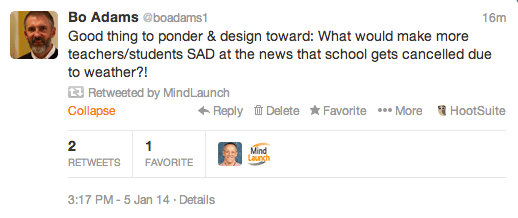
What would make school so great as a learning-and-engagement community that teachers and students would actually be sad, devastated even, when school was canceled for inclement weather?

Screen Shot 2014-01-05 at 3.34.39 PM

We should design for that emotion! For that desired user experience!

And if school canceled simply provides more time for people to do other things that get neglected “due to” their professional/school lives – hence the excitement about the cancelation, then we could learn from those insights, too! But I imagine that’s not all that’s at stake. How ’bout you?!

[Selfish blogger’s note: I so wish hundreds…thousands of people would fill the comments with examples of what school would/could be like that would make them sad if it got canceled due to weather. And then I wish we would make those schools happen more!]

+ + + + +

RELATED POST FROM THE PAST:

CHANGEd: What if schools factored in experiment days like snow days? 60-60-60 #6