May seem roundabout, but it’s an exhilarating intersection

The principal goal of education is to create men [people] who are capable of doing new things, not simply repeating what other generations have done – men [people] who are creative, inventive, and discoverers. – Jean Piaget (quoted in Time Magazine, 1969)

Since I announced that I would be stepping aside from my current post as principal at the end of this academic year, a number of friends, acquaintances, and never-before-knowns have invited me to coffee, lunch, or dinner to talk about my plans for the future. Through these conversations, I am gaining the benefit of prototyping and revising my “elevator speech” detailing what I want to do next. These dialogues are invaluable back-and-forths in which I get to hear myself express what I am thinking, and I gain the gift of garnering other perspectives.

I find myself explaining, “I know exactly what I want to do, but I do not know yet where I will do this.” I dream of working at the exhilarating intersection of LEARNING COACH, EDUCATIONAL DESIGNER, and INNOVATION STRATEGIST.
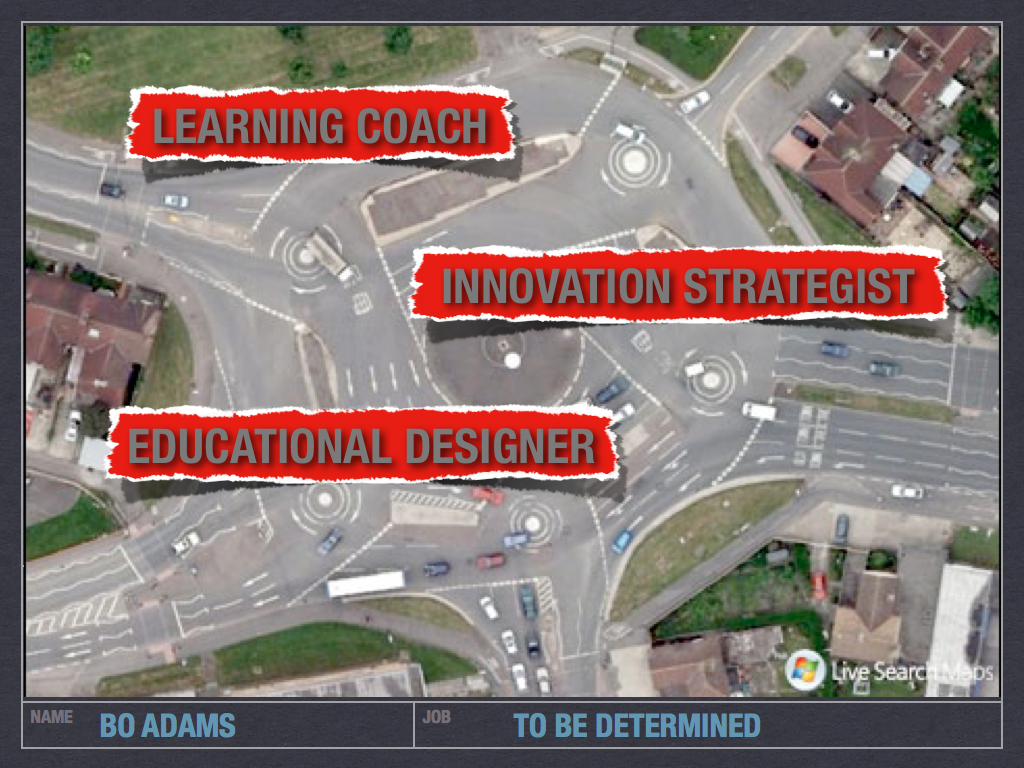
As a middle school principal and educational leader, I count myself very fortunate to live in each of these roles as parts of what I do many days. However, I want to amplify the roughly 35% of my job into 90+%. I see my evolution as a cog in the gears of school evolution.

Schools must evolve. Our children and our future demand that we continuously improve our schools. Yet, where is this R&D (research and development) formalized in schools…between schools…among schools…among schools and other industries?

Teachers are often so busy with over-filled plates that they lack the “room” to think, research, innovate, and implement. (Some are innovating and implementing, gradually building tribes within slow-changing schools, and I feel connected to a number of these folks through the greatest faculty lounge in the world – Twitter and the blog-o-sphere.) Administrators, consultants, and professors of education run the risk of becoming “theoretical planners” who can lose connection with what it is like to be “in the trenches” (I despise that metaphor for teaching, but it makes the point). Powerful thinkers in other industries possess insights that are invaluable for schools that are readying students “for college and for life,” but they often lack pathways or invitations to school communities. If possible, I would like to serve as the “connective tissue” or the “roundabout” that pulls together the bones and avenues of learning coach, educational designer, and innovation strategist. I hope to work in the intersecting Venn of those teachers, administrators, consultants, professors, and other-industry professionals.

I imagine continuing my “pracademic” work in the following areas. Think of these as some of the lanes on the intersecting roads pictured above.

  1. Synergy (a non-departmentalized, integrated studies, problem-based course for student learners) or some similar course(s) devoted to transdisciplinary, project-based engagement, so that I can continue to practice and promote the complex challenges of PBL and authentic assessment with student learners and adult learners;
  2. Professional Learning Communities, so that I can remain in job-embedded, relation-based, professional growth with  teams of dedicated people;
  3. Strategic Design, so that I can continue the core-messaging and story-telling work that I pursue as a visual communicator and that I was able to be a part of during my sabbatical at Unboundary and with such communities as TED and TEDxAtlanta, and so that I can help advance the needed work in program and space re-design with such organizations as RE:ED and educational architects;
  4. Entrepreneurial Teaching and Learning Support, with such institutions as The Center for Teaching and RE:ED, so that educational innovation, strategic coaching, and learning design can be re-mixed, re-purposed, and re-shared among schools and businesses rather than silo-ed in various places all working on similar goals.

I believe I am capable of being one of those people that Piaget describes, and I want to devote my work to co-laboring with others who are dedicated to shaping education – particularly schools – into that principal goal that Piaget described.

Team Teaching as Coaching

I continue to return for focused re-reading of sections from a New Yorker article by Atul Gawande entitled, “Personal Best.” The article is a deep, personal reflection and contemplation of the power of coaching – employing a trusted mentor to provide “outside eyes and ears” in order to improve one’s performance. Gawande makes the point that many professional athletes utilize coaches; however, most of the other professions fail to use coaches at a systemic level. His reflection, as a surgeon committed to improving in his art and science, provides a compelling look at how we all would benefit from targeted coaching and a commitment to the growth mindset.

This morning, I wonder if TEAM TEACHING is such a favorable and valuable experience because of the aspect of co-coaching that can happen when educators team up to guide a classroom of learners. I team teach with Jill Gough. We team teach Synergy 8, and we co-facilitate many of the PLC efforts at our school. We also provide PD for schools and organizations around the country. We continuously coach one another, and I know I learn immeasurably from the debriefs and post-activity reflections that we commit to completing. Recently, I have also watched Clark Meyer and Peyten Dobbs engage team teaching for two, combined sections of Writing Workshop: Environmental Studies. And just yesterday, I heard a teacher new to our school say that she had combined classes with another teacher, and they were likely never to go back to single sections – they were learning so much from each other, and they were seeing so much enhanced learning for the students, now able to learn with two, interactive guides.

In challenging economic times even, I will continue to make the case that schools should do everything they can to provide job-embedded team time for teachers, as well as opportunities for team teaching. Gawande summarizes why…

Coaching done well may be the most effective intervention designed for human performance.

And the existence of a coach requires an acknowledgment that even expert practitioners have significant room for improvement. (p.9)

Yesterday’s related post: Learning to See & Seeing to Learn

d.school, innovation, creativity, and possibility #Synergy

What if…

What if we employed more “design thinking” into our programs in K-12 education in Atlanta? In “Innovation 101,” Carolyn Geer detailed a bit of Stanford’s d.school (the Hasso Plattner Institute of Design) and founder David Kelley. What would it take to integrate more design thinking across curricula in our schools? How could we use design thinking as “connective tissue” among the curricula? To design potential solutions for identified community problems certainly provides glue that holds together what is typically thought of as history, science, math, English, art, etc.

How could a K-12 Design Lab for schools in Atlanta be grown right here in our surrounds?

Reminds me of Geoff Mulgan’s TED talk on studio schools.

Also reminds me of RE:ED #nxtchp2011.

Imagine the possibilities…

Empowering and Guiding Students to Take Charge of Assessment – Synergy 8 Example

For many, many years, at school “marking periods,” I have written narrative comments regarding eighth-grade student progress. Typically, these comments have been summative and brief in nature. They generally covered work habits, class-participation trends, and performances on quizzes and tests. When I completed such a comment, I recorded my progress report in a school database, where it was reviewed and proofed by a grade-level administrator. Then, after about a week, the comments were sent – now emailed – home to parents.

When we (Jill Gough and Bo Adams) inaugurated Synergy 8 in 2010-11, we decided to use this non-departmentalized, non-graded, community-issues, problem-solving course to run some “pracademic” experiments in a number of areas, including assessment and student-progress reporting. Now, instead of an adult (teacher) writing a static comment to another adult (parent), the Synergy 8 students utilize moderated journaling to prepare their self-assessment reports. The student learners take primary responsibility for preparing their reflections about their own learning and growth. The student learners initiate the communication of this self-generated progress report to their parents, their teacher-facilitators, their grade chairs, and their director of studies. Before the published draft is sent, student learners peer review other team member’s reports, and they engage in a series of iterative prototypes, enhancements, and revisions.

The student learners “live” at various stages of maturity regarding their capacity to self-assess and initiate their own progress-report discussion with adults. BUT…they are practicing this incredibly vital, life-long skill of evaluating their own learning, performance, skill development, and growth. They are precipitating virtual, student-led conferences when they send their reports to the adults who serves as guides and coaches. Unlike the database-housed comments of the past, these student-based comments stir responses from their parents and the adults at school to whom they write. During the course, we see growth and progress in EVERY student’s capacity to engage in such self-assessment and progress reporting, and we believe this is a critical skill to develop at this middle-school age.

Obviously, because of the relatively private nature of such progress reporting, I cannot publish one of the student samples here. However, I am pasting below what now goes in the school database, so that you can see additional context about this student-centered way of reporting progress, learning, and growth.

From Midterm Marking Period (Friday, October 14, 2011):

Since we last wrote to you, the Synergy 8 Team has been hard at work, engaged in the KP Challenge. At the same time, we have been focused on communications, presentation, and design. Additionally, our team members have collected almost 300 community observations on a tool called Posterous. At this midterm, we will be transitioning from the KP Challenge alpha project to projects conceptualized and organized by the Synergy 8 student learners – projects that will be born from the Posterous observation journals. Expect more project news and updates as those projects get underway.

At the first-interim marking period, Mr. Adams and Ms. Gough concluded their comment this way:

“As we dig deeper into our projects and learning rubrics, you can expect more information coming to you. Much of the assessment will be relative to the “essential learnings” expressed on the course logo – the Synergy 8 Light Bulb and Gears (http://scr.bi/Synergy8-ELs). At the midterm, you can expect more self-assessment from YOUR CHILD, and Ms. Gough and Mr. Adams will provide more feedback from their seats, as well.”

Working intensely and introspectively for the past two weeks, our Synergy 8 members have been preparing a “bright-spot” reflection regarding each person’s deepest learning. YOUR CHILD will be presenting that evidence-based, essential-learning story to you soon. You can view a short movie (http://vimeo.com/30541014, password: provided only to parents and school personnel due to new school policy) to see an overview of our approach, and you can access the originating rubric (http://scr.bi/EL-rubric) from which the stories emerged. As you receive an email summary from YOUR CHILD, Mr. Adams and Ms. Gough will respond to that communication so that all of us – student-learner, teacher-facilitator, and parents – can engage in a discussion about YOUR CHILD’s learning and growth.

_____________________________

From 1st Interim Marking Period (Friday, September 14, 2011):

When Ms. Gough and Mr. Adams conceptualized Synergy 8, we envisioned an interdisciplinary, problem-based course rooted in student-directed inquiry. Now that the course is underway, we increasingly desire to share responsibility from teacher to student, so that the eighth graders can practice being even more involved in their own learning – similar to the powerful, self-directed learning that children engage in before and after formal, traditional schooling. Synergy 8 possesses many elements of experimental design, and progress reporting in a non-graded course is one such element. Ms. Gough and Mr. Adams expect Synergy 8 students to take a more active role in the assessment and evaluation of their own learning and growth. Therefore, you can expect your child to send you more information about Synergy 8 and his/her experience thus far. At this marking period, you should have already received a progress report via email.

As we dig deeper into our projects and learning rubrics, you can expect more information coming to you. Much of the assessment will be relative to the “essential learnings” expressed on the course logo – the Synergy 8 Light Bulb and Gears (http://scr.bi/Synergy8-ELs). At the midterm, you can expect more self-assessment from YOUR CHILD, and Ms. Gough and Mr. Adams will provide more feedback from their seats, as well.

[Cross-posted at Experiments in Learning by Doing]

Thinking like a child – it may be exactly what we adults need! #21C

So, I just watched a newly posted TED talk by Alison Gopnik: What do babies think?

Throughout the talk, I was fascinated by the experimentation that she implemented in order to test her hypotheses about baby cognition. Looking at the totality of her results, Gopnik posits that babies can decipher what others are thinking, that babies think more like a lantern than a spotlight, and that babies naturally experiment and hypothesize and prototype to test their understanding of the world.

Listening to Gopnik, I found connection with her talk and Tom Wujec’s Marshmallow Challenge – the key to building better things is experimenting, failing, and prototyping improvements. It turns out that kindergarteners are really quite good at this reiterative learning.

Additionally, I was reminded of Steven Johnson’s The Innovator’s Cookbook, in which he encourages us to “get a little lost” and “play each other’s instruments.” By placing ourselves in novel situations, we can deliberately disorient ourselves and return to our “baby brains.” When we are young, we are all artists, inventors, astronauts, and aliens! Unfortunately, too many of us unlearn these perceptions about ourselves.

We have a great many transitions and transformations to make in school and the ways in which school is structured. I believe our world demands us to re-imagine “school.” Just today, one of the student-learners in Synergy 8 posted this pondering on our group Posterous:

How much in school has changed since the 1800’s?

Posted by  josephka to Synergy-8-2011-12-S1
Even with computers and smart boards not much has changed since the 19th centruy, but why not? the world has changed so much. People don’t have tha same jobs that they would have had 200 years ago. Maybe the system should be changed.

Another Synergy 8 team member commented back:

sumterf just commented on the post “How much in school has changed since the 1800’s?” on Synergy-8-2011-12-S1

I think if someone came to the future from the 1800s, they would recognize that our science, math, english, and language classes are school, but they probably would not recognize Synergy class as school.

And even if you don’t believe that school could stand a makeover, then perhaps you could allow that school should at least be re-examined…re-explored. To stand still is to grow stagnant and to ignore current research and learning from emerging best practices. Let’s employ the scientific method to our own structure…let’s play with ideas and possibilities like a child plays and integrates imagination with future possibility for reality. Let’s tap the butterflys that are our children and learn to flutter from their capacities and potential for creation and reiterative examination of enhancing prototypes. Let’s DO DIFFERENT…to discover and improve our current attempts.

Here’s to playing, to thinking more like a lantern, to trying another’s instrument, to disorienting ourselves, to wanting to know what others might be thinking. Here’s to not yet knowing that math, science, English, and history will be taught separately and from the vantage point of a individual desk and chair.

It’s not about convenience nor convention. It’s about learning!