The Wise Routes Project Blog

If you are anything akin to a regular reader here at It’s About Learning, you probably know that I am fascinated by the various, creative approaches to “schooling” and education. Because we are in more of a “learn anything, anywhere, anytime” developing culture, school will likely adjust to these cultural shifts, or school as we know it may become increasingly irrelevant. On a regular basis, I attempt to stay current with research and experiments and practices related to this school-transformation in which we are involved. Blended learning, DIY University, and unschooling are just a few of the emerging educational practices complementing, supplementing, and recreating “traditional,” industrial-era schools.

Recently, a parent sent me a link to a blog entitled The Wise Routes Project Blog, and specifically to a post entitled “Ride Somewhere Far.” Many thanks to the parent…my interest is peaked, and I thought some of you might like to join in the investigation. Enjoy. It’s about learning.

Sharing Curiosity Paths and Resources – #Design, #Engagement, #PBL

I don’t have a lot of time to write this morning, but I do have some time. So, it occurred to me to use my time to share a bit. This week, I benefited greatly from various colleagues sharing their “curiosity paths” and resources with me. My colleagues know that I am interested deeply in design thinking, learner engagement, and project-based learning. Among many shares this week, I highlight three below by embedding three videos and the links to the sites that contain these videos and additional resources about design, engagement, and PBL. In my mind’s eye, I see these three strands as a braided whole – I see them synergisticly. I am not sure that design thinking, learner engagement, and project-based learning could ever be un-braided into silo-ed parts. They are intricately connected parts of an entire system. Enjoy. It’s about learning.

http://www.designthinkingforeducators.com/

http://edu20.bretford.com/index.html

http://www.edvisions.com/custom/SplashPage.asp

A future of synergists and dot connectors…for enhanced customer experience

I am a synergist. I love to work at the intersection and collision of ideas, disciplines, and departments. Of course, like anything, I have to practice this skill, and I hope to continue progressing in the synergizing of things. As Carol Dweck has taught me to say, “I am not yet the synergist that I will be!” I believe Howard Gardner that one of the five minds of the future is the “synthesizing mind.” So, I practice synthesizing and synergizing.

How do I practice? I look for the connections between and among things. I purposefully look. I risk and experiment and take chances. Often, I fail. But I keep synergizing. I work to connect those parts that might result in a whole whose sum is greater than I originally imagined. Also, I get a lot of help from others. WE are smarter than ME when it comes to colliding and synergizing ideas.

This morning, I watched another synergist on TED. In just 4 short minutes, Nathalie Miebach demonstrated to me that mathematical data collection, weather science, 3D art, and music are marvelously integrated. What if school promoted and empowered this type of work…

Then, I remembered a blog post from Garr Reynolds in which he quotes Steve Jobs from a 1997 interview:

You’ve got to start with the customer experience and work backwards to the technology. You can’t start with the technology and try to figure out where you’re going to try and sell it…we have tried to come up with a strategy and vision for Apple, it started with “What incredible benefits can we give to the customer? Where can we take the customer?” Not starting with “Let’s sit down with the engineers and figure out what awesome technology we have and then how are we going to market that?” And I think that’s the right path to take.”

And, so, here is some of my synergy practice this morning: I see Miebach’s TED talk and Job’s quote as inextricably linked together. Schools are envisioning a transformation towards more integrated studies. Some schools are already doing so with great success. Researchers are studying such schools and writing about the Powerful Learning that is happening in such places. Among other shared traits, the schools that are transforming successfully are putting “customer experience” far ahead of “awesome technology.” The successful ones, it seems to me, are guiding students to discover the intersections – the synergies – among such things as mathematical data collection, weather science, 3D art, and music. Then, they are engaging various technologies as tools with which to explore and deepen understanding.

Yesterday, at our faculty meeting, we also took a step in synergy practice. For the second meeting in a row, we told “campfire stories” of some exciting “customer experiences” from our classes and courses. We identified some points on our faculty graph. Now, we have a greater potential to play that great game of motor skill – connect the dots. Wanna play?

May seem roundabout, but it’s an exhilarating intersection

The principal goal of education is to create men [people] who are capable of doing new things, not simply repeating what other generations have done – men [people] who are creative, inventive, and discoverers. – Jean Piaget (quoted in Time Magazine, 1969)

Since I announced that I would be stepping aside from my current post as principal at the end of this academic year, a number of friends, acquaintances, and never-before-knowns have invited me to coffee, lunch, or dinner to talk about my plans for the future. Through these conversations, I am gaining the benefit of prototyping and revising my “elevator speech” detailing what I want to do next. These dialogues are invaluable back-and-forths in which I get to hear myself express what I am thinking, and I gain the gift of garnering other perspectives.

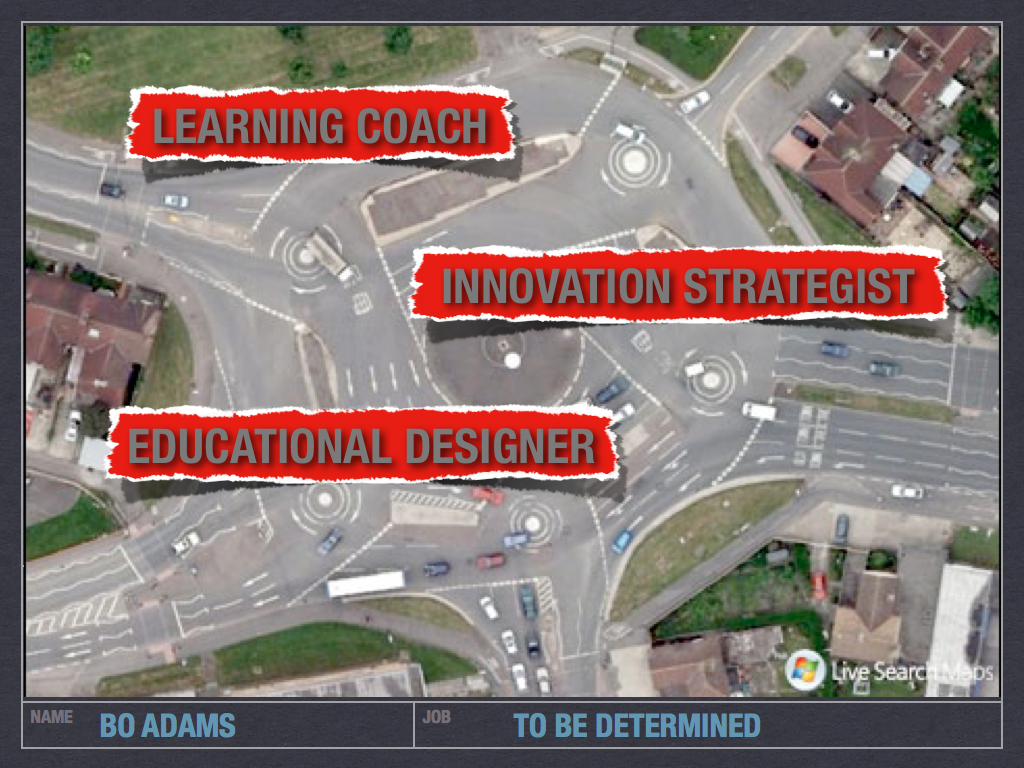
I find myself explaining, “I know exactly what I want to do, but I do not know yet where I will do this.” I dream of working at the exhilarating intersection of LEARNING COACH, EDUCATIONAL DESIGNER, and INNOVATION STRATEGIST.
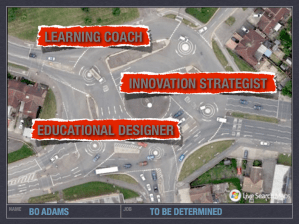
As a middle school principal and educational leader, I count myself very fortunate to live in each of these roles as parts of what I do many days. However, I want to amplify the roughly 35% of my job into 90+%. I see my evolution as a cog in the gears of school evolution.

Schools must evolve. Our children and our future demand that we continuously improve our schools. Yet, where is this R&D (research and development) formalized in schools…between schools…among schools…among schools and other industries?

Teachers are often so busy with over-filled plates that they lack the “room” to think, research, innovate, and implement. (Some are innovating and implementing, gradually building tribes within slow-changing schools, and I feel connected to a number of these folks through the greatest faculty lounge in the world – Twitter and the blog-o-sphere.) Administrators, consultants, and professors of education run the risk of becoming “theoretical planners” who can lose connection with what it is like to be “in the trenches” (I despise that metaphor for teaching, but it makes the point). Powerful thinkers in other industries possess insights that are invaluable for schools that are readying students “for college and for life,” but they often lack pathways or invitations to school communities. If possible, I would like to serve as the “connective tissue” or the “roundabout” that pulls together the bones and avenues of learning coach, educational designer, and innovation strategist. I hope to work in the intersecting Venn of those teachers, administrators, consultants, professors, and other-industry professionals.

I imagine continuing my “pracademic” work in the following areas. Think of these as some of the lanes on the intersecting roads pictured above.

  1. Synergy (a non-departmentalized, integrated studies, problem-based course for student learners) or some similar course(s) devoted to transdisciplinary, project-based engagement, so that I can continue to practice and promote the complex challenges of PBL and authentic assessment with student learners and adult learners;
  2. Professional Learning Communities, so that I can remain in job-embedded, relation-based, professional growth with  teams of dedicated people;
  3. Strategic Design, so that I can continue the core-messaging and story-telling work that I pursue as a visual communicator and that I was able to be a part of during my sabbatical at Unboundary and with such communities as TED and TEDxAtlanta, and so that I can help advance the needed work in program and space re-design with such organizations as RE:ED and educational architects;
  4. Entrepreneurial Teaching and Learning Support, with such institutions as The Center for Teaching and RE:ED, so that educational innovation, strategic coaching, and learning design can be re-mixed, re-purposed, and re-shared among schools and businesses rather than silo-ed in various places all working on similar goals.

I believe I am capable of being one of those people that Piaget describes, and I want to devote my work to co-laboring with others who are dedicated to shaping education – particularly schools – into that principal goal that Piaget described.
Team Teaching as Coaching

I continue to return for focused re-reading of sections from a New Yorker article by Atul Gawande entitled, “Personal Best.” The article is a deep, personal reflection and contemplation of the power of coaching – employing a trusted mentor to provide “outside eyes and ears” in order to improve one’s performance. Gawande makes the point that many professional athletes utilize coaches; however, most of the other professions fail to use coaches at a systemic level. His reflection, as a surgeon committed to improving in his art and science, provides a compelling look at how we all would benefit from targeted coaching and a commitment to the growth mindset.

This morning, I wonder if TEAM TEACHING is such a favorable and valuable experience because of the aspect of co-coaching that can happen when educators team up to guide a classroom of learners. I team teach with Jill Gough. We team teach Synergy 8, and we co-facilitate many of the PLC efforts at our school. We also provide PD for schools and organizations around the country. We continuously coach one another, and I know I learn immeasurably from the debriefs and post-activity reflections that we commit to completing. Recently, I have also watched Clark Meyer and Peyten Dobbs engage team teaching for two, combined sections of Writing Workshop: Environmental Studies. And just yesterday, I heard a teacher new to our school say that she had combined classes with another teacher, and they were likely never to go back to single sections – they were learning so much from each other, and they were seeing so much enhanced learning for the students, now able to learn with two, interactive guides.

In challenging economic times even, I will continue to make the case that schools should do everything they can to provide job-embedded team time for teachers, as well as opportunities for team teaching. Gawande summarizes why…

Coaching done well may be the most effective intervention designed for human performance.

And the existence of a coach requires an acknowledgment that even expert practitioners have significant room for improvement. (p.9)

Yesterday’s related post: Learning to See & Seeing to Learn