Unknown's avatar

About boadams1

Learner. Husband. Dad. Mountaineer. Head of School at Mackintosh Academy - Boulder, in Boulder, Colorado. Have worked in transformation design, educational innovation, and school leadership for 30+ years.

Grant Lichtman’s #EdJourney Videocast, Episode 1

In just a few short days, my friend and colleague Grant Lichtman, author of The Falconer: What We Wished We Had Learned In School, will begin a three-month, cross-country trek to visit more than fifty schools – schools that are navigating their own journeys through the transforming landscape of education.

You can follow Grant’s adventure by tuning into his blog, The Learning Pond. Grant will also be tweeting to #EdJourney. Most recently, on September 5, Grant provided a T-3 Days countdown to his trip’s beginnings.

In the spirit of innovating and learning-by-doing, Grant and I are trying a little experiment to accompany his travels. As Grant ventures from school to school, I plan to do my best impression of Daniel Pink’s Office Hours and interview Grant about a few highlights from the week. This morning, we captured episode #1 of Grant Lichtman’s #EdJourney Videocast. We hope you’ll follow along as Grant gathers insights about the ways in which different schools are addressing the issues that surround “schools of the future” and the “future of schools.”

Inspired by possibilities of #PBL – how are we engaging our students with problem finding and solving?

Two emails and a nearby creek have me giddy about #PBL possibilities. Yep, that’s right – I said giddy. I admit that I have an issue – whatever it is I think I see… becomes a PBL to me.

Giddy-up #1: Soccket! Yesterday, my long-time co-teacher and learning partner @jgough sent me a link to this amazing invention – a soccer ball that functions as a generator. Incredible – Uncharted Play: Innovate. Play. Empower. Watch the video, at least!

Giddy-up #2: Hopscotch Detroit! Thanks to a subscription to The Daily Good, I was invited into a story about a community building the largest hopscotch court in history. The goal – to encourage a city to find communion in playing with each other.

Giddy-up #3: Seeing students in Peachtree Creek. I wish I could give you a link to this one. As I was driving to work this morning, I noticed a school activity vehicle (a.k.a. “bus”) stopped near Memorial Park. It appeared that high school students were collecting water samples in Peachtree Creek. Yes! I have dreamed for a few years that more schools would engage our city creeks in such a way. I only with I knew who it was; I’d love to talk with them about what they’re trying to accomplish.

So, when I read and see these examples, I imagine a cohort of students posing questions and curiosities to a facilitator (known as a teacher in the olden days). Through expert contextual guiding, the facilitator enables the students to pursue their own passions. One group is interested in energy, and one of the team members had recently read about using a piece of playground equipment to pump water in an African village. Another team member wondered what other play things could be turned into energy generators. The soccket – or something like it – is born. In another group, the student-learners are crazed at thinking that they can turn the city streets into something like an adult playground. Perhaps they’ve watched Kiran Bir Sethi’s TED talk about teaching kids to take charge, or maybe they’ve seen the video about turning steps into piano keys. They are inspired by the Indian children’s zebra-stripping and the feet symphonies of subway exiters, and they want to go large scale to with a Hopscotch Detroit idea. And a third group feels passionate about improving the water quality of the creek that runs in front of their Atlanta homes. They decide to do something about it, and their facilitator organizes an activity vehicle to cart them to the shores of the waste-ladden waters.

Oh, the possibilities! There’s science, math, English and language arts, history, sociology, economics, psychology, anthropology, design and city planning, architecture, prototyping, community interviewing and communication, making a difference with things that matter and affecting real audiences.

It’s not 50 minutes of math, 50 minutes of science, 50 minutes of English, and homework to check and grade the next day. It’s as much transformational as informational. It’s not unstructured and loose; it’s hyper-structured and necessarily tight. It requires more of technology as field equipment than just a digital replacement for a notebook. It’s engaging and inspirational. And it’s highly and gloriously doable.

But more schools could be doing it.

Just imagine…

No, don’t stop there. Get started…

What’s your school’s pedagogical master plan? Will your students systemically have such experiences?

They could be.

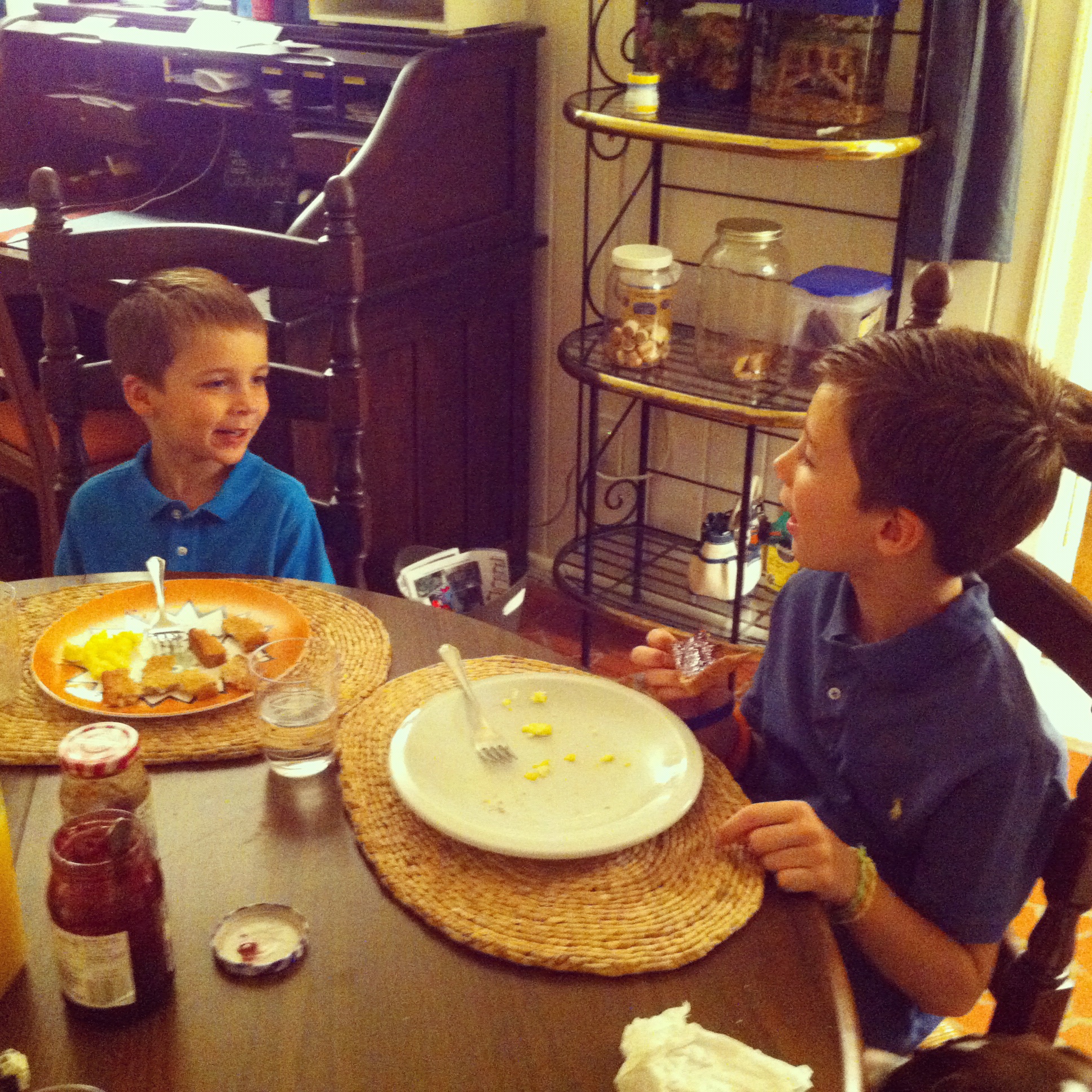
Breaking Bread – edu180atl: bo adams 9.5.12

“Okay, I’ll act it out. You guess the G-word.” I raised my arm above my head and made my hand a mouth.

“Elephant!”

“That’s an E-word.”

“Giraffe!”

“Yes! Whose turn is it now?”

Breakfast is my new favorite time during the workweek. Dinner is a close second. For years, as a school administrator, I advised parents to eat as many family meals together as possible during the workweek. Folks like Ned Hallowell, Dan Kindlon, and Wendy Mogel have written about the close correlation between number of family meals and good children. Yet, I must admit that as a school administrator I ate only 3-5 meals a workweek with my wife and two sons, ages 7 and 5. All of these meals were dinners.

For breakfast, I usually ate a banana and a Clif Bar while I traveled to work or as I started my first meeting. Most mornings, I would kiss my family goodbye as they were still wiping sleep from their eyes.

Now, we eat breakfast together everyday. Since starting a new chapter in my educational career, I have doubled the frequency of family meals during the workweek. We’re growing into stronger sharers of stories, values, and play. This morning, we played a game to help Jackson, my kindergartener, with his G-words.

Identity is fascinating. Years ago, during a conference, we had to make a list of ten words that described our identities. Then, we had to strip away all but two. One of my words that survived was “Dad.”

I’m grateful to have heard my own advice…finally.

_____

Bo Adams (@boadams1) is a learner, husband, and dad. He strives for school transformation and serves as Director of Educational Innovation at Unboundary.

[This post was originally published as “edu180atl: bo adams 9.5.12“]

An idea worth spreading – Grant Lichtman visiting with 50 schools re: future of schools & schools of the future #EdJourney @GrantLichtman

This from Grant Lichtman (@GrantLichtman)…

Dear Colleagues,

As you know, over the next three months I will be meeting with hundreds of educators at more than 50 leading independent, charter, and public schools around the country, each with a unique story to tell about how they are evolving their organizations to meet the challenges of a rapidly changing world.

I hope you will help leverage this opportunity for professional connections with fellow educators around the country who share common interests.  How?  It is really simple.   Share this link to my blog, The Learning Pond, or #EdJourney on Twitter with a few colleagues or collaborators. My blog posts will have active links to people, places, and programs that might be of interest. Here are three examples before I even leave San Diego, of schools that are doing some really interesting work:

Groundbreaking New Pilot at Dallas Townview Magnet School

This is What School Innovation Looks Like

Middle School Hunger Game: Check It Out

I am fortunate to be visiting some of the most exciting schools in America, and I hope to widely distribute those seeds of knowledge. Thanks for helping to share, learn, and grow!

Regards,

—

Grant Lichtman

http://learningpond.wordpress.com

Twitter @GrantLichtman

Marrying power and context in the organizational pyramid. Lessons inspired by Gary Hamel. #PedagMasterPlan

Power and context.

This morning, on my walk with Lucy, I re-listened to Daniel Pink’s Office Hours with Gary Hamel. I continue to return to Gary Hamel’s session for a number of reasons, some of which are:

  1. I find that the information I internalize changes depending on what else is on my mind.
  2. The interview is super packed with incredible, thought-provoking ideas.
  3. Gary Hamel is exploring organizations that are not conforming to industrial-age paradigms for management and operational structure. He is interested in management 2.0. I see countless lessons here for school transformation in the next decade.

This morning, I was most enamored with the ideas surrounding the organizational pyramid – the hierarchical org chart that defines many companies, institutions, and schools. Of course, I am primarily interested in schools.

Hamel outlined that power resides at the top of the pyramid. For this session with Hamel, power seemed to be defined as the positional ability to set organizational strategy and direction. However, context resides at the base of the pyramid. The situational and conditional parameters for employing strategy and direction – through tactics and daily actions – lives at the classroom level, not the head of school level (in my immediate world). Obviously, this dynamic creates a tension. Those at the base – those with the richest context immersion – often feel that they have very little, if any, power to enact systemic change. Those at the top – those with the power to set the organizational direction and strategy – often lack the context needed to fully understand, in a learning-by-doing kind of way, if the strategy and direction makes sense in the daily operations and actions of the workforce – with the teachers, in a school setting.

So, organizational change and transformation is easy, right? We just have to figure out the most effective ways to move power down the pyramid and/or move context up the pyramid…that is, if we don’t want to replace the pyramid altogether with some other design. How might we move power and context through the pyramid?

  1. We could improve the pyramid’s ability to conduct communications electricity. One way to enact this type of conduction enhancement is to utilize the ethos and practices of a PLC (professional learning community). During my last five years as a school principal, the junior high established PLCs in multiple departments. I attended all of the PLC meetings as we began, but as the number of PLCs and participants grew, I was only able to attend one to two of every four meetings for every PLC. While I wish I could have been in 100% of the meetings, the 25-50% attendance (mostly as a co-participant) allowed me to get more of the context, and it allowed my teammates to contextualize the strategic and direction-setting power with which I was invested. Consequently, as one example, the English PLC was able to create significant course change in a few weeks because we could mix and mingle with context and power. The department chair was also a regular member of the PLC. As a result of improving the exchange of power and context, the writing program in grade 8 was revolutionized in short order.
  2. We could flatten the pyramid. By doing so, context and power would reside in the same neighborhood and play at the same playgrounds. Recently, I have been exploring such an idea with suggestions like bringing “Mutual Fun” to school faculties. Instead of using a top-down approach, engage more of a bottom-up methodology. Give more strategy and direction-setting power to those with the best context. Empower the faculty to generate and select the ideas that are most worth doing as a collective whole. I imagine some would consider this inverting the pyramid.
  3. We could build a new shape within the pyramid. (I picture a sphere within the pyramid, essentially connecting the top and the base through proximity to a common object.) Hamel said in his session with Pink that organizational change is directly proportional to organizational experimentation. So, an R&D (research and development) team could be assembled to investigate and implement various cutting-edge pedagogies and methodologies. Medicine uses R&D. The automotive industry uses R&D. Technology uses R&D. Heck, meat cutting and steak makers use R&D (I heard it on another podcast – NPR’s Planet Money). Many industries use R&D. Does education really use a systemic form of R&D? We should. By creating an R&D group and building it wisely, a school could synergize context and power by leveraging this iSchool group.

Of course, at a school that finds itself enmeshed in the world 1.0 hierarchical pyramid, it would take some very special and atypical leadership to disrupt the comfortable and familiar. Another thing that Hamel said that continues to stick in my mind – most leaders are not able to “depreciate their existing intellectual capital.” He earlier had indicated that “change is so hard, not because the future is unpredictable, but because it is unpalatable.”

So, I would definitely say that designing and strategizing the management structure – the power and context grid – must be a part of a school’s “pedagogical master plan.” Such is one of the primary engines that is charged to motor the entire organization. I imagine that purposeful alignment and integration must happen for the management dynamic to “fit” with the organizational progression dynamic. You simply must use the correct engine for your vehicle.

If you expect to get somewhere…pleasantly and enjoyably.

___

Related post(s):