Thanks to colleague Mary Cobb, who shares with me what she is reading, I explored this “Opinionator” commentary from Virgina Heffernen (click or tap on image below). I thought Heffernen’s piece provided a strong summary of the 21st-century-education argument. [Also, I was reminded of a post I wrote a few months back, and I was thankful to have that reflection recorded (one of the reasons “Why to blog?” discussed at yesterday’s Blogging as Digital Portfolio session).] With appreciation on my part, Heffernen captures that the industrial model of education is not necessarily working for many; however, 21st century education resembles classical education and a return to the past, as much as a forecast to the future. What we hope for students is a blend of the traditional methods that have proved effective, combined with innovative learning that can reach a developing brain being reared and “envionmentalized” today.
Monthly Archives: August 2011
FedEx Session: Blogging as Digital Portfolio
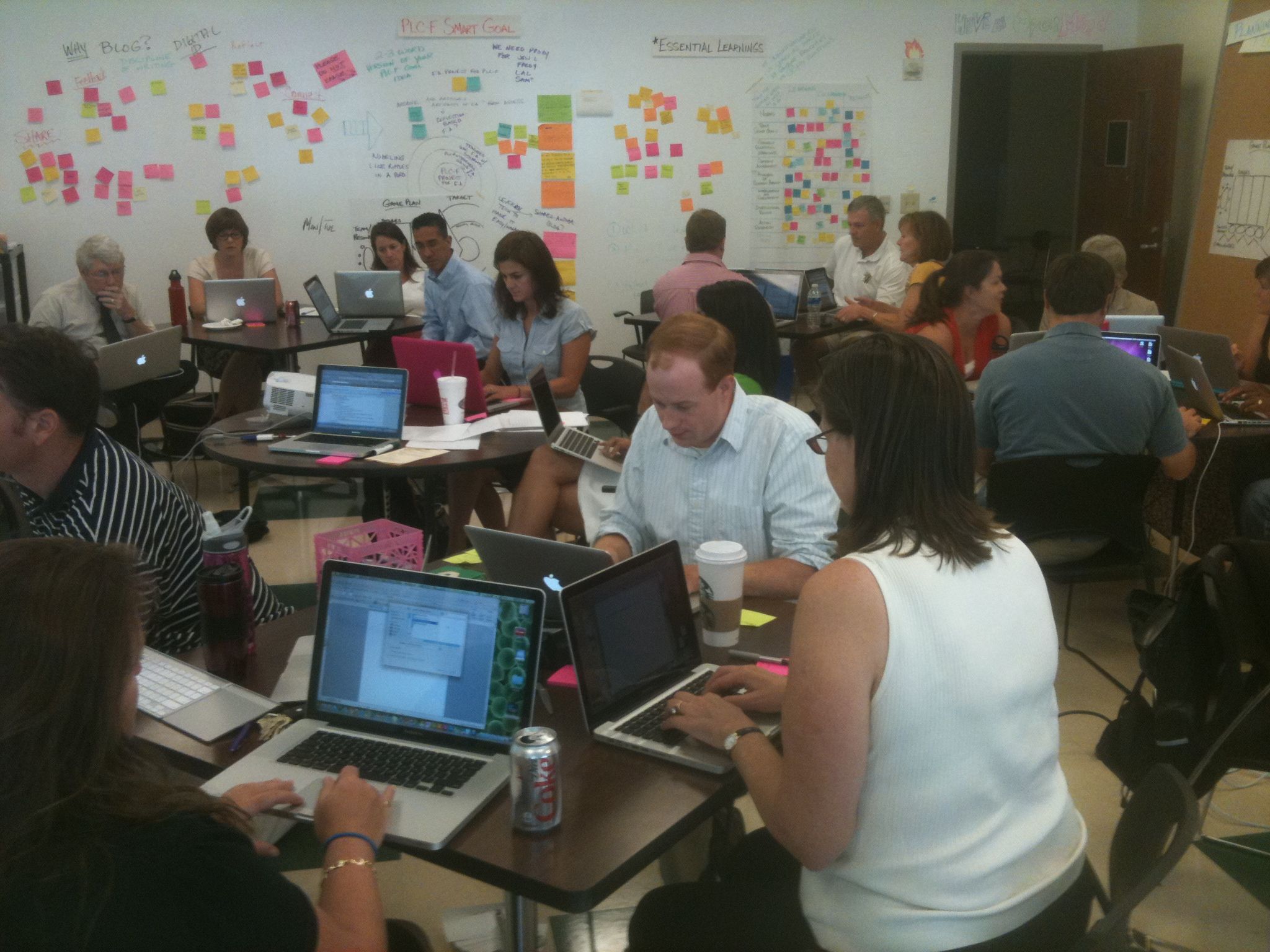
Today, as part of Westminster’s Faculty Forum, we are working in a “FedEx Day” format. Several faculty created workshops for which people could register. Various other faculty organically gathered into groups to co-labor on particular projects. Here’s a small sample of the workshop titles:
Jill Gough and I hosted a session on “Blogging as Digital Portfolio.”* Our framework plan looked like this:
- Why to blog?
- What to blog?
- How to blog?
We began with a post-up gamestorm in which people recorded reasons why to blog. Each of these ideas was recorded on a Post-it note, and we posted the notes to our idea wall.
Then, we used an affinity map gamestorm to gather related Post-it notes and categorize our thinking.
Next, we used Poll Everywhere to gather some data and assess our participants:

The discussion was great, and people contributed mightily to our collective understanding about why people might blog…and what can get in the way.
In order to dive into the “What to blog?” section of our game plan, we used a Google Doc for collaborative brainstorming: http://bit.ly/py3yvb.
Finally, we walked through the steps of actually establishing a blog on our WordPress Multi-user Domain. We encountered some technical difficulties with the confirmation-email process, but our group found ways to positively engage. Some wrote practice drafts of blog posts using Word and Pages. Others drafted a directions/instructions document about what we had done in the session. A few others even split into teams for a cooperatively competitive contest about taking the “30 Day Challenge” for posting once a day for a month…to get in the habit (posts might be as short as a sentence or an image-and-question combo).
Of course, with @gcouros here, we had access to a great resource from him, too: http://bit.ly/hlmym9
Now, as I wrap up this post, there are some stragglers here still working…still learning. It’s 11:55 a.m., and we are having fun learning and working together.
* FOOTNOTE: Interestingly, Jill and I had planned a session on PBL. On Thursday afternoon, we realized we had a small list of registrants. Because of the enthusiasm over digital portfolios – generated the day before – we decided to use this formative assessment to shift our workshop plan. Our three, original registrants were very understanding and flexible, and we ended up with a full house – about 24-25 folks.
A Single Note Can Make It All Worthwhile
There was a single note on the teacher’s desk. Turning the envelope, she slid her curious finger under the seal, anxious to read what awaited her. Just the crackle and hiss of that seal being broken blocked out the ambient sounds of anything else around. Wrestling the note from the casing, she realized she held one of “those notes.” Occasionally, over the years, she received several of those notes. Each one precious. These notes find their way into a treasure chest of memories – memories that resurface on a challenging day or a day soaked in gray rain. A student had penned a thank you – a note of gratitude and appreciation. Sustaining nourishment. Sweet nourishment.
As teachers, I believe that many of us “live for” that note from a student, or from any learner to whom we’ve contributed, that expresses the impact of a lesson or moment of learning. Yesterday, my school received such a note, and I share it here with the sender’s permission:
Bo,
I’ve overcome severe jealousy to write a brief thanks to you & your school for today’s tweets.
I’m certain you have issues that drive you mad in faculty meetings, whether it’s dress code or recess or something else only tangentially relevant to Learning – but today had too many of those moments for me – and then I checked Twitter.
Watching the hashtag responses, and knowing that people I knew and respected were having the right conversations about students in the midst of preparing for the year ahead, gave me hope that such conversations would continue to blossom here, and maybe we would have a Twitter stream as a backdrop to a professional development session someday – to the betterment of our students, and maybe even to eavesdropping friends elsewhere!
Thank you again – not only for the knowledge, but for the Potential it represents for us all.
Please visit when you can – we’d love to show you what we’ve been doing since you were last here.
Warmest regards,
Ezra
At this week’s end, Westminster is enjoying Faculty Forum with George Couros (@gcouros). Faculty Forum is an annual, opening-of-school set of faculty meetings for inspiring and readying the work ahead for another school year. As we transition our technology to Apple and a 1:1 framework, some may mistake that the focus is on the technology. George provided a keynote, and the school organized a number of learning spaces, which spotlight the actual focus – LEARNING and SHARING. That’s what it’s really about. [Twitter stream for Westminster Faculty Forum – #wmatl]
Didn’t we all get into teaching – if we are in it for the right reasons – because we ourselves love to learn…and because we want to share that learning with students? The mere word “students,” however, makes many think of children and teenagers. Yet we are all students if we steer our mindset to continuous learning. And we are all teachers, too, with such a mindset. In wholeness, we are learners, and we can hardly hide our passion for sharing that learning.
I am eternally grateful for Ezra’s note, and I am grateful to my school community – including @gcouros – for inspiring such a note. Ezra expresses the creative tension between vision and current reality, and he exudes that learner’s passion to close the gap by working to achieve the vision. And, he’s connected. He’s connected to a tribe of learners who want to do our best for ourselves, for our colleagues, and for our students.
We helped students today – before they even arrive at school for the year. We ourselves learned. And we shared. It is our way, and Ezra reminds us why we do it. A single note can make it all worthwhile.
Big Rocks First!
I love the classic camp devotional (that’s where I saw it first, at least) involving someone trying to fill a glass jar with sand, small rocks, and big rocks.
During round #1, the person pours the sand in the jar. Then he tries to get the small rocks and big rocks to fit. They don’t fit!
During round #2, the person puts in the big rocks first, then the small rocks, then the sand. IT ALL FITS!
Here…watch for yourself…
For the last few years, I have committed to putting in the big rocks first…for my typical weekly schedule. As a principal, so many different tasks and needs arise. My day can get filled with sand, and the big rocks get crowded out. However, if I schedule in the big rocks, then the sand – which is still important stuff – can fill in around the big rocks. Here’s what my “glass jar” looks like…
Of course, life requires some flexibility and adaptability. But first loading the big rocks helps ensure that major tasks get tended to and accomplished!
What are the big rocks in your work? Are you scheduling guaranteed space for them?