A major aspect of Pedagogical Master Planning involves generating an “as-built set of blueprints” for a school’s pedagogical ecosystem, so that a school can see itself in ways it likely never has before. The pedagogical ecosystem is comprised of the interconnected sub-systems of 1) purpose, 2) leadership, 3) professional learning, 4) instruction, 5) curriculum, 6) assessment, and 7) learning environments.
One way we are conceptualizing the as-built blueprints involves the use of “infrastructure polygons,” inspired originally by Candy Chang’s work.
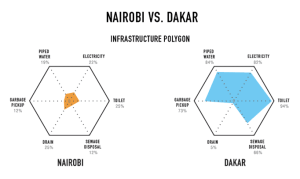
In this example, in which Chang visualizes the contrasted city infrastructures in Nairobi and Dakar, one can quickly see that Dakar possesses a much higher density of piped water, electricity, and toilets than Nairobi. For example, about 19% of Nairobi’s population has access to piped water, compared to 84% of Dakar’s residents.
Recently, TED uploaded Jessica Green’s TED2013 talk, “We’re covered in germs. Let’s design for that.”
As another great example of using info-graphic polygons, Green employs these visualized data tools to compare and contrast the microbes in various rooms in a building. (You should watch the talk, just to see how this method of data visualization works. It’s fascinating.) The information polygons make it easy to see how classrooms compare with offices in terms of microbial “footprints” or profiles. [Stick with me if that last sentence made you want to click to the next post in your feed reader or email!]
With Pedagogical Master Planning, a dimension of the Discover phase involves capturing information about instructional methodology. Through classroom observation, interviews, self-reporting, etc., we collect data about instructional modes like lecture, lecture and discussion, demonstration, simulation, case study, PBL, role play, graphical creation, etc. After aggregating the data, we can visualize the information using polygons similar to those used by Chang and Green.
Imagine a polygon put to use as an info-graphic that summarizes the instructional methodologies used throughout the school. In a very oversimplified example, one might show that 78% of instructional time is spent in lecture, 11% in demonstration, 5% in case study, and 6% in graphical creation. What invaluable information for a school that is working strategically to become more student-centered and student-directed in its pedagogical approach.
And imagine the power of such visualization in an actual school situation. We could potentially visualize the following:
- A student’s user experience as an individual throughout a day. Such an info-polygon could show the instructional modalities that “Suzie” experienced in a day of attending classes. Or a week, or a month.
- A particular department’s aggregated picture of instructional methods. Such a picture might reveal strengths in a department so that members of that department become mentors in that methodology for other departments less familiar in practice with that mode. It might also reveal areas for targeted professional development.
- An ability to overlay instructional methodology polygons with learning environment set ups (e.g., seating arrangements like seminar, cooperative, senatorial, etc.). Internal action research could be conducted regarding how modifying the classroom layout influences instruction over time.
- An in-depth look at how the predominant instructional methods relate to desired outcomes in certain skill sets such as the so-called “Cs” of 21st C learning – communication, collaboration, creativity, critical thinking, etc. Wouldn’t it be interesting to see how much time students actually have to BE primary communicators in a week of school, if the school believes it wants to help students develop advanced capabilities in various communications. [Think about the 10,000 hour rule of developing mastery. Do you know how much time students actually spend practicing these skill modalities?]
- Time studies for a school, showing how their instructional methods evolve over time once they become more systemically engaged in studying something like this as a school working to shift or enhance a culture of diversified pedagogy.
Such ideation around information polygons and “as-built blueprints” are only one piece of the potential for Pedagogical Master Planning. By being able to see more clearly what is happening in the actual pedagogical ecosystem, a school can be more strategic in developing it’s integrated sub-systems for the learning that can happen. Being able to see provides clarity from which to plan for innovation and development. Being able to see can help reduce resistance as people are able to gain greater understanding about the current reality of instructional methods used compared to the desired learning outcomes for students. It’s a bit like turning on the lights in a darkened room. The light shed on the situation helps us navigate more agilely and purposefully. We’re less likely to need to shuffle our feet slowly and wave our arms in from of us to keep from running into something unexpectedly.

 it's about learning