Brief context: I co-facilitate a course for eighth graders; the course is called “Synergy.” Synergy is a non-departmentalized, non-graded, transdisciplinary, community-issues-problem-solving course. My teaching and learning partner Jill Gough (@jgough; Experiments in Learning by Doing) and I co-created the course and we are the two adult-learners among twenty-four student-learners. [If you want to know more about #Synergy, then you can search that category/tag on either of our blogs.]
Brief story: Yesterday, Jill posted this TED Talk on our Synergy Posterous (the collective observation-journal system for our team). Mick Ebeling’s talk is well worth the 7.5 minutes. Be inspired to do something you think impossible…
A sub-group on our team is interested in something they are calling the Graffiti Project. A few student-learners are curious about graffiti and such questions as “is graffiti art or vandalism…could it be both?” Or “why do people paint graffiti…not the quick ‘dirty word’ kind, but the elaborate, beautiful, intricate-scene kind?”
Curiosity begets a project. A project begets an investigation. An investigation begets a TED talk. A TED talk begets…
What could come from this series of path points on our journey in Synergy? Perhaps the team, ages 13 to 40-something (high 40s!), will internalize these critical questions of innovation, connection, citizenship, relationship, and possibility:
The prompt: Do you think our Synergy team’s project possibilities are accurately and fairly represented? Why or why not?
“I think they are accurately represented because it’s easy to see and understand, as well as find one in a group of many that you are passionate about. I think we should have a survey. I think they are fair to everyone’s choices, and I like that everyone got three post-it notes.” ~ BM
“I think our Synergy team’s project possibilities are more accurately and fairly represented with the idea wall system, because we thought of what projects we were most passionate about, and then as a class they were organized into groups on the wall, according to their topic. With the other system they were categorized under tags that each of us individually had tagged, in our own language, and five out of 300+ of our tags were represented with that system. I think this left out a lot of other project possibilities that many people in our class feel passionate about. In my opinion, both of these systems were flawed, but I am excited about many of the projects, and with both I was able to see one or two projects that our class had identified, that’d I’d love to start working on.” ~ OK
“I think that the project possibilities that are represented are fairly represented but we have more ideas that we can add to the wall. Also I think the tagging system was very complicated and hard to understand, but we did a good job of cleaning it up and getting everyone to use the same tagging language to tag their posts.” ~ MB
“I believe that our Synergy team’s project possibilities are mostly accurately and fairly represented, but I don’t think that’s true for everyone. Every team member has put there idea up on the idea wall, but everyone does not understand what each idea means.” ~ OV
“Everyone definitely had an equal say in what we have so far, so I think it is apparent that the data we have is fair. I think the idea wall represents our project possibilities accurately, but the Posterous tags do not. I think the idea wall works because it represents what stuck with people. It specifically represents PROJECT ideas, while the tags also represent random observations that projects cannot be done on.” ~ FS
“I don’t think that our Synergy team’s project possibilities are accurately and fairly represented through our Posterous Idea Wall. I don’t think they are accurately represented because we have over 300 posts and there are bound to be posts that are as equally important to us that we forgot about. Others aren’t represented well, because they are thrown into a miscellaneous category. When something is put in a category like this, people tend to skip over it and ignore it. For example when people are choosing project possibilities that interest them, they will probably skip over the “Other” categories and head straight to the ones that have titles. Although there are some down sides to our wall, like the ones I stated above, our Synergy class has made significant progress through this exercise.” ~ DJ
“Well, I did but now I have realized that they really aren’t. Before, I thought that they were because of the sticky notes and Posterous posts, but now I think that they are not. Today at the end of class, we tried to decide on a number of project ideas for the poll. I thought that we should vote because the final numbers were 8 and 12. Someone suggested that we use 10 because that is between 8 and 12 but some people weren’t satisfied.” ~ CC
Based on the feedback from our young learners, we have learned that we need to work with our team to create a better understanding of the “folksonomy” aspect of tagging our observation journal posts in Posterous. From Reinventing Project-Based Learning: Your Field Guide to Real-World Projects in the Digital Age by Suzie Boss and Jane Krauss:
“Folksonomy” refers to the social taxonomy or classification system that evolves as users collectively make sense of what they find on the Web. Users associate “tags” or keywords to the content they bookmark, and they can see how others have treated the same material.
The easiest way to understand the power of bookmarks and tagging is by using it. [p. 22]
We are working to develop a common language with our tags. We are learning by doing as recommended by Boss and Krauss.
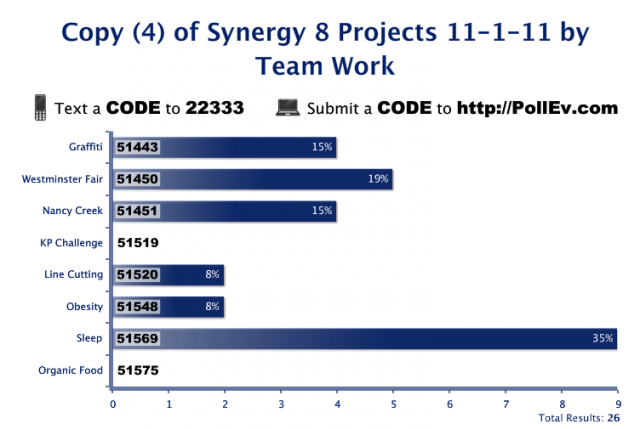
After more work and reorganizing the Post-it Notes from the idea wall, the team decided to use Poll Everywhere to formatively assess the team’s thinking and preferences. We (Bo Adams and Jill Gough) created the topics for the poll based on the top 10 tags from our Posterous blog. Our learners decided that these categories, shown below, were similar to the categories from the idea wall.
As you can see, we definitely need to work on developing a common language and understanding of tagging. School, for example, is a pretty broad topic for project selection. There were 82 posts tagged with school in our Posterous observation journal site.
Here are the results after the first poll.
Our learners discovered that their categories were too general. If you wanted to work on the KP Challenge, did you select school or cafeteria? If you were interested in organic food or obesity, did you select environment, cafeteria, or health? Fortunately, the Post-it Notes contained more details. Our learners then asked to eliminate the general categories where they showed no interest and add more specific categories to eliminate some confusion. For a quick glimpse into their discussion and work, we offer the following iMovie*.
Here are the results after the second poll.
Serving as their coaches, we now had to intervene. PowerPuff does not meet the standard of project or problem for our course. We want our learners to work on projects or problems that effect more than half of one grade in our division. Our learners were assured that we would help them work on this project outside of class if they are serious about pursuing this as a community issue. One of our learners made a motion from the floor to poll again with the category PowerPuff removed.
Again, there was discussion coupled with questions. Could the KP Challenge and Line Cutting choices be grouped together?
In groups, our learners’ next task was to use the technique of brainwriting to share, connect, and contribute to the team’s ideas of the selected topic.
Learners are now working on project concepting using a worksheet we adapted from BIE.
For the projects where there are less than 4 teammates, how will they cover the internal, team “leads” for each essential learning needed? Will these teams choose to push forward on the project they have selected, or will they choose to join forces with another team?
[Cross-posted at Experiments in Learning by Doing]
[*NOTE: iMovie video effects have been added to the movies because of a new school policy about student images on faculty blogs.]
I don’t have a lot of time to write this morning, but I do have some time. So, it occurred to me to use my time to share a bit. This week, I benefited greatly from various colleagues sharing their “curiosity paths” and resources with me. My colleagues know that I am interested deeply in design thinking, learner engagement, and project-based learning. Among many shares this week, I highlight three below by embedding three videos and the links to the sites that contain these videos and additional resources about design, engagement, and PBL. In my mind’s eye, I see these three strands as a braided whole – I see them synergisticly. I am not sure that design thinking, learner engagement, and project-based learning could ever be un-braided into silo-ed parts. They are intricately connected parts of an entire system. Enjoy. It’s about learning.
Our Synergy team is at the halfway mark, time wise, of the semester. For the past 9 weeks we have been recording images, questions, and thoughts in our observation journals. We use a common space, a Posterous group, to communicate, collaborate, and connect ideas.
The challenge now upon us…What data mining strategies should we employ to uncover community issues that, as a team, we want to study, investigate, problem-find and problem-solve? We have over 300 posts. It seems daunting, almost overwhelming to sift through our data.
Via his talk at TEDGlobal 2010, “How complexity leads to simplicity,” Eric Berlow was our “guest expert” to help us think about and learn that “complex doesn’t always equal complicated.”
A couple of key insights that stuck with us include:
[Use] the simple power of good visualization tools to help untangle complexity to just encourage you to ask questions you didn’t think of before.
and
The more you step back, embrace complexity, the better chance you have of finding simple answers and it is often different than the answer that you started with.
Here is a quick trailer and then approximately 4 minutes of video from Monday’s Synergy learning experience to show one of our attempts to find simplicity on the other side of our complex task of data mining for new projects.
If you facilitate project-based learning, how do you empower students to determine the team projects?
What other methods would you recommend to us for putting students in “that driver’s seat?”
How does assessment for learning change when immersed in PBL?
How would you assess the various learning demonstrated in the video?
I am a synergist. I love to work at the intersection and collision of ideas, disciplines, and departments. Of course, like anything, I have to practice this skill, and I hope to continue progressing in the synergizing of things. As Carol Dweck has taught me to say, “I am not yet the synergist that I will be!” I believe Howard Gardner that one of the five minds of the future is the “synthesizing mind.” So, I practice synthesizing and synergizing.
How do I practice? I look for the connections between and among things. I purposefully look. I risk and experiment and take chances. Often, I fail. But I keep synergizing. I work to connect those parts that might result in a whole whose sum is greater than I originally imagined. Also, I get a lot of help from others. WE are smarter than ME when it comes to colliding and synergizing ideas.
This morning, I watched another synergist on TED. In just 4 short minutes, Nathalie Miebach demonstrated to me that mathematical data collection, weather science, 3D art, and music are marvelously integrated. What if school promoted and empowered this type of work…
Then, I remembered a blog post from Garr Reynolds in which he quotes Steve Jobs from a 1997 interview:
You’ve got to start with the customer experience and work backwards to the technology. You can’t start with the technology and try to figure out where you’re going to try and sell it…we have tried to come up with a strategy and vision for Apple, it started with “What incredible benefits can we give to the customer? Where can we take the customer?” Not starting with “Let’s sit down with the engineers and figure out what awesome technology we have and then how are we going to market that?” And I think that’s the right path to take.”
And, so, here is some of my synergy practice this morning: I see Miebach’s TED talk and Job’s quote as inextricably linked together. Schools are envisioning a transformation towards more integrated studies. Some schools are already doing so with great success. Researchers are studying such schools and writing about the Powerful Learning that is happening in such places. Among other shared traits, the schools that are transforming successfully are putting “customer experience” far ahead of “awesome technology.” The successful ones, it seems to me, are guiding students to discover the intersections – the synergies – among such things as mathematical data collection, weather science, 3D art, and music. Then, they are engaging various technologies as tools with which to explore and deepen understanding.
Yesterday, at our faculty meeting, we also took a step in synergy practice. For the second meeting in a row, we told “campfire stories” of some exciting “customer experiences” from our classes and courses. We identified some points on our faculty graph. Now, we have a greater potential to play that great game of motor skill – connect the dots. Wanna play?


 it's about learning