Do Schools Match the Tools?

With the creation and proliferation of Web 2.0 technology, I wonder if we have entered the first time in history that primary media and typical school do not match. Could this be a fundamental cause for the urgency that seems to define discussions of educational change for the 21st century?

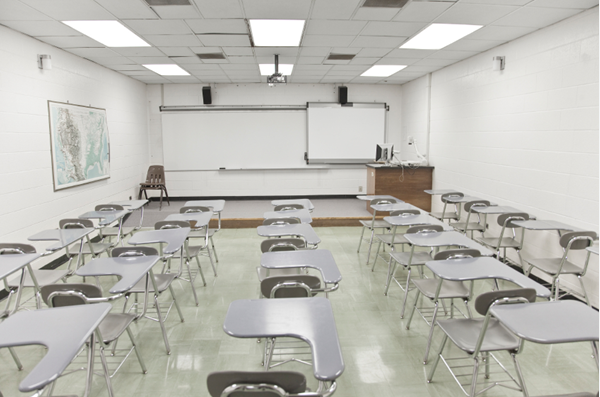
What do I mean about the match between primary media and typical school? Well, when Socrates was utilizing the method that bears his name, the primary medium was voice, inquiry, and discussion. “School” matched that basic model of media. During historical periods in which mass-produced print media dictated information relay, schools grew to rely on the same – books. As the industrial revolution produced radio and TV, information was broadcast from a sending station to a set of receivers. We learned to “sit and get” our information. School transformed into a comparable system. In fact, in typical factory model, we efficiently organized classrooms in rows and columns of “receivers.”
Today, in my opinion, we incorrectly refer to students in school as “digital natives.” They are not born with innate digital understanding. The world they live in as children, though, is very different than the world we lived in as children. As we all know, they do grow up in a world in which they have never not known cell phones that function more like computers than telephones. Students in high school essentially have no memory of life before Web 2.0. What an effect this must have on growing learners, day in and day out. They live with an Internet to which they could always contribute. The can create, contribute, and connect. They don’t just “sit and get” like couch potatoes watching a screen or listening to the radio. They use services like Pandora and order what they want on the radio – they determine the broadcast. They make playlists with the computer, not a set of CDs and a tape deck. They text, tweet, and facebook.
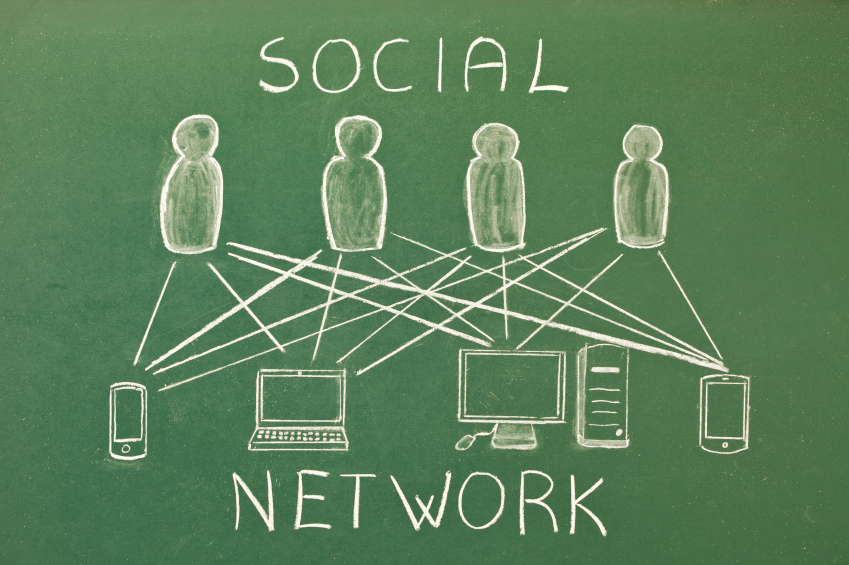
Until they go to school. Schools, for the most part, are still in the broadcast and receiver phase. Schools are more like those sets of CDs and tape decks. Technology is a faster adapter than schools. Why? Because our professional development largely still exists as “sit and get” – broadcast and receive. When administrators and teachers create conditions for School 2.0, things start to happen.

Through educational innovation driven by 2.0 learners, countless schools are changing for the better. They are working diligently to ensure that student learning is at the core in our 21st century world. Schools are moving from an unintended focus on what’s convenient for the braodcasters, to an intentional refocusing on what’s best for the co-creators. Schools are leveraging Web 2.0 tools, utilizing the last two decades of brain research, and organizing away from the egg-crate culture into cultures of collaboration. Thank goodness! May we continue to strive for improvements and enhancements that will help our students see school as a primary place of learning – not an irrelevant pitstop between periods of more self-engaged exploration and discovery.

Note: Photos acquired from iStockPhoto.
GOOGLE and the JHS

Recently, I have been struck by the number of people who are talking about Google’s “philosophy” of encouraging engineers to take up to 20% of their at-work time to pursue projects of their own. Here are a few of the hits produced if one Googles the topic:

According to many of the stories, some of Google’s greatest innovations have been born from this 20% time. Rather than assuming the typical hierarchy of organization would provide vision and mission to “require” a workplace of innovation, the admin and management merely provide encouragement for an attitude of “bottom-up” leadership (I hate that term and what it implies). The admin and management simply encourage the professionals to pursue personal interests and they provide time for that pursuit to happen at work. As I read the blogs and article linked above, I became intrigued by the idea of “grouplets.” Rather than individuals pursuing personal projects, engineers were banding together to work collaboratively with this 20% time.

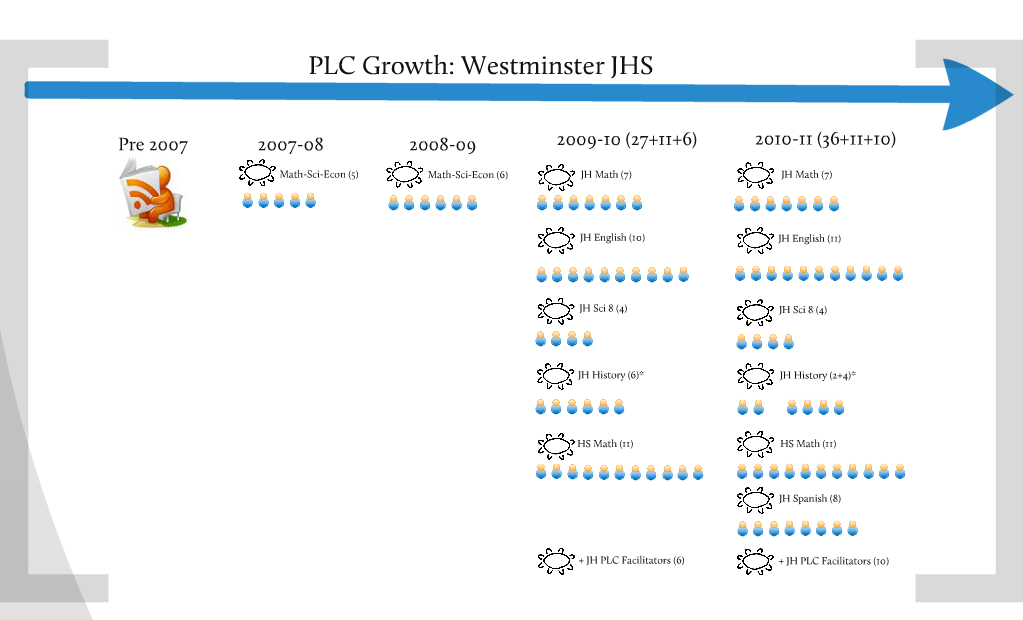
At Westminster, in the Junior High School (JHS) in particular, we have been on a multi-year journey to restructure professional development. We are using the professional learning community (PLC) model and principles to create a new infrastructure for teachers (our “learning engineers”) having the opportunity to work collaboratively together. We have taken a bit of an aggressive approach, and we believe that job-embedded time must be created for such collaboration.

Typically, teachers carry a five-class student course load. For example, a math teacher, in the past, would have five sections of student classes. In the more recent history, we have transitioned one of those periods to be a PLC period. In essence, we have created something akin to Google’s 20% time. One of five sections, transitioned to serve as a PLC period for teacher collaboration, equates to “20% time.”

Through the PLCs, teachers are innovating! Just having a guaranteed time to discuss all of the complexities of teaching and learning is such a positive development. However, much more than discussion is happening. With these four hours per week (we have a rotating schedule and every period meets four times per week), teacher teams are re-exploring writing as thinking, formative assessment ideas, second-chance testing, four-point rubric development, technology integration, content understanding in various fields, and the list goes on.

But I wonder if the 42 (of 74) teachers currently involved in formalized PLCs (we plan to work toward 100% integration for ALL teachers) see their PLC period as this Google-esque 20% time. I believe some do, for sure. But do all of them? Have I exercised my leadership in such a way that it is obvious and communicated clearly that PLC time can be for assessing student learning and creating innovations for enhancing that learning?

So many opportunities, so many possibilities! By striving to “democratize” the work day for careful study of student learning and possible educational innovations, don’t we increase the likelihood for better teaching and learning? In fact, without the 20% time in schools for the commited, motivated teachers who strive for their own continued learning and that of their students, will we really improve education, in any considerable ways, during this second decade of the 21st century?

Here’s to a New Year’s resolution for “20% time” in our schools…for the countless, dedicated teachers who simply need time to collaboratively explore, discover, innovate, and educate!

Figure 1: Formalized PLC Growth at Westminster, 2007-2011

Play! Tinker!

An important reminder from Lee Burns about the importance of PLAY in learning. As for me, I may have learned more about problem solving by finishing the basement of a house than I have learned about problem solving in any other way. And it all felt like play…well, most days!

Take some time and check out Gever Tulley’s Tinkering School, and watch his TED talks, too.

Kaizen

For the past few days, I have been enjoying Garr Reynolds’ book Presentation Zen Design. A friend gave me the book because he knows I make many presentations and because he knows that we study and implement design in the Synergy 8 course. In short, the book is brilliant. It is one of those relatively rare reads that makes you think you have only just begun when you finish reading the last page. It satisfies while leaving one hungrier still.

Throughout the book, Reynolds makes the point of “kaizen” as continuous improvement. On page 234, he summarizes that

Kaizen is key to the steady improvement and innovation of successful companies….’Kaizen is one of those magical concepts that is at once a philosophy, a principle, a practice, and a tool.’ It’s also an approach we can learn from and apply to our own lives as we strive for continuous improvement on a personal level….Kaizen is daily, continuous, and steady – it takes the long-term view. Kaizen also requires a commitment and a strong willingness to change….The interesting thing about kaizen is that big, sudden improvements are not necessary. Instead, what is important is that you’re always looking for ideas-even the smallest ideas-that you can build on. Tiny improvements are OK as over the long term they can add up to great improvements. Each journey begins with a single step.

So, here’s to kaizen. And, on a related note, check out Garr Reynolds’ site devoted to presentation zen.
Garr Reynolds’ recent post on education and learning.