Held Accountable

Principals, other school admin, teachers, educators, and other learners…STOP! and READ! Bill Ferriter’s The Tempered Radical blog post “What I’d Hold YOU Accountable For.” From the perspective of this principal teacher, Bill’s tweet and post are right on the money…they certainly do NOT rub me the wrong way. May I strive to live and lead by his recommendations!

Are we creating the conditions necessary for innovation in schools? Are we leading learning innovation?

In an effort to complement Bill’s post, I offer these supports, suggestions, and examples:

  1. Tear down the walls that exist between teachers and rebuild an infrastructure that provides for a powerful community of learners. The PLC infrastructure is well-researched, well-documented, and well-utilized (in many places). At the Junior High at Westminster, we have adopted and adapted an aggressive model – replace a class in the rotating schedule with an opportunity for regular, job-embedded PLC work. Our teams meet four days per week, for 55-minutes each day…just like our student learners meet for math, English, science, etc. Additionally, we use a co-facilitator, teacher-leader model, and we rely on a PLC structure to support the facilitators of the various teams. As a facilitator PLC, we meet one day per week for face-to-face time.
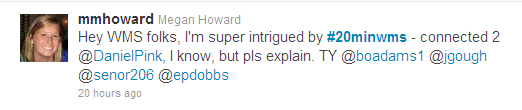
  2. Tear down the walls that exist between teachers and leverage social media to provide an “anywhere, anytime” PLC/PLN. For the past month, a growing team of teachers at Westminster has been engaged in the “20 minute experiment” on Twitter. Take a look…
  3. Tear down the walls that exist between teachers and implement a faculty assessment plan that holds growth and development more dear than evaluation. Let’s conduct “physicals” rather than “autopsies.” We are several years into this process at Westminster.
  4. Tear down the walls that exist between teachers and promote innovation, creative thinking, and project-based learning. Find ways to highlight the experiments, innovations, prototypes, and trials of an amazing faculty of lifelong learners.

And, in conlusion for this post, to put the proverbial cherry on top, be sure to watch this Jay McTighe video…
http://jplgough.wordpress.com/2011/02/01/learning-habit-assumptions-experience-practice-and-empathy/

It’s about learning…and learning is all about prototyping, which is just a pretty euphemism for trying, practicing, failing, and trying again.

Pull Together: Part II

I hope I do not sound overly paternalistic when I say, “I am so proud of the teams of teachers in our Junior High!” Currently, our PLC (professional learning community) facilitators are enacting an action research project. We are facilitating the construction of essential learnings for an upcoming unit of instruction in our various PLCs (math, English, science, history, Spanish, etc.). Among the groups, essential learnings exist at various stages and phases. Some teams are a year or more into the process. Others are just starting. Some take to it like a fish to water. Others struggle. Sounds like any learning endeavor, doesn’t it?!

To help find common ground in our journeys to establish essential learnings, we decided to “shrink the change” (from Switch, by Dan and Chip Heath). What if all the PLCs worked on essential learnings for an upcoming unit? Could that help us all to understand essential learnings more deeply? Could such a project illustrate a variety of ways for teams to respond to the first essential question of all PLCs: What should students learn?

After a few facilitator workshop meetings, in which we strived to understand the basic processes of establishing essential learnings, we got to work in our various PLCs. Take a look at the method the Junior High Math PLC used to discuss and enhance the vertical alignment of their established and evolving essential learnings in 6th through 8th grade math.

Can you fathom the potential of this team-oriented work? They are breaking down the silos of individual courses and teachers. They are building an essential learnings “scope and sequence” to ensure that our math students develop deep and enduring understanding of critical math concepts. To know what students should learn then allows us to build assessment strategies to ensure that deep learning is occuring and enduring. And we can work out the kinks of overlaps and gaps so that student-learning is part of a system, rather than a vaccuum.

In the background of the current, short version of the video, the Science 8 PLT is completing a new draft of their essential learnings. Those go on the board next! Can you see what’s coming? The potential for integrated studies that weave together the related essentials of math and science. [I am looking forward to showcasing that video journal.] What potential! I am so proud of our teams of teachers learners! When we pull together, we can accomplish more.

Do Schools Match the Tools?

With the creation and proliferation of Web 2.0 technology, I wonder if we have entered the first time in history that primary media and typical school do not match. Could this be a fundamental cause for the urgency that seems to define discussions of educational change for the 21st century?

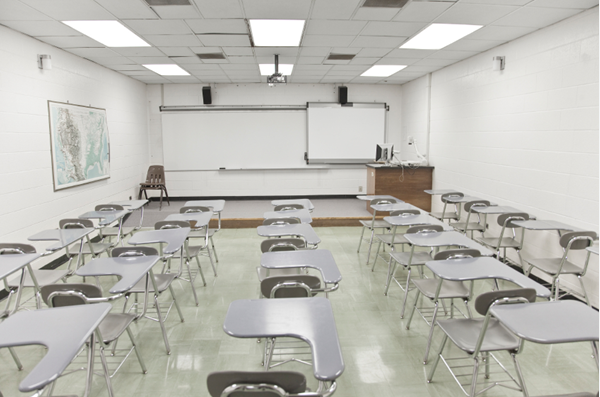
What do I mean about the match between primary media and typical school? Well, when Socrates was utilizing the method that bears his name, the primary medium was voice, inquiry, and discussion. “School” matched that basic model of media. During historical periods in which mass-produced print media dictated information relay, schools grew to rely on the same – books. As the industrial revolution produced radio and TV, information was broadcast from a sending station to a set of receivers. We learned to “sit and get” our information. School transformed into a comparable system. In fact, in typical factory model, we efficiently organized classrooms in rows and columns of “receivers.”

Today, in my opinion, we incorrectly refer to students in school as “digital natives.” They are not born with innate digital understanding. The world they live in as children, though, is very different than the world we lived in as children. As we all know, they do grow up in a world in which they have never not known cell phones that function more like computers than telephones. Students in high school essentially have no memory of life before Web 2.0. What an effect this must have on growing learners, day in and day out. They live with an Internet to which they could always contribute. The can create, contribute, and connect. They don’t just “sit and get” like couch potatoes watching a screen or listening to the radio. They use services like Pandora and order what they want on the radio – they determine the broadcast. They make playlists with the computer, not a set of CDs and a tape deck. They text, tweet, and facebook.

Until they go to school. Schools, for the most part, are still in the broadcast and receiver phase. Schools are more like those sets of CDs and tape decks. Technology is a faster adapter than schools. Why? Because our professional development largely still exists as “sit and get” – broadcast and receive. When administrators and teachers create conditions for School 2.0, things start to happen.

Through educational innovation driven by 2.0 learners, countless schools are changing for the better. They are working diligently to ensure that student learning is at the core in our 21st century world. Schools are moving from an unintended focus on what’s convenient for the braodcasters, to an intentional refocusing on what’s best for the co-creators. Schools are leveraging Web 2.0 tools, utilizing the last two decades of brain research, and organizing away from the egg-crate culture into cultures of collaboration. Thank goodness! May we continue to strive for improvements and enhancements that will help our students see school as a primary place of learning – not an irrelevant pitstop between periods of more self-engaged exploration and discovery.

Note: Photos acquired from iStockPhoto.

AP, PBL, EL

As a middle school principal who does not face the direct pressures of the AP debate, I realize that I may possess a “too-simple” understanding of the discussion. However, I admire the dialogues that a few colleagues of mine are precipitating on their blogs: Quantum Progress and Experiments in Learning by Doing. Addtionally, I found the recent New York Times article on AP to be fascinating. I sent the following email to the PLC (professional learning community) facilitators at my school because I think the article illuminates two important discussions about PBL (project-based learning) and EL (essential learnings – the process of deciding “What students need to learn”).

If you have not read the NYT piece on AP, then here is link to it. I have pasted in two quotes from the article that I think are interesting in relation to the discussion about 1) PBL (project-based learning), and 2) ELs (essential learnings).
 

A committee of the National Research Council, a part of the National Academy of Sciences, called attention to these problems in 2002. It criticized A.P. science courses for cramming in too much material and failing to let students design their own lab experiments. It also said the courses had failed to keep pace with research on how people learn: instead of listening to lectures, “more real learning takes place if students spend more time going into greater depth on fewer topics, allowing them to experience problem solving, controversies and the subtleties of scholarly investigation.”

And to the delight of teachers who have gotten an early peek at the plans, the board also makes clear what will not be on the exam. Part or all of at least 20 of the 56 chapters in the A.P. biology book that Mrs. Carlson’s class uses will no longer need to be covered. (One PowerPoint slide explaining the changes notes sardonically that teachers can retire their swift marches through the “Organ of the Day.”)

Achievement-Action: #20minwms

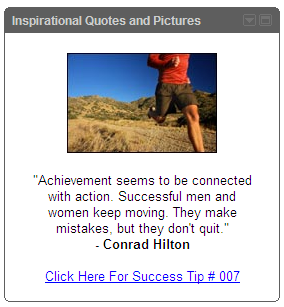
When I logged into iGoogle this Saturday morning, I was greeted by this image:

Achievement is certainly preceded by action. Yesterday, on Friday, I was inspired by the ACTION a sizeable handfull of teachers took when they embarked on the “20 minute experiment.” Explained more fully in the permalink above, Jill Gough encouraged a number of us to engage in an experiment that would synthesize: 1) some of David Souza’s brain research on primacy and recency, 2) formative assessment, and 3) tweeting as a means of forum discussion. Among several others, a ninth-grade physics teacher agreed to participate and became immediately involved. He provides a summary of how he implemented the experiment at Quantum Progress. Throughout the day, participating teachers would take a brief “commercial break” 20 minutes into class and ask students to summarize what they had learned so far. Together the class would craft a 140-character tweet to summarize their learning, and they would post to the teacher’s Twitter account with the hashtag #20minwms. As the tweets appeared, we could all see what was being learned in the participating classes. We even received a spirited and curious inquiry about what we were doing from a Director of Teaching and Learning at a neighboring school. As the day progressed, the number of involved teachers grew – a snow ball was born!

Can you imagine the potential of this process to serve as formative assessment for teachers and students? To connect the learning that occurs between and among classes? To break down the walls that exist between classes? To serve as a window into learning for parents? To archive an essence of what was happening during a day of school? To…

It is about learning, isn’t it?! It takes action, it requires some risk taking, and it certainly is fun when we do it together!