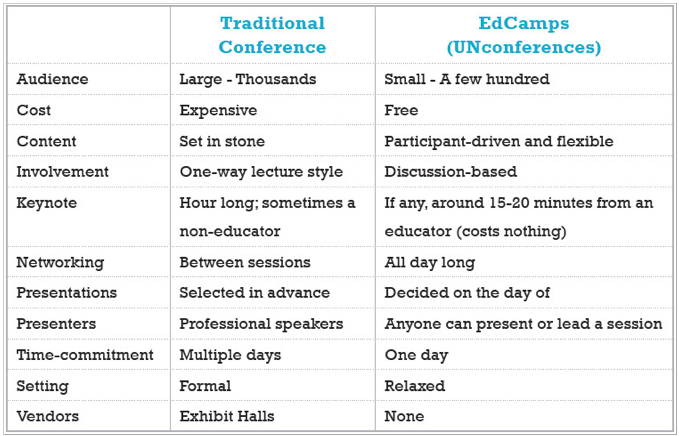
On Saturday, September 8, 2012, I attended EdCampAtl (@EdCampAtl and #EdCampAtl on Twitter). At the EdCampAtl website, one can see a table or matrix comparing the structure of a traditional conference with the workings of an EdCamp. Without a doubt, the organizers of EdCampAtl did an amazing job at delivering the system and ethos of the EdCamp “unconference.”
Nikki Robertson (@NikkiDRobertson) and Wanda McClure (@Wanda McClure) were the primary organizers, and they gathered a team they called the Fab5 to organize and host the event. These people are educators who answered the call, “If not now, then when? If not me, then who?” Realizing that no EdCamp existed in Atlanta, they set out to make sure that this city offered such an experience for interested learners. For six and a half hours on a Saturday (and countless hours before), they facilitated the gathering of teachers and administrators who want to make a difference in the education arena. And they did so with a format that allowed for democratic, spontaneous, informal participation.
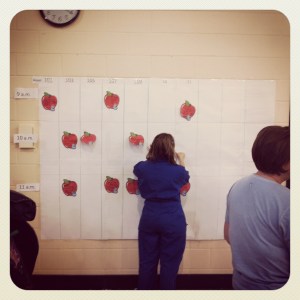 As the day began, we organized a board of session topics and offerings. There were no forms to complete before the conference. There were no acceptances or denials of session offerings prior to conference day. There was simply a blank slate for a room of educators to fill. It was up to us to make certain that we had sessions worth attending. We ended up with three, hour-long blocks that housed about seven sessions in each block. As people participated in the sessions, if they were not getting everything they needed or if they became interested in another session being discussed on the Twitter hashtag, then they could leave a session to attend another…no offense taken by the session facilitators because it’s not about the facilitators. It’s about the learners (not that facilitators aren’t learners, too).
At the beginning and end of the day, the unconference organizers had arranged for two, short, video-conference sessions – one with Skype and one with Google+ Hangouts – so that EdCamp-ers could see these tools in use, and so that we could benefit from three educators who were not physically present for the day. What a great way to demonstrate that physical presence does not have to be a limiting factor to the school day and one’s learning environment.
After lunch, a “Smackdown” event occurred. For an hour, there were 30, two-minute highlights in which anyone could take the microphone and the computer or doc-cam to show an edtech tool for the classroom or learning studio. We were carpenters sharing our favorite tools…so as to create a better toolbox for the collective. I’m not sure where the name comes from, but a Smackdown is essentially adult Show-n-Tell, which there should be more of in school!
Overall, I enjoyed the day immensely. I feel indebted to those who made such a day possible. Re-read the table at EdCampAtl to get a sense of why I might feel this way. 
I see this movement as a powerful step in the direction of widening the possibilities of the school spectrum. Nevertheless, many of my usual questions remain…
- How will the educators who attended create systemic change in the schools to which they return? They gathered some superb pollen on Saturday, but now they have to go back to their schools and make honey with their home hive. How will they do this? Will they have the support they need?
- The topics at the event seemed very tactical in nature, and they were technology heavy. I think that is the history of the EdCamp events, as I understand them. As these devoted educators return to their respective schools, will their new learning, excitement, and growth cause them to inadvertently widen the gap that might exist between them and the teachers who continue to teach in the same way that they have taught for 25 years – the same lessons, repeated annually, 25 times? Are schools considering a pedagogical master plan that orchestrates a high-level coordination among these learning and transforming efforts?
- Are we stuck in the habit of teacher-student organization? In the three morning sessions that I attended, there was a fairly traditional structure within the sessions. And I helped facilitate two of the three sessions, so I am pointing a finger at myself, too. But there was a typical pattern of one or a few people doing 80-90% of the talking and the “audience” listening. Are we such creatures of habit that this methodology seeps into our way of working – even in a venue of progressive educators? I could have kicked myself at the Smackdown. The “app” I wish I had used in the sessions I helped facilitate is the brain-based, human app of stopping at about 10 minute intervals to have people turn to a neighbor and discuss what they are learning and staying curious about. The ones doing the talking are usually the ones doing the learning, and I did not do a good job at facilitating in such a way.
- Are we facilitating such EdCamp-like moments for the students in our schools? What if, on at least some days, we created a blank-slate board on which students could post what they wanted to learn and facilitate? What if we more spontaneously and democratically and informally grouped students based on what they wanted to learn and understand better? What if Show-n-Tell remained a part of school well beyond elementary school?
Yes, I am so appreciate and grateful for Nikki, Wanda, and the other EdCampAtl organizers for stimulating and provoking such learning and thinking in me. Now, I have to do my job to systematize and share – to spread the good work. To help make the honey for the entire, collective hive.
[This post has also been published on the EdCampAtl blog.]

 it's about learning