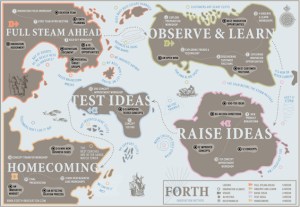
This map from Gijs van Wulfen, one of LinkedIn’s thought leaders in innovation, is worth exploring. In van Wulfen’s Nov. 12 article, “The best innovators are need seekers,” he summarizes Booz & Company’s three fundamental innovation strategies, and van Wulfen adds his own Fourth innovation method. Definitely worth exploring.
School prepares us to be successful. We aspire to be happy.
– Robert Landis, Falconer Class of 2001
We are not teaching our children, our students, and our co-workers what they really need to know. The lessons aren’t out there on some shelf or Web site. They won’t be found with more money and more programs to push more stuff in more different ways at our kids and our employees. It’s not about computer-to-student ratios, distance learning, high-speed links to the Library of Congress, or lecture podcasts. It’s not a pricey self-help guru claiming that his “new thing” is new, seven cookbook steps to success, or ten simple mileposts to make a million for your company.
Those tools help, but they are the dressing, like ornaments on a Christmas tree. We need to pay attention to the tree itself. Look at the people who invented computers, who designed the Internet, who overcame the Depression, who envisioned the best sellers, who challenged racism, who explored the ocean depths, who built the Panama Canal, who created the management-consulting firms that you hire to tell you how to run your business more efficiently. I want my children and my employees and my co-workers and my friends to exhibit qualities like invention, courage, creativity, insight, design, and vision a lot more than I want them to know the capitals of South America or the sequence of presidents and kings, fractions, computer science, art history, running a cash register, or throwing a football.
In short, I want us to spend more time teaching how to generate and recognize elegant solutions to the many problems facing our world.
School could – should – be more about generating and recognizing elegant solutions to the many problems facing our world. Content and skills could – should- be wrapped in contexts of citizenship, character, and caring. Not separate programs. Integrated programs. Systems programs.
—
What a pleasure it has been to help host Grant in Atlanta this week. After talking for almost two hours about the scope of educational transformation we envision at Unboundary, and after introducing Grant to the studio, we shot our weekly video interview – happily recorded not over Skype, but in the same room, sitting with each other.
.
Grant Lichtman’s #EdJourney Atlanta posts, thus far…
I love dreaming about the future of education. From dreams come possibilities and innovations. To stretch my own thinking, I seek inspiration from a number of sources. Frog design and TED are two of my favorites.
In the past 24 hours, I’ve thought more about data collection and dashboard display, all in the service of continuing to develop systems that visualize and enhance individual student learning. Recent inspirations for this dreaming have come from:
Advancing the Future of Healthcare: frog’s Connected Care Solution. I particularly love the images and visuals of the individual health dashboard. Where frog is showing dashboard items for blood pressure, BMI, physical activity, etc., I see a translation to education that could be dashboard items for oral communication, collaborative problem solving, and project management success.
Matt Killingsworth: Want to be happier? Stay in the moment (TED talk). In the talk, Killingsworth describes his app that collects information from a huge data set of people. In translation to education, I could see such an app being used on student smart phones, so that learners could real-time report on what they’re doing in class or at home to learn, if they are enjoying and/or benefiting from what they are doing, if they feel deeply engaged or confused or bored. That individual data could be aggregated to see a clearer picture of an individual learner’s preferences, proficiencies, etc. That data could also be aggregated on a larger set to see what types of activities are working best for various learner profiles, age groups, etc. And all of this data could feed into the dashboards imagined above.
Does any such app, data collection, and dash boarding already exist? If so, I would love for you to leave a comment and a link about what’s already out there. The closest thing I have seen personally is the data tool being developed with Khan Academy that provides individual and class data sets of learning targets, time spent on modules, etc.
Just like frog design’s CCS could reveal what’s working and what to address with a person’s health, and just like Matt Killingsworth’s app could reveal what is leading to greater happiness for folks, a comparable learning app could make tangible so much about what is working and what to address with individual learners and groups of learners.
Tidbit #1. Meghalayas Living Bridge. At Unboundary, we share what we’re learning on a WordPress system we call Foundary. This morning, in my feed from Foundary, I found this beautiful, less-than-five-minute piece (HT to Witt Langstaff) about the living bridges of Meghalaya. The story itself is mesmerizing, but the teaching and learning process is what struck me most profoundly. Field study. Project work. Actions that matter to a bigger cause. Apprenticeship and communal focus.
.
Tidbit #2. The Right Mindset for Success. This morning, walking in the rain with Lucy, I listened to a new podcast for me – I’ve recently added HBR’s Idea Cast to my morning podcast set. In this episode Sarah Green interviews legendary Carol Dweck about the Growth Mindset.
Among other morning learning, these tidbits have me thinking about what roots we’re cultivating in schools in order to bridge the gaps we face, and how we take on a growth mindset as an entire school or education system facing a world of rapid change, networked information development, and significant needs for problem and solution finding.
 it's about learning