QUILT POST: One patch… “we need to change our present concept of education” – Wendell Berry

A patchwork quilt of ideas, only loosely assembled so that you might do your own sewing and stitching. The patches are thanks to my wonderful professional learning network…

Some words – and ideas – to chew on.

The complexity of our present trouble suggests as never before that we need to change our present concept of education. Education is not properly an industry, and its proper use is not to serve industries, either by job-training or by industry-subsidized research. It’s proper use is to enable citizens to live lives that are economically, politically, socially, and culturally responsible. This cannot be done by gathering or “accessing” what we now call “information” – which is to say facts without context and therefore without priority. A proper education enables young people to put their lives in order, which means knowing what things are more important than other things; it means putting first things first. ― Wendell Berry [HT @cannonball31]

“10 Ideas Driving The Future Of Social Entrepreneurship,” Co.EXIST, Mark Cheng

And these 10 seem broader and more universal than just applying to social entrepreneurship. See the entire Fast Co. post here. Just the section headlines here… [HT @cannonball31]

  1. “It’s about changing the system, stupid.”
  2. “Change is accelerating.”
  3. “To solve our problems, we need more problem-solvers.”
  4. “It starts with young people.”
  5. “Scale through collaboration”
  6. “Technology is driving creative disruption.”
  7. “Power is moving from the few to the many.”
  8. “The silos are breaking down.”
  9. “Here comes the social entrepreneur.”
  10. “When you pass the torch on, light many fires.”

The Hard Parts, Seth Godin, blog post on April 28, 2013

Seek out the difficult, because you can. Because it’s worth it. [HT Google Reader]

Young Movers, With a Passion for Change, NYTonline, May 1, 2013

These young peacemakers challenge the standard notions many adults have about people their age. “We tend to look at young people in one of two ways: they’re either victims or potential victims we need to protect, or they’re perpetrators we need to punish. That’s our narrative. That’s our public policy,” said Eric Dawson, Peace First’s founder. “The idea behind the Peace First Prize is to offer a different narrative. That young people are peacemakers — powerful change makers.” [HT Mary Cobb]

This article is so inspiring. And it reminds me of a post I wrote not long ago about what schools grant students credit for. Some might think I am “missing the point” by suggesting that schools grant credit for such community work and independent social entrepreneurship. That such examples live in the necessary space “outside of school curriculum.” I disagree. I think the work in this article COULD BE SCHOOL CURRICULUM!

“If We Didn’t Have the Schools We Have Today, Would We Create the Schools We Have Today?” Thomas Carroll, 2000 (yep, 2000!)

(HT to @SAISNews for reminding me of the post by @WillRich45 linking to this article.)

Dewey, Self-Interest, and Community

A brief Storify archive of a Twitter discussion that is proving to be invaluable to some of my thinking and dot connecting. Thanks to this blog post: “Finland: The Lighthouse of Progressive Education and Divergent Learning,” by Kavan Yee, shared by Chris Thinnes.

(HT @KavanYee, @CurtisCFEE, @pgow, @GrantLichtman, @FredBartels)
Triangle Learning Community #NewSchoolModels @SteveG_TLC

Two years ago, at EduCon 2.4, I was privileged to meet Steve Goldberg (@SteveG_TLC). Steve is a visionary educator and activator. In August, Steve and a team of others will open Triangle Learning Community in Durham, NC.

The three-minute video below overviews the form and function of TLC. And it also serves as a catalyst for re-thinking some of our assumptions about how “school” has to be structured. I appreciate so much that Steve lives out a profound idea – humans created “school,” so we can also re-imagine it, recreate it, and remodel it.

Along with new start-up schools, though, I deeply hope that long-standing schools with lengthier histories are also re-imagining school, recreating school, remodeling school. At the very least, I hope that we are engaging in such design exercises. If they reveal that our current structure and system is the best, then so be it. But what if school could be even better?! Shouldn’t we be willing to do that research and design, so that we can know more certainly, more confidently. Not let habit and assumption blind us to possibility.


You can also learn more about TLC at the school website and Steve’s great blog.

Teaching innovation and innovating the system. #BothAnd

From Thom Markham, as read on MindShift, April 1, 2013

One overriding challenge is now coming to the fore in public consciousness: We need to reinvent just about everything. Whether scientific advances, technology breakthroughs, new political and economic structures, environmental solutions, or an updated code of ethics for 21st century life, everything is in flux—and everything demands innovative, out of the box thinking.

The burden of reinvention, of course, falls on today’s generation of students. So it follows that education should focus on fostering innovation by putting curiosity, critical thinking, deep understanding, the rules and tools of inquiry, and creative brainstorming at the center of the curriculum.

This is hardly the case, as we know. In fact, innovation and the current classroom model most often operate as antagonists. The system is evolving, but not quickly enough to get young people ready for the new world. But I do believe there are a number of ways that teachers can bypass the system and offer students the tools and experiences that spur an innovative mindset. Here are ten ideas: (emphasis added)

Read the full post here.

I think Thom’s post is excellent. The three intro paragraphs are profound and thought-provoking – and, hopefully, action-provoking. Also, I appreciate his willingness and ability to empower teachers and classroom practices. Thom’s thinking and examples resonate strongly with me and with my experience co-designing and co-implementing Synergy – a transdisciplinary, community-issues, problem-solving course for eighth graders.

But I am also left wondering about and wanting more concerted efforts to actually affect the system purposefully and intentionally, rather than feeling that our only, or most practical, choice is to bypass the system.

How are you and the schools with which you are involved systematizing the learning of innovation? All of us – in education, in for-profit business, in non-profit organizations beyond education, and in our personal lives and families – should be more focused on such questions, issues, and solutions. The citizens can affect such change and impact current and future quality of life – if we commit to doing so. Of the people, by the people, for the people enables us to do so. We can affect the system. The system is made from us, by us, and for us. If not us, then who? If not now, then when?

#MustRead Shares (weekly)

Posted from Diigo. The rest of my favorite links are here.

Visualizing instruction in our school ecosystem #PedagogicalMasterPlanning

A major aspect of Pedagogical Master Planning involves generating an “as-built set of blueprints” for a school’s pedagogical ecosystem, so that a school can see itself in ways it likely never has before. The pedagogical ecosystem is comprised of the interconnected sub-systems of 1) purpose, 2) leadership, 3) professional learning, 4) instruction, 5) curriculum, 6) assessment, and 7) learning environments.

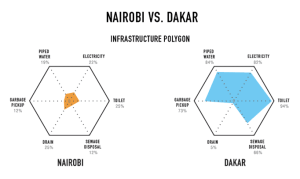
One way we are conceptualizing the as-built blueprints involves the use of “infrastructure polygons,” inspired originally by Candy Chang’s work.

Screen Shot 2013-04-24 at 2.57.16 PM

In this example, in which Chang visualizes the contrasted city infrastructures in Nairobi and Dakar, one can quickly see that Dakar possesses a much higher density of piped water, electricity, and toilets than Nairobi. For example, about 19% of Nairobi’s population has access to piped water, compared to 84% of Dakar’s residents.

Recently, TED uploaded Jessica Green’s TED2013 talk, “We’re covered in germs. Let’s design for that.

As another great example of using info-graphic polygons, Green employs these visualized data tools to compare and contrast the microbes in various rooms in a building. (You should watch the talk, just to see how this method of data visualization works. It’s fascinating.) The information polygons make it easy to see how classrooms compare with offices in terms of microbial “footprints” or profiles. [Stick with me if that last sentence made you want to click to the next post in your feed reader or email!]

With Pedagogical Master Planning, a dimension of the Discover phase involves capturing information about instructional methodology. Through classroom observation, interviews, self-reporting, etc., we collect data about instructional modes like lecture, lecture and discussion, demonstration, simulation, case study, PBL, role play, graphical creation, etc. After aggregating the data, we can visualize the information using polygons similar to those used by Chang and Green.

Imagine a polygon put to use as an info-graphic that summarizes the instructional methodologies used throughout the school. In a very oversimplified example, one might show that 78% of instructional time is spent in lecture, 11% in demonstration, 5% in case study, and 6% in graphical creation. What invaluable information for a school that is working strategically to become more student-centered and student-directed in its pedagogical approach.

And imagine the power of such visualization in an actual school situation. We could potentially visualize the following:

  1. A student’s user experience as an individual throughout a day. Such an info-polygon could show the instructional modalities that “Suzie” experienced in a day of attending classes. Or a week, or a month.
  2. A particular department’s aggregated picture of instructional methods. Such a picture might reveal strengths in a department so that members of that department become mentors in that methodology for other departments less familiar in practice with that mode. It might also reveal areas for targeted professional development.
  3. An ability to overlay instructional methodology polygons with learning environment set ups (e.g., seating arrangements like seminar, cooperative, senatorial, etc.). Internal action research could be conducted regarding how modifying the classroom layout influences instruction over time.
  4. An in-depth look at how the predominant instructional methods relate to desired outcomes in certain skill sets such as the so-called “Cs” of 21st C learning – communication, collaboration, creativity, critical thinking, etc. Wouldn’t it be interesting to see how much time students actually have to BE primary communicators in a week of school, if the school believes it wants to help students develop advanced capabilities in various communications. [Think about the 10,000 hour rule of developing mastery. Do you know how much time students actually spend practicing these skill modalities?]
  5. Time studies for a school, showing how their instructional methods evolve over time once they become more systemically engaged in studying something like this as a school working to shift or enhance a culture of diversified pedagogy.

Such ideation around information polygons and “as-built blueprints” are only one piece of the potential for Pedagogical Master Planning. By being able to see more clearly what is happening in the actual pedagogical ecosystem, a school can be more strategic in developing it’s integrated sub-systems for the learning that can happen. Being able to see provides clarity from which to plan for innovation and development. Being able to see can help reduce resistance as people are able to gain greater understanding about the current reality of instructional methods used compared to the desired learning outcomes for students. It’s a bit like turning on the lights in a darkened room. The light shed on the situation helps us navigate more agilely and purposefully. We’re less likely to need to shuffle our feet slowly and wave our arms in from of us to keep from running into something unexpectedly.