#MustRead Shares (weekly)

Posted from Diigo. The rest of my favorite links are here.

Visualizing instruction in our school ecosystem #PedagogicalMasterPlanning

A major aspect of Pedagogical Master Planning involves generating an “as-built set of blueprints” for a school’s pedagogical ecosystem, so that a school can see itself in ways it likely never has before. The pedagogical ecosystem is comprised of the interconnected sub-systems of 1) purpose, 2) leadership, 3) professional learning, 4) instruction, 5) curriculum, 6) assessment, and 7) learning environments.

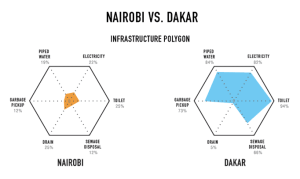
One way we are conceptualizing the as-built blueprints involves the use of “infrastructure polygons,” inspired originally by Candy Chang’s work.

Screen Shot 2013-04-24 at 2.57.16 PM

In this example, in which Chang visualizes the contrasted city infrastructures in Nairobi and Dakar, one can quickly see that Dakar possesses a much higher density of piped water, electricity, and toilets than Nairobi. For example, about 19% of Nairobi’s population has access to piped water, compared to 84% of Dakar’s residents.

Recently, TED uploaded Jessica Green’s TED2013 talk, “We’re covered in germs. Let’s design for that.

As another great example of using info-graphic polygons, Green employs these visualized data tools to compare and contrast the microbes in various rooms in a building. (You should watch the talk, just to see how this method of data visualization works. It’s fascinating.) The information polygons make it easy to see how classrooms compare with offices in terms of microbial “footprints” or profiles. [Stick with me if that last sentence made you want to click to the next post in your feed reader or email!]

With Pedagogical Master Planning, a dimension of the Discover phase involves capturing information about instructional methodology. Through classroom observation, interviews, self-reporting, etc., we collect data about instructional modes like lecture, lecture and discussion, demonstration, simulation, case study, PBL, role play, graphical creation, etc. After aggregating the data, we can visualize the information using polygons similar to those used by Chang and Green.

Imagine a polygon put to use as an info-graphic that summarizes the instructional methodologies used throughout the school. In a very oversimplified example, one might show that 78% of instructional time is spent in lecture, 11% in demonstration, 5% in case study, and 6% in graphical creation. What invaluable information for a school that is working strategically to become more student-centered and student-directed in its pedagogical approach.

And imagine the power of such visualization in an actual school situation. We could potentially visualize the following:

  1. A student’s user experience as an individual throughout a day. Such an info-polygon could show the instructional modalities that “Suzie” experienced in a day of attending classes. Or a week, or a month.
  2. A particular department’s aggregated picture of instructional methods. Such a picture might reveal strengths in a department so that members of that department become mentors in that methodology for other departments less familiar in practice with that mode. It might also reveal areas for targeted professional development.
  3. An ability to overlay instructional methodology polygons with learning environment set ups (e.g., seating arrangements like seminar, cooperative, senatorial, etc.). Internal action research could be conducted regarding how modifying the classroom layout influences instruction over time.
  4. An in-depth look at how the predominant instructional methods relate to desired outcomes in certain skill sets such as the so-called “Cs” of 21st C learning – communication, collaboration, creativity, critical thinking, etc. Wouldn’t it be interesting to see how much time students actually have to BE primary communicators in a week of school, if the school believes it wants to help students develop advanced capabilities in various communications. [Think about the 10,000 hour rule of developing mastery. Do you know how much time students actually spend practicing these skill modalities?]
  5. Time studies for a school, showing how their instructional methods evolve over time once they become more systemically engaged in studying something like this as a school working to shift or enhance a culture of diversified pedagogy.

Such ideation around information polygons and “as-built blueprints” are only one piece of the potential for Pedagogical Master Planning. By being able to see more clearly what is happening in the actual pedagogical ecosystem, a school can be more strategic in developing it’s integrated sub-systems for the learning that can happen. Being able to see provides clarity from which to plan for innovation and development. Being able to see can help reduce resistance as people are able to gain greater understanding about the current reality of instructional methods used compared to the desired learning outcomes for students. It’s a bit like turning on the lights in a darkened room. The light shed on the situation helps us navigate more agilely and purposefully. We’re less likely to need to shuffle our feet slowly and wave our arms in from of us to keep from running into something unexpectedly.

Dad, testing is affecting my bladder and my play! #TrueQuote

State testing is impacting my second grader’s view about the Georgia Criterion-Referenced  Competency Test (CRCT) and high-stakes standardized testing, in general. [And I promise I keep my personal and professional rhetoric on this topic to a minimum at home!]

This morning, PJ told us that they are not allowed to use the bathroom from 8:00 a.m. – 11:00 a.m. because of the CRCT testing, which second graders at PJ’s school don’t take officially. But the rest of the school is on “testing lockdown.” Additionally, he said that his teacher announced that recess would resume on next Monday, after the CRCT is completed. Now, I know I should not base my entire understanding on the perceptions of a second grader. There is some perspective-skewing, I’m sure. But still!

My eight year old is now imprinted with the idea that CRCT takes away his bathroom and recess. That stinks!

He’s certainly learning some lessons from state testing, and he has not even taken a test segment yet.

#JustAnotherDropInTheBucketForReExaminingTheSystemWeCreated

#WeSayWeWillDoWhateverIsBestForTheKids

#DoWeReallyMeanIt

Chris Thinnes offers a much more eloquent parental response here and here. I’ve added Chris’ posts to this post after the original publication. Chris’ sharing will certainly help me to be a better parent in such family decision making in the future. Thank you, Chris.

Building a fragmented ‘non-system’ of well-meaning, specialized programs

Twenty-two years ago [now 25], while analyzing why so little of what is known to work gets applied in practice, Lisbeth Schorr wrote of “traditions which segregate bodies of information by professional, academic, political, and bureaucratic boundaries” and a world in which “complex intertwined problems are sliced into manageable but trivial parts.” Around the same time, Sid Gardner wrote that “we end up contributing our money, and more important, our political and spiritual energy, to building a fragmented ‘non-system’ of well-meaning, specialized programs.” Sadly, both observations are still true today.

From A KIDS COUNT Special Report from the Annie E. Casey Foundation – Early Warning! Why Reading by the End of Third Grade Matters. 2010.

PROCESS POST: Putting it all together OR Mood board for school=life

When I talk to people, it is highly likely that I will end up sharing something that I have been contemplating and studying for years. I just can’t help it. It usually emerges in, at least, one of two forms…

If school is supposed to prepare kids for real life, then why doesn’t it look more like real life?


School, in its current form, is a profound interruption from our natural ways of learning as humans.

Think of how children tend to learn before formalized schooling. Picture the events of childhood learning – to crawl, to walk, to talk, to play, etc. Now, picture “school.” In what ways do your two mental-imagery exercises match and differ?

Repeat for the learning that typically happens after formalized schooling, during our adult lives. How do your mental images compare?

I’ve shared here before that my own sons did not “disaggregate” their explorations and learnings about the world until they started formalized schooling. In other words, it wasn’t until school that PJ started to say things like, “Oh, that’s math.” Or, “that’s language arts – that’s not math.” Before school, all of the learning was more integrated and holistic. When he could start to put it in rooms, some doors closed.

Two posts caught my eye just moments ago – one on Twitter and one on Edutopia’s blog. I think they help illustrate the idea of re-blending ways of knowing and integrating various capabilities. I think they provide elements on a mood board for re-imagining school and how to blur the lines between school and real life.

Here’s the first – a tweet from SciencePorn:

Screen Shot 2013-04-23 at 11.15.54 AM


Here’s the second – a post from Shawn Cornally (@ThinkThankThunk) on Edutopia. To whet the appetite for a full click on that link, I offer a few quotes that resonated with me.

As the media coverage and administrative spotlight is turned on these new benchmarks, I’d like us all to keep the following in mind: Engagement trumps all.


we have millions of children in schools learning things on narrative arcs that they had no part in authoring.


As more and more references to STEAM (Science, Tech, Engineering, Arts and Math) flood my Twitter feed, I can’t help but wonder how long until we all realize that lessons go where they will, which results in unplannable but reflectable STEHALM (Science, Tech, Engineering, History, Arts, Language and Math) experiences.

Isn’t that great! STEHALM could be letter labels in that photo of the PDA + the video camera + the laptop + the watch + the beeper + the cell phone + the Polaroid + the Walkman. Just two representations of the same overarching idea(l).

When will we act to make “school” more like that iPhone, instead of carrying around the discreet elements as separate and disaggregated pieces? Even if we subdivided the day and did some of each – integrated project-based learning where challenges and issues drive the agenda, as well as some time for exercising the disciplinary lenses sparked by those authentic explorations – I believe we would be moving in a right direction to help make school more life like.

= = =

Thanks to those who inspired with those posts!