“I am slowly learning to embrace the struggles that students experience as they engage with authentic work. If I don’t allow learning to be messy, I eliminate authentic experiences for students as thinkers and creators. I find it important to regularly remind myself that frustration leads to insights and that learning is not necessarily the equivalent of mastery.”
Principal Ken Schlaff explains that 10th graders spend three hours a day in a project-based learning class, where they explore cross content in chemistry, language, and world history
Three teachers, experts in each content area, teach the class collaboratively, all sharing a common prep time.
“Few things leaders can do are more important than encouraging helping behavior within their organizations. In the top-performing companies it is a norm that colleagues support one another’s efforts to do the best work possible. That has always been true for pragmatic reasons: If companies were to operate at peak efficiency without what organizational scholars call “citizenship behavior,” tasks would have to be optimally assigned 100% of the time, projects could not take any unexpected turns, and no part of any project could go faster or slower than anticipated. But mutual helping is even more vital in an era of knowledge work, when positive business outcomes depend on creativity in often very complex projects. Beyond simple workload sharing, collaborative help comes to the fore—lending perspective, experience, and expertise that improve the quality and execution of ideas.”
Bill of Rights for Self-Determined Learning via @BombayScot [note to self: interesting serendipity this morning w/ re-discovering McIntosh essay on privilege]
President of NAIS, John Chubb, looks at Hillbrook iLab and other learning spaces – concludes that it’s not even as much about the space as it is about student choice driving the learning engagement and pedagogy. Environment is a third teacher in establishing such student-driven exploration and ownership of learning.
The transformation from educational institutions to learning flows is profound and disruptive, and no existing institution will have the luxury of remaining unchanged. Such transformation requires us to rethink all of the assumptions, structures, and principles that have worked thus far. It also raises a new set of questions and challenges that educational institutions, learners, and our society as a whole will have to grapple with.
On wait time, the nature of questions, visible thinking, formative assessment and deeper learning:
A particular feature of the talk between teacher and pupils is the asking of questions by the teacher. This natural and direct way of checking on learning is often un-productive. One common problem is that teachers do not allow enough quiet time so that pupils can think out and offer an answer. Where, as often happens, a teacher answers her or his own question after only two or three seconds, and where a minute (say) of silent thought is not tolerable, there is no possibility that a pupil can think out what to say. There are then two consequences. One is that, because the only questions that can produce answers in such a short time are questions of fact, these predominate. The other is that pupils don’t even try to think out a response—if you know that the answer, or another question, will come along in a few seconds, there is no point in trying. It is also common that only a few pupils in a class answer teachers’ questions. The rest then leave it to these few, knowing that they cannot respond as quickly and being unwilling to risk making mistakes in public. So the teacher, by lowering the level of questions and by accepting answers from a few, can keep the lesson going but is actually out of touch with the understanding of most of the class—the question-answer dialogue becomes a ritual, one in which all connive and thoughtful involvement suffers.
There are several ways to break this particular cycle. They involve giving pupils time to respond, asking them to discuss their thinking in pairs or in small groups so that a respondent is speaking on behalf of others, giving pupils a choice between different possible answers and asking them to vote on the options, asking all to write down an answer and then reading out a selected few, and so on. What is essential is that any dialogue should evoke thoughtful reflection in which all pupils can be encouraged to take part, for only then can the formative process start to work.
Inside the Black Box Raising Standards Through Classroom Assessment Paul Black and Dylan Wiliam
In those few sentences above, one can find some of the simplest and easiest methods to transform teaching and learning in significant and profound ways.
If you spend time visiting and observing classrooms in this country, you know that we all can improve on the methods suggested above.
= = = = = = = = = =
NOTE: Just about everything that I have read about assessment in the last decade references and/or connects in some way to Black & Wiliam’s article “Inside the Black Box.” Yet I wonder how many educators have taken the time to read it, study it, and strive to implement it. And, I do not mean to sound accusatorial. I genuinely wonder.
If school is supposed to prepare kids for real life, then why doesn’t school look more like real life?
This question lives at the heart of my research for the past decade. This question largely drives my work.
Many people ask me, “So, Bo, what do you mean by ‘real life?'”
Well, one aspect of blurring the lines between school and real life involves reimagining the kind of work that students engage in during their school experience. What if more of the student work had real-life application? What if more of the student work were aimed at targets well beyond the grade-book columns and end-of-year locker clean outs?
For example, what about the question, “Paper or plastic?” You know – at the grocery store. How should we respond to that question at the conveyor-belted check-out counter? (If, of course, we don’t bring our own reusable bags.)
From that question, a group of student designers and solution seekers might find themselves on a path leading to the investigation of the refrigerator and the crisper drawer.
“What?!” You might ask. What if student-learners actually worked on product design for such things as refrigerators, water boilers, etc.? What if students really knew the best answers to “Paper or plastic?”
Student-learners engaging in real-life work that goes well beyond a grade in a grade book and provides the weave-work and relevancy hooks that integrate and amplify the core purposes of our school-segregated subject areas. Work that recognizes and respects the systems of which our products and our persons are all parts of the whole…
If you’re connected to a school in Atlanta, GA, and if your school name is on some local news channel today with the word “Cancelled,” are you considering it a…
#Snowcation, or a
#Snopportunity?
It’s fascinating to me how many schools have discussed for years such topics as “21st Century Education,” “Blended Learning,” “Virtual Learning,” “Online Learning,” “Digital Learning,” “Connected Learning,” etc., yet when a would-have-been-in-school-anyway Tuesday turns into a snow day, so many at the school see the day as a day off from school-connected learning.
Perhaps it’s due in some way to the language one’s school uses. For sure, a #Snowcation communicates a very clear cultural expectation about the relevancy of school-connected learning when the school people don’t actually meet in the same physical space because of some winter-weather occurrence. On the other hand, to say that “learning is open” even if school is closed communicates an altogether different way of believing. As Peter Block said, “All change is linguistic,” and a school community’s language – even in the seemingly small moments – can either promote the status quo or dynamism.
Perhaps it’s due in some way to the culture of innovation that’s been created and nurtured (or not) at one’s school. I mean, after all, a snow day is a day to kick the feet up and forget about school, right? Because that’s the way it’s always been. Or it could be an opportunity – a #Snopportunity – for a school that’s deeply invested in leading into the future of education — to “ooch” (as the Heath Brothers describe it in Decisive) some possibilities and prototypes for school-connected learning, even when the school community is not gathering at the same physical campus for the day.
Of course, when a school regularly practices design thinking and iterative prototyping, it becomes relatively easy to see a snow day as a chance for extraordinary research and experimentation – all in the “ordinary” way that the school usually approaches windfall chances to learn and create and enhance common practice. Such has become a part of the school’s (Innovator’s) DNA.
And for a school that not only pays attention to the research and development of educational practice, but also contributes to it, it comes as no shock or surprise that the future of education is about learning flows and not just the physical campuses of school houses. So, when a snow day occurs, such a school sees and seizes opportunities to further a deepening understanding of how school and learning can be brought even closer together as ever-eclipsing Venn circles.
I feel genuinely blessed to serve at such a school. And I feel an obligation and responsibility to share our practices – the practices of an entire community of professional learners, innovators, and extraordinary educators.
Sharing Mount Vernon’s Practice
Systemic Communication from Division Heads & Directors of Teaching and Learning
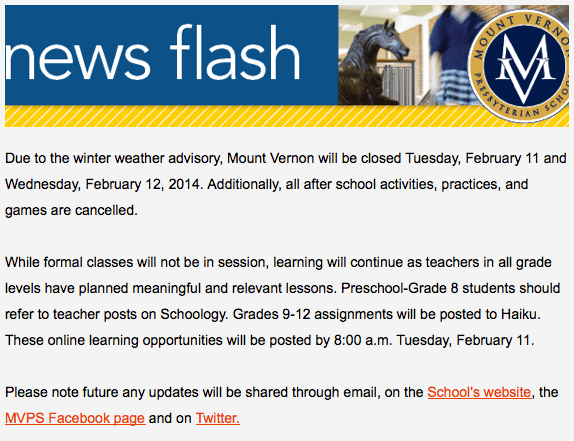
High-value communication and collaboration happen regularly within and among the divisions at Mount Vernon. And the educators act as a team, moving strategically together. So, when the decision was finalized to close the school campuses for Tuesday and Wednesday, the Division Heads and Directors of Teaching and Learning distributed communiques to the faculty. Below is one such message from our Upper School Dean of Academics and Director of Teaching and Learning.
On Feb 10, 2014, at 5:10 PM, Emily Breite wrote:
Hello everyone,
I trust you have seen the news that Mount Vernon’s buildings will be closed tomorrow and Wednesday in the interest of safety. However, as Tyler outlined in his earlier email, we will still treat these days as learning days with the expectation that our students be demonstrating their learning and that we be available to support them as they do so.
Instructions for Faculty and Students:
1. Students will continue with learning exercises and assignments that teachers have posted on haiku by 8 am on Tuesday morning at the latest. Those can be due virtually while we are away or can be due when we return to school. Given that most of the ice is expected on Tuesday evening (from what I hear), it may make sense to have some work due to you by the end of the day Tuesday.
2. For each day that we are away from the building, teachers will hold two face-to-face sessions through Google Hangouts for 5-10 minutes for each of their preps at some point before noon to communicate about the learning plan for each day and to answer student questions. Holding two sessions will allow us to handle the capacity of Google Hangouts (15 people can hangout together at a time) and minimize conflicts for students.
You could also break this up into 5-10 minute chunks over four hours, if that works better for your situation. Obviously this will be a bit of an experiment and we will not be giving students official absences or tardies, but I do think we need to make sure students know that this sort of virtual interaction is the expectation and to follow up if they do not engage. (Again, if there are widespread power outages, hangouts may not be possible.)
If you have a special situation that would prevent you from being able to engage with students for 5-10 minutes a few times each day, chat with your Head of Grade and me about a solution. One idea might be to make a little video (capture is one app you can use) to give students an overview of what they’ll be doing and then being accessible via email. A little bit of face-time is the goal.
Below is Mikey’s how-to video for facilitating Google Hangouts and he sent a few from Trey just a few minutes ago.
Thank you for all of your efforts to help us make use of these days. Stay safe!
Emily
Google Hangouts
Even before the above messages were fully crafted and sent, other internal communications at Mount Vernon were bouncing around to provide support and coordinated understanding around our approach to this #Snopportunity.
For example, as mentioned in Ms. Breite’s message, our Director of IT and our Creative Director established resources for faculty wanting to capitalize on Google Hangouts:
Team,
In case of inclement weather, Google Hangouts On Air are a great tool for connecting with students virtually. I have created three video tutorials around Hangouts On Air and a video on the general philosophy of Hangouts and the classroom.
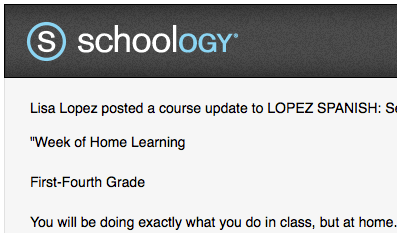
Because Mount Vernon regularly employs the MiddleburyInteractive program to create a blended learning environment for world language instruction, student learners were able to engage various elements of their language acquisition, just as they do when they are in the school house.
Screenshot of a small portion of a thorough Schoology post from a Spanish teacher.
Learning Management Systems (LMS) – Haiku, Schoology & Orchestration
In a recent leadership podcast from Andy Stanley, Stanley details the importance of striving for clarity in the face of complexity. One way Stanley explains that a complex organization can promote clarity is to “orchestrate and evaluate” – to routinize certain processes and procedures while being diligent and committed to constantly evaluating and bettering those routines.
For my sons, in first and third grades, school-connected learning at home (a.k.a. “homework”) benefits from the routine of Schoology. (As noted above, the Upper School uses an LMS called Haiku.) Each week, long before Monday, my sons’ teachers post the week’s homework outlines and expectations. Because of this technology-enhanced routine, we could continue on today, even during our #Snopportunity.
Third Grade
We are a School of inquiry, innovation, and impact. Grounded in Christian values, we prepare all students to be college ready, globally competitive, and engaged citizen leaders… Even on snow days! As you have heard, school is closed, but learning remains open! We are excited to share some learning opportunities for you and your child to enjoy together.
Literacy
Reading: Read your fantasy book and log your reading. You should be reading a minimum of 30 minutes each day. Read with your pencil in hand to help process the story’s information. Jot down major ideas, happenings, plot twists, character strengths, etc. as you read. Bring your notebook back to school to share with your reading partner.
Writing: Write out loud! “Story tell “ your final totally made up fairy tale to a parent, sibling or friend. Remember to use your storyteller voice thinking about what your characters are saying and doing. Plan through the beginning, middle, and end of your story. Use your parent as a writing partner! What feedback can you glean from them?
Spelling: The students have a prefixes study guide in their homework folders. They should be reviewing the meaning of a morpheme, prefix and base word. They should also review our weekly red words (iron, honest, honor, guess, guest, guard). Complete the Prefix Word Hunt with your family. Brainstorm words that begin with dis, un, pre and in/im. Please bring the word hunt back to school to share with your classmates.
Math
Continue to explore division:
review math facts and complete Practice 8-2 (check handouts from backpack)
Complete the Daily Spiral Review for 8-3 (check handouts from backpack)
Please continue to work on multiplication and division facts with flashcards, iXL and other sites like www.iknowthat.com.
Complete: iXL F.3, F.5 (Multiplication 2s and 4s), G.5, G.6 (division facts to 12 and division patterns)3, F.5 (Multiplication 2s and 4s), G.5, G.6 (division facts to 12 and division patterns)
Design Thinking Challenge (Snow Jam emergency car kit)
Finish either making your “low resolution” prototype or drawing. Remember to add length measurements so we can get the right scale. Bring in drawings and/or prototypes.
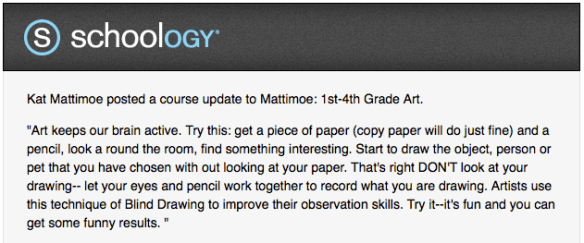
And because the faculty are well-practiced in connected learning, they are accustomed to online-enabled interactions with the children. For example, when the art teacher Ms. Kat posted this #Snopportunity for drawing, I so enjoyed watching my email notifications “light up” with the conversation threads happening among Ms. Kat and her students as they traded stories and coaching about what they were drawing around their houses.
Twitter
Of the 145 faculty and staff at Mount Vernon, about 120 are users of Twitter. So, a snow day does little, if anything, to deter the connected learning and communication among our community of educators. By searching the hastag #MVPSchool, you can see some of the interactions and exchanges that have happened as collective habits of minds engaging this #Snopportunity. As another example, you could peruse a Storify that details another #CarpeOpportunity moment two weeks ago during the snow and ice that hit Atlanta during the last days of January.
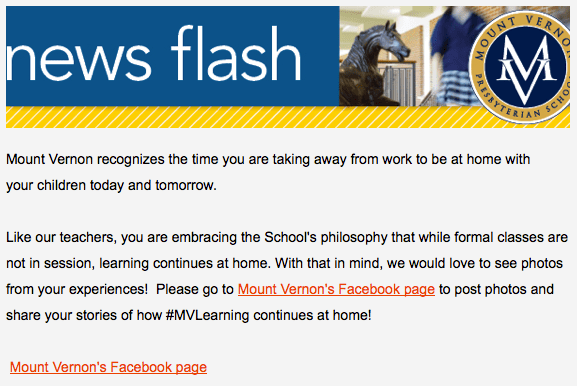
These are but a few of the ways that Mount Vernon calls on its Innovator’s DNA to take advantage of a #Snopportunity. In closing, it’s also worthwhile to see how our Communications Team encourages school-connected learning at home to be shared and showcased among our community…

 it's about learning