“Bright Spot on Flexible Faculty Forum” Guest Post: Sally Finch

When Dr. Roger Bannister broke the four-minute mile, numerous other runners soon ran through the opening that he cracked in an apparent barrier. Perhaps we have a similar situation here. Thanks, to Jen Lalley, the 112-day wait time paid off, and It’s About Learning enjoyed it’s first Junior-High-faculty guest post. Now, Sally Finch has offered up an email that she sent to Dean of Faculty Thad Persons. THANK YOU to Jen and to Sally for their willingness and courage – to share with a broader audience.

Thad:
I loved the ease of registering on the multi-colored spreadsheet!  It was so user-friendly and made so much sense.

I just read Bo’s blog about how he and Jill changed topics at the last minute and got a whopping increase in attendance.  This kind of flexibility for Faculty Forum, with an “expert” speaker working along with us, and with us teaching each other, is the best kind of choice for getting back to school.  Even those sessions I could not attend but wanted to (Sophie is just across the hall from me) can be an asset in the future.

The flexibility made it possible for Marjorie and me to work together on economics, and that was especially helpful since Jay was on jury duty.  I was getting a little nervous about the technology before Thursday, but feel much better now that I have taken some baby steps on some new things and know that I have lots of folks around to help.

Thanks for a great two days.
Sally

People often pick up the phone or pound on the e-mail to complain. Fewer (it seems) take opportunity to communicate about a bright spot. For instance, we call the help desk when technology is frustrating us, and we call Georgia Power when the power shuts down. How often do we call to say, “Things worked great today! Thanks for providing the tools and the electricity!” Such positive feedback goes a long way to building a record of what works, what helps, and what needs to continue. Thanks, Sally!

Let’s Know Our Campus & Getting the Wind Back in @clarkbeast

First, I hope you will read these two posts from @clarkbeast (they are brief in length and powerful in message):

“like a punch in the solar plexus”

“a simple vision”

I truly don’t have time to draft and publish a post this morning. By prioritizing this writing, something else important to the start-of-school is not getting done right now. However, a faculty member has inspired me to respond and support. As a true believer in formative assessment and community collaboration, I would be acting irresponsibly if I were slow to respond this morning. Additionally, what middle-school learning could be more important than a place-based education for our children? They should know their world, and that can begin with the very world around them…a world that we are fortunate and blessed to occupy with nearly 200 acres in the heart of Buckhead, Atlanta, Georgia.

This morning, I was following my routine of reading a few blog posts. I was concentrating on my folder of “Blogs-Colleagues.” In the past few days, it appears that @clarkbeast has been reflecting even more than usual on the delicate balance between our charge with technology and our critical need to attend to our natural world. Moreover, @clarkbeast has posted a response (same as second link above) to a call for #PBL ideas (link to Keynote on PBL…sent before 8-11-11 JH fac mtg). The intentions for our 8-11-11 JH faculty meeting took a different turn, and we discussed some questions that were not on the agenda. Therefore, we were not able to act with the #PBL ideas that people were asked to bring to the meeting. I am so thankful that @clarkbeast used his blog to ensure that the conversation did not end with a change-of-course-faculty-meeting.

On a related note, as I was playing around campus – in Nancy Creek – with my two boys, I snapped a few pictures and posted to my Posterous blog (such is now a habit with us). To the three Adams boys’ great pleasure, @clarkbeast responded to a post and got us excited about a potential stream exploration (click link to read that quick exchange)!

How can we better know our campus – our 200 acres of Atlanta, GA? What can we do to understand the natural world which is our very own school backyard? In what ways can we use our campus to study the essential learnings present across the departmentalized curricula?

I hope the JH will undertake this challenge this year. We have some superb feet in the door already – past bright spots to build on and improve. What’s best for the children? We need to get outside!

“Out of the Egg Crate” Guest Post: Jennifer Lalley

Last spring, I “offered my blog” to any and all Junior High faculty who might want to guest post. I thought it might be one small step on the journey of trying something new and thinking out loud with a public reflection – for some, like trying on clothes before deciding what to buy. Then, I waited. And waited.

Wait time is an invaluable tool in the educator’s tool kit, eh? (pronounced “A” and in honor of @gcouros). Since I extended the invitation, 112 days have gone by.

But learning is the constant – we should guarantee that people will learn…at high levels. Time and support should be the variables.

Thanks to the support offered at Faculty Forum, and perhaps some other support I am unaware of, a Junior High faculty member has submitted a guest post. Many thanks to Jennifer Lalley for taking this opportunity.

It’s the beginning of a new year, and we are all frantically trying to keep track of the influx of information coming our way. However, something about this year feels different for me (Jen Lalley). At the moment, I feel more energized than overwhelmed. Yesterday in the faculty meeting, I felt thankful for the time and space to speak openly and honestly about the changes here at Westminster. Although it’s hard, it’s valuable to have differing opinions on how technology is affecting our students and our classrooms. I left our meeting wanting more discussion. Can we continue it here?

Some of the themes thrown out…

– How do we find balance with screen time/non-screen time?
– How do we communicate to parents what we are doing in school?
– What is valuable about “traditional” teaching, and what needs revision?
– How is technology transforming pedagogy?

As said in the meeting, I echo how all of this boils down to “learning and sharing.” To me, that’s the reason we blog, MOODLE, tweet, journal, etc. Honestly, there are times when I’m working with other teachers when my individual spot in the “egg crate culture” seems nice and cozy and warm. It’s safe there, and I can move at my own pace.

There’s a problem with that statement, ”at my own pace.” It’s not really about me. It’s about the students. The moments I venture out of the egg crate have made me sharper, and most importantly, have engaged my students on a deeper level.

Great NYT Piece: “Education Needs a Digital-Age Upgrade”

Thanks to colleague Mary Cobb, who shares with me what she is reading, I explored this “Opinionator” commentary from Virgina Heffernen (click or tap on image below). I thought Heffernen’s piece provided a strong summary of the 21st-century-education argument. [Also, I was reminded of a post I wrote a few months back, and I was thankful to have that reflection recorded (one of the reasons “Why to blog?” discussed at yesterday’s Blogging as Digital Portfolio session).] With appreciation on my part, Heffernen captures that the industrial model of education is not necessarily working for many; however, 21st century education resembles classical education and a return to the past, as much as a forecast to the future. What we hope for students is a blend of the traditional methods that have proved effective, combined with innovative learning that can reach a developing brain being reared and “envionmentalized” today.

FedEx Session: Blogging as Digital Portfolio

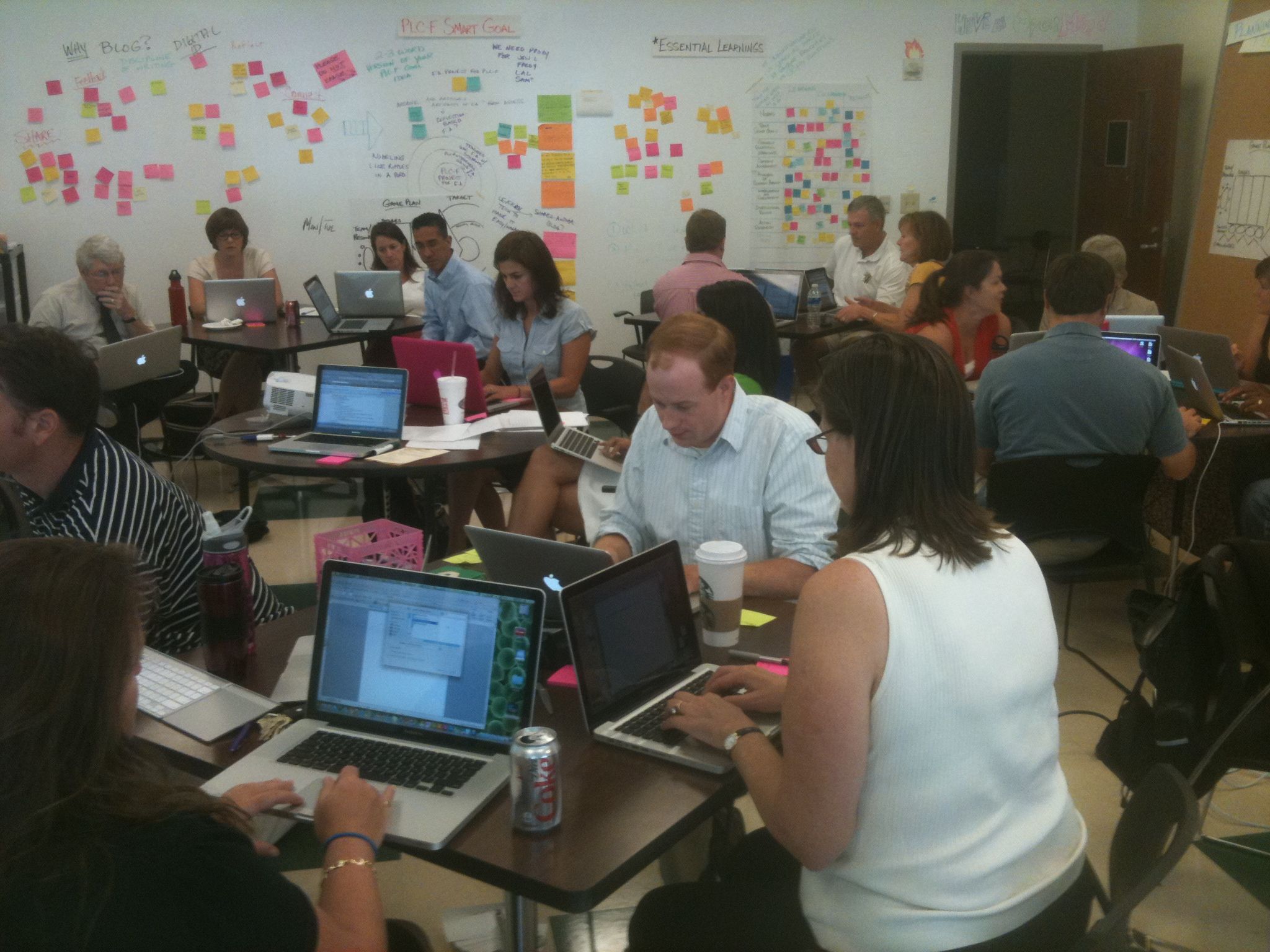
Today, as part of Westminster’s Faculty Forum, we are working in a “FedEx Day” format. Several faculty created workshops for which people could register. Various other faculty organically gathered into groups to co-labor on particular projects. Here’s a small sample of the workshop titles:

Jill Gough and I hosted a session on “Blogging as Digital Portfolio.”* Our framework plan looked like this:

  • Why to blog?
  • What to blog?
  • How to blog?

We began with a post-up gamestorm in which people recorded reasons why to blog. Each of these ideas was recorded on a Post-it note, and we posted the notes to our idea wall.

Then, we used an affinity map gamestorm to gather related Post-it notes and categorize our thinking.

Next, we used Poll Everywhere to gather some data and assess our participants:

The discussion was great, and people contributed mightily to our collective understanding about why people might blog…and what can get in the way.

In order to dive into the “What to blog?” section of our game plan, we used a Google Doc for collaborative brainstorming: http://bit.ly/py3yvb.

Finally, we walked through the steps of actually establishing a blog on our WordPress Multi-user Domain. We encountered some technical difficulties with the confirmation-email process, but our group found ways to positively engage. Some wrote practice drafts of blog posts using Word and Pages. Others drafted a directions/instructions document about what we had done in the session. A few others even split into teams for a cooperatively competitive contest about taking the “30 Day Challenge” for posting once a day for a month…to get in the habit (posts might be as short as a sentence or an image-and-question combo).

Of course, with @gcouros here, we had access to a great resource from him, too: http://bit.ly/hlmym9

Now, as I wrap up this post, there are some stragglers here still working…still learning. It’s 11:55 a.m., and we are having fun learning and working together.

* FOOTNOTE: Interestingly, Jill and I had planned a session on PBL. On Thursday afternoon, we realized we had a small list of registrants. Because of the enthusiasm over digital portfolios – generated the day before – we decided to use this formative assessment to shift our workshop plan. Our three, original registrants were very understanding and flexible, and we ended up with a full house – about 24-25 folks.