PROCESS POST: Contemplating innovation, homework, practice…and their intersections. +Awe. Iteration Two.

We have a responsibility to awe.

What if the molten foundations of K12 “homework” – if we must give it – were poured into and formed by the molds and casts of the Innovator’s DNA verbs?

  • Observe
  • Question
  • Experiment
  • Network
  • Associate

How might we better nurture our learners’ responsibility to awe? Our own responsibility to awe?

[Hat tip to David Cannon for the video!]

What’s our balance like, as educators…as schools, for utilizing homework to “go through the motions” vs. “inspire awe” at our condition as humans? How might we rebalance our scales?

#PuttingOurPracticeWhereOurPurposeIs

+ + +

PROCESS POST: Contemplating innovation, homework, practice…and their intersections. Iteration One.

The Balance (mini)Series

organized for constant change…organization’s function is to put knowledge to work

Peter Drucker on the Profession of Management, 1998 [Hat tip to Mike Wagner (@BigWags)]

… [A business] must be organized for the systematic abandonment of whatever is established, customary, familiar, and comfortable, whether that is a product, service, process; a set of skills, human and social relationships; or the organization itself.

In short, it must be organized for constant change. The organization’s function is to put knowledge to work — on tools, products, and processes; on the design of work; on knowledge itself. It is in the nature of knowledge that it changes fast and that today’s certainties always become tomorrow’s absurdities.”

Could, should, would we substitute “school” for “business?”

GET INVOLVED as a #SolutionSeeker @colabsummit #colab13

Screen Shot 2013-09-22 at 8.14.12 AM

A day-and-a-half summit, where today’s executives and tomorrow’s leaders from our business, education and civic communities connect, communicate and collaborate on issues vital to a thriving Atlanta region.

And YOU CAN GET INVOLVED! [The following is from a @colabsummit email blast.]

For this inaugural summit, we’re launching a social innovation experiment through our LABS, to capture the ideas, dreams and hopes of what we want the future of greater Atlanta to be. And we’re asking for your help.

We need your vision, your dreams, and your ideas (lots of them) on how to solve six challenges directly related to our three main themes at (co)lab: Attracting & Retaining Talent, Cultivating Innovation and Transforming Education.

To get us started, dozens of local thought leaders, content experts and storytellers have spent weeks framing these six challenges, writing compelling briefs and creating powerful videos that will make you laugh and cry.

Here’s how you can help.

At this moment, you have immediate access to IdeaString, a digital collaborative ideation platform where together we can solve six core challenges facing the Atlanta region. We encourage you to learn about these challenges, login to IdeaString, and contribute your best ideas.

The top ideas posted onto IdeaString will be presented at (co)lab during the closing keynote, following Thomas Friedman. And all ideas will be collected into a final report that will be sent to all (co)lab partners, attendees and change agents across the greater Atlanta region.

Our goal is to catalyze great thinking and bold solutions that none of us working independently could achieve. So get in there, add your brilliant ideas and help us transform our greatest challenges into exciting opportunities. Together, we can dream and build a truly greater Atlanta region.

To access IdeaString: [as a non-attendee, AND as a powerful solution seeker!]

We invite you to share IdeaString with friends, peers, co-workers and other passionate citizens. If they are not registered for (co)lab, have them fill out this quick form to be added to IdeaString: IdeaString registration

CHALLENGES

  1. How might we design our communities to attract and retain the creative class?
  2. How might we better celebrate and amplify our arts and cultural assets?
  3. How might we foster partnerships among business, universities and governments to spark innovation and entrepreneurship?
  4. How might we make our cities and our region smarter, more efficient, more connected and more collaborative through technology?
  5. How might we raise Metro Atlanta’s current High School graduation rate to 90%
  6. How might communities rally around our students to help develop the next generation of leaders?

PROCESS POST: Mission, Vision, Strategies, Tactics, and Logistics

“We are a house of exceptional height whose purpose is to keep its inhabitants safe and dry.”

“We will raise this house so that it is impregnable from flood waters.”

“We will utilize beam and tie jacks to increase and enhance the height of this abode and build a more formidable foundation.”

Mission, vision, strategies, tactics, and logistics. These words – these objectives and means – spur a great deal of thought from me. To be most honest, I am working to discern the important differences in these words – these means and objectives. I am convinced that a school must continually strive to ensure that its people have shared understanding and shared values around these words – that when someone talks of a school’s mission, or when someone speaks of strategy and tactics, we are operating from a deep sense of mutual understanding. It’s not just semantics. Shared meaning of this language – mission, vision, strategies, tactics, and logistics – ensures that members of a school community work together more harmoniously as a team, with less negative friction at the points of movement and change.
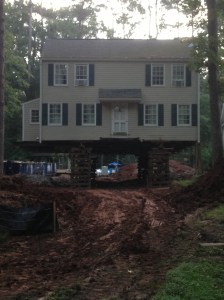
House Raised 2013-08-03 06.57.59

On many mornings, as Lucy (my dog) and I are walking, we venture past this house that is being raised. The house is in an area of Atlanta that floods fairly often, and I can certainly understand the homeowners investing in a different foundation system. A number of other houses in the neighborhood have done the same.

Because of my work for the past decade (in school innovation and transformation), I feel I am constantly trying to get a better handle, a better grip, on “mission, vision, strategy, tactics, and logistics.” This house – as a metaphor – is helping me do so.

As I walk past this house, I imagine what the mission and vision of the homeowners might be. Perhaps that mission or vision is represented in the quotes that opened this post. Perhaps not. I try to imagine the conversations and planning that certainly occurred among the homeowners and the experts who are lifting that house with those beams and ties. I can hear them talking strategy and tactics and logistics, and I can hear them working out a shared understanding of those means and objectives. I think how critical it must be for the workers on this project to have a shared sense of the strategies, tactics, and logistics!

Then, I begin to wonder if the owner of the lifting company talks of the mission of his/her company. I become curious if the lifting company’s mission and vision is actually more of a strategy or tactic in the view of the homeowner. I ponder how confusion over these things might result in a less than optimal house transformation. Or worse – a house toppling.

If you’re still with me, God bless you! If you’re wondering what in the world I am writing about, then I would challenge you to listen more intentionally to conversations and meetings at your school. Listen as people talk about mission, vision, and strategy. Consider how faculty and admin are approaching the tactics and logistics to achieve the strategies that will ensure success of the mission and vision. Perhaps your school’s mission is only written in aspirational terms, loose and general terms, that make strategic design a significant challenge for teachers, parents, and students. Simply listen for the words “strategy” and “strategic” and note if different people speak of the very same actions being different rungs of the strategy, tactics, and logistics ladder.

Listen as teachers talk of lesson plans and classroom activities. Listen as students respond to questions about what they are learning and why. Listen as parents discuss where the school is headed and how it plans to get to such a destination.

Try to discern when people are talking with clear, shared understanding around mission, vision, strategies, tactics, and logistics. For a school to strive for common language around these means and objectives – such effort could have significant consequences on the trajectory on which a school intends to be. Such effort around common language and shared understanding could be a real difference maker in the “if and when” a school will accomplish its mission and achieve its vision.

What’s your school’s mission? Your vision? Your strategies? Your tactics? Your logistics? In what ways are these ends, means, and objectives aligned and misaligned? When students, parents, alums, faculty, staff, surrounding community members and administrators talk of the change you are undertaking at your school, do they speak with common language and shared understanding?

Being called and curious. Being an explorer. Widening our options.

“Certainly to enter a world of terror, you should not be pushed by someone. You should be called. You should be curious. You should have the heart of an explorer.” — Philippe Petit, high-wire artist (from here)

In Dan and Chip Heath’s newest book, Decisive, they illuminate a process for making better decisions. It’s called W.R.A.P.

W = Widen Your Options

R = Reality-Test Your Assumptions

A = Attain Distance Before Deciding

P = Prepare to Be Wrong

On the Heath Brothers’ site, one can register and gain access to some great resources. One of them is a one-pager summary of the WRAP process.

For “W” —

Screen Shot 2013-08-01 at 5.56.14 AMIn looking for “analogies from related domains,” I often turn to TED and NPR. Recently, I listened to the TED Radio Hour feature called “To The Edge” – a curation of talks about exploration.

Many people talk about “fear of the unknown” and our “V.U.C.A.” world (Volatile, Uncertain, Chaotic, Ambiguous). While the future of schooling is not a “world of terror” in any way, shape, or form, in my opinion, I wonder if some view it that way, even if subconsciously.

As for me, I feel called. I feel curious.

I am an explorer.

And I am grateful to be a member of a team that believes in systemic exploration – driven by curiosity – to generate increasingly better models of school-based learning and education.

I learn a lot about my role and my calling and my curiosity by approaching educational innovation as an explorer.

How might we enhance the manner in which we systemically explore innovation in schools? 

One idea (among many) – BE an explorer! Encourage systemic exploration and nurture methods and manners to explore educational enhancement AS a school team and community.

Most, if not all, schools highlight the explorers and inventors in world and U.S. history, mathematics, science, etc. How many of us are practicing exploration and invention, as an organization – intentionally, purposefully? How are we creating time and space for exploration and invention?

Here’s to being called out on that high-wire, to that summit, for that row across the ocean. (You’ll just have to listen to To The Edge, if those references make you… curious.)