If not now, then when? If not me, then who? Inspired by Mick Ebeling and #Synergy

Brief context: I co-facilitate a course for eighth graders; the course is called “Synergy.” Synergy is a non-departmentalized, non-graded, transdisciplinary, community-issues-problem-solving course. My teaching and learning partner Jill Gough (@jgough; Experiments in Learning by Doing) and I co-created the course and we are the two adult-learners among twenty-four student-learners. [If you want to know more about #Synergy, then you can search that category/tag on either of our blogs.]

Brief story: Yesterday, Jill posted this TED Talk on our Synergy Posterous (the collective observation-journal system for our team). Mick Ebeling’s talk is well worth the 7.5 minutes. Be inspired to do something you think impossible…

A sub-group on our team is interested in something they are calling the Graffiti Project. A few student-learners are curious about graffiti and such questions as “is graffiti art or vandalism…could it be both?” Or “why do people paint graffiti…not the quick ‘dirty word’ kind, but the elaborate, beautiful, intricate-scene kind?”

Curiosity begets a project. A project begets an investigation. An investigation begets a TED talk. A TED talk begets…

What could come from this series of path points on our journey in Synergy? Perhaps the team, ages 13 to 40-something (high 40s!), will internalize these critical questions of innovation, connection, citizenship, relationship, and possibility:

If not now, then when?

If not me, then who?

The Wise Routes Project Blog

If you are anything akin to a regular reader here at It’s About Learning, you probably know that I am fascinated by the various, creative approaches to “schooling” and education. Because we are in more of a “learn anything, anywhere, anytime” developing culture, school will likely adjust to these cultural shifts, or school as we know it may become increasingly irrelevant. On a regular basis, I attempt to stay current with research and experiments and practices related to this school-transformation in which we are involved. Blended learning, DIY University, and unschooling are just a few of the emerging educational practices complementing, supplementing, and recreating “traditional,” industrial-era schools.

Recently, a parent sent me a link to a blog entitled The Wise Routes Project Blog, and specifically to a post entitled “Ride Somewhere Far.” Many thanks to the parent…my interest is peaked, and I thought some of you might like to join in the investigation. Enjoy. It’s about learning.

Sharing Curiosity Paths and Resources – #Design, #Engagement, #PBL

I don’t have a lot of time to write this morning, but I do have some time. So, it occurred to me to use my time to share a bit. This week, I benefited greatly from various colleagues sharing their “curiosity paths” and resources with me. My colleagues know that I am interested deeply in design thinking, learner engagement, and project-based learning. Among many shares this week, I highlight three below by embedding three videos and the links to the sites that contain these videos and additional resources about design, engagement, and PBL. In my mind’s eye, I see these three strands as a braided whole – I see them synergisticly. I am not sure that design thinking, learner engagement, and project-based learning could ever be un-braided into silo-ed parts. They are intricately connected parts of an entire system. Enjoy. It’s about learning.

http://www.designthinkingforeducators.com/

http://edu20.bretford.com/index.html

http://www.edvisions.com/custom/SplashPage.asp

A future of synergists and dot connectors…for enhanced customer experience

I am a synergist. I love to work at the intersection and collision of ideas, disciplines, and departments. Of course, like anything, I have to practice this skill, and I hope to continue progressing in the synergizing of things. As Carol Dweck has taught me to say, “I am not yet the synergist that I will be!” I believe Howard Gardner that one of the five minds of the future is the “synthesizing mind.” So, I practice synthesizing and synergizing.

How do I practice? I look for the connections between and among things. I purposefully look. I risk and experiment and take chances. Often, I fail. But I keep synergizing. I work to connect those parts that might result in a whole whose sum is greater than I originally imagined. Also, I get a lot of help from others. WE are smarter than ME when it comes to colliding and synergizing ideas.

This morning, I watched another synergist on TED. In just 4 short minutes, Nathalie Miebach demonstrated to me that mathematical data collection, weather science, 3D art, and music are marvelously integrated. What if school promoted and empowered this type of work…

Then, I remembered a blog post from Garr Reynolds in which he quotes Steve Jobs from a 1997 interview:

You’ve got to start with the customer experience and work backwards to the technology. You can’t start with the technology and try to figure out where you’re going to try and sell it…we have tried to come up with a strategy and vision for Apple, it started with “What incredible benefits can we give to the customer? Where can we take the customer?” Not starting with “Let’s sit down with the engineers and figure out what awesome technology we have and then how are we going to market that?” And I think that’s the right path to take.”

And, so, here is some of my synergy practice this morning: I see Miebach’s TED talk and Job’s quote as inextricably linked together. Schools are envisioning a transformation towards more integrated studies. Some schools are already doing so with great success. Researchers are studying such schools and writing about the Powerful Learning that is happening in such places. Among other shared traits, the schools that are transforming successfully are putting “customer experience” far ahead of “awesome technology.” The successful ones, it seems to me, are guiding students to discover the intersections – the synergies – among such things as mathematical data collection, weather science, 3D art, and music. Then, they are engaging various technologies as tools with which to explore and deepen understanding.

Yesterday, at our faculty meeting, we also took a step in synergy practice. For the second meeting in a row, we told “campfire stories” of some exciting “customer experiences” from our classes and courses. We identified some points on our faculty graph. Now, we have a greater potential to play that great game of motor skill – connect the dots. Wanna play?

Learning to See & Seeing to Learn #Coaching #DBL

My oldest son, PJ, is seven. He loves art, and he sees himself as an artist. According to Dan Pink, in A Whole New Mind, many children grow out of identifying themselves as artists. I hope and pray that PJ always sees himself as an artist. I believe that visual communication and design will only increase in importance as PJ grows up and inherits this world. No matter what he becomes professionally, I believe design and visual communication will be critical as our professional communities address the issues and problems of society.

I possess great hope that PJ will continue to identify as an artist. I possess this hope because PJ has a coach, also named PJ (so I will call her “PJ2”). My son PJ asked if he could take art lessons this year. Thanks to my wife and a good colleague, we were able to find an art teacher – PJ2. PJ2 comes to our home on Tuesdays, and she coaches my son PJ in “learning to see and seeing to learn.” I love this! She is helping him understand the shapes and forms of things. She helped him see the circles, ovals, rectangles, and frowny faces in the frog that my son PJ drew at his first lesson. My son PJ knows circles and rectangles, so he believes that he can do this drawing thing. He is learning to draw what he sees by looking at the whole, breaking it down into parts, and reproducing a creative whole of his own.

At his second lesson, PJ drew this bear and fish. My wife and I are trying hard to follow Carol Dweck’s advice in Mindset and praise the specific, repeatable behaviors that are helping PJ enact his seeing, drawing, and learning. We are trying hard not to say things like, “Wow, you are such a great artist.” It’s really hard not to say such things. I mean look at what he is drawing! A proud dad, I am.
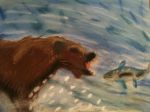
But, I think I am even more proud as an educator than I am as a dad. We all have this capacity within us. We may not all have the interest or passion that lasts, but I believe we all have the capacity. PJ2 is “simply” teaching my son PJ to see what is in front of him. She is coaching him to transform a piece of blank paper into something from the future – his drawing. She is drawing out of him what is already there. She is coaching him to see this capacity in himself. She is practicing educare – to draw forth what lies within. She is coaching him in design thinking.

Recently, a colleague of mine who lives and educates in New York sent me this “Personal Best” article by Atul Gawande from The New Yorker. I am meandering through the article because it is so rich and full of wisdom about COACHING and the teaching profession – all professions, really. I am fascinated that she sent me this article at this moment in time. She and I do not converse or exchange messages at any regularity. But, at the time in which my son PJ is receiving coaching in art, JB sends me this article about coaching and the critical need for more coaching across the board.

I hope you will make time to read the article from The New Yorker, and I hope to write more about learning to see and seeing to learn. For now, I am merely recording some emerging thinking at the crossroads of an article and my son’s personal experience.

Coaching seems the key ingredient. In the article, Gawande describes coaching as “outside eyes and ears.” These coaching insights help us to see the future of what we can do and become. We need coaches. We need to be coaches. Coaches may be the central ingredient to schools making the transformation that faces us now in this 21st century. Coaching can help us see what is possible. Coaches can guide our processes of learning to see and seeing to learn. Coaching is more akin to what I hope to do next professionally.

May we all retain the childish belief that we are artists. May we all work diligently to repeat endlessly that word which Robert Fulghum described as the first real verbal magic of childhood: “LOOK!” May we lead from the future to transform blank canvas into beautiful works of art. The capacity to do so is in us all – if we will learn to see and see to learn.

Thanks to the visionaries and coaches!