PROCESS POST: Observation Journals, Bus Stops, Daring to Fly High #TDed

“Taking issues and situations and problems and going to root components; understanding how the problem evolved – looking at it from a systemic perspective and not accepting things at face value.

It also means being curious about why things are the way they are and being able to think about why something is important.”

Annmarie Neal’s definition of “critical thinking,” as reported in Tony Wagner’s The Global Achievement Gap, p. 16. Neal is VP Talent Management at Cisco Systems.

Training to Be an Innovator

In working to be a student of innovation, I have come to believe that I must practice the five skills of disruptive innovators, as defined by Dyer, Gregersen, and Christensen in The Innovator’s DNA: observing, questioning, experimenting, networking, and associating. (Of course, these traits mirror the phases and stages typically described in “design thinking,” too.) For me, this practice takes several different forms. As just one example, keeping an observation journal has proven to be a transformative exercise that continues to develop fascinating habits-of-mind muscle. Just like a person purposefully training in running or cycling develops fitness and musculature, by purposefully training in observation and questioning, as well as in the other skills, I know I am developing fitness and musculature as an innovator and design thinker.

Such observation journaling and innovation training, I believe, exist as critical foundations and pillaring for faculties and students who are serious about developing the Seven Survival Skills that Wagner details in The Global Achievement Gap:

  1. Critical Thinking and Problem Solving
  2. Collaboration Across Networks and Leading by Influence
  3. Agility and Adaptability
  4. Initiative and Entrepreneurialism
  5. Effective Oral and Written Communication
  6. Accessing and Analyzing Information
  7. Curiosity and Imagination

An Example from the Field

Thanks to my training, I walk through my surroundings and communities differently now. My senses are sharper and I am more intentional about my awareness.

Not long ago, on one of my morning walks with Lucy (my pointer-hound mix), I was stopped in my tracks by these signs:
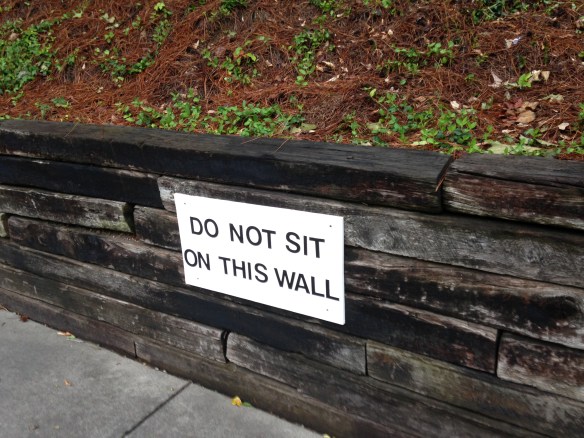
2013-06-29 07.19.58

Along this railroad-tie wall, there are several of these signs. The wall is located on Howell Mill Road, near the I-75 ramp at Northside and W. Paces, in Atlanta, GA. The wall is immediately adjacent to a MARTA bus stop:

2013-06-29 07.20.25

As has become my practice, I act on my curiosity in such situations by 1) snapping a picture or two with my phone, 2) sending the images to an email composer, 3) recording a few questions or ideas, and 4) sending the email to be uploaded to a blog I keep for observation journaling.

What was/am I curious about?

  • Why don’t “they” want people to sit on this wall?
  • Are the bus-stop users sitting on the wall because they are tired, wanting to take a break, etc.?
  • Has the wall failed or fallen because of previous sitters? Did the place of business behind the wall have to spend money to replace a wall in the past?
  • What are the bus-stop users supposed to do… where might they sit?
  • What’s it like to have to use Atlanta’s public transportation, for those that might not have a car, for convenience, like I have?
  • Would I want to sit down – even on that wall – if I rode a MARTA bus every day?
  • What happens when it rains? When it’s bloody hot!? When it’s freezing cold.
  • What other solutions to the problem could be tried? Have any others been tried?
  • What did that wall and those signs cost? What would a wall with integrated seats and head cover cost? Would adding benches be that much to spend?

And I could just go on and on.

It’s only fair for me to divulge that I have been significantly influenced by the 2012-13 First Graders at my school – Mount Vernon Presbyterian School. While I don’t know any of last year’s First Graders, I do practice networking and associating, too, and I followed the blog of the iDesign Lab at MVPS. Last year, before I joined MVPS and MVIFI (Mount Vernon Institute for Innovation), the First Graders took on a design challenge related to the bus stops in Sandy Springs. There are numerous posts demonstrating the D.E.E.P. method of design thinking (Discover, Empathize, Experiment, Produce) – here’s just one showing some of the prototypes after spending quite a bit of time in the discovery and empathizing modes, and after creating Point-Of-View statements and HMW (How Might We…) declarations.

So, if I were as smart as an MVPS First Grader, supported by my teacher and @SciTechyEDU, then I might spend more time at that bus stop, near those signs, and interview some of the people who are regularly there. I might ask for an interview with a MARTA official, one of the people that manages the business behind that wall, etc. Then, I might develop some POVs and HMWs. All of this involves a great deal of in-context, relevant communication, critical thinking, etc. (some of the essential Cs of 21st C or Modern or Timeless learning, depending on which “label camp” you belong to for these essential skills and habits of mind).

Next, I might begin prototyping various solutions based on my insights gathered during my discovery and empathizing. I imagine lots of creativity here as I build and experiment. I could return to the MARTA office, business, bus-stop site and get feedback on my designs. I imagine I would have used quite a bit of mathematics, physics, sociology, etc. during this experimenting and prototyping stage. Perhaps even some history, economics, engineering, foreign language. More communication skills, too. All very STEM, STEAM, and STREAM, if you ask me.

Of course, in “regular school” these subjects would be more siloed than they are in the experience I am describing. Like dinner plates of different colors, they would occupy their distinct places on the table. However, in my field-study example here, the plates have been smashed and the colored shards have been re-organized and glued as a different-kind-of-beautiful mosaic. Same number of total-size pieces (theoretically) as existed when they were whole plates of one color, but now they are mosaically bonded with pieces of various colors. Same amount of total school time might be involved, regardless of whether we scheduled by departments or in an integrated manner, but the time would be more mosaically organized with the integrated approach. My engagement and motivation in this kind of mosaic, difference-making environment might also help me to remain captivated, involved and experiencing Csikszentmihalyi flow for longer than just 45-55 minutes. Of course, different days of the week might be organized differently, depending on what our needs and purposes were as we undertook such challenges as curriculum.

Finally, after presenting my project results and solution to a board of experts, so to speak, I might partner with MARTA or the business or the bus-stop regulars or the surrounding community to realize the solution we developed together. Great opportunities for collaboration, creative expression, leading by influence, entrepreneurialism, etc.

Feeling pretty motivated and invested by now, I might be at a different level of understanding and wisdom about citizenship, civic engagement, and difference-making.

Another Interesting Thought (To Me)

Within a 2-mile radius of this bus-stop-railroad-tie-wall-shouting-signage location, there are about seven schools – some being independent/private and some being public. Meaning that it would not be that challenging to think of a “curriculum,” or “unit,” or “lesson,” or “experience” that could involve student and adult learners engaging in similar design-thinking, project-based, and innovation-training exercises. I am NOT meaning to sound critical of these schools in any way. Some of them, perhaps all of them, are already practicing such mosaic learning and community engagement to develop the Cs and the Seven Survival Skills. My point is that schools have possibilities – infinite possibilities – for such exercises and engagement in their immediate and close-by surrounds. Perhaps the most underutilized learning spaces for schools are our own campuses and immediately surrounding communities.

A Final Note

Rigor (I prefer Vigor – see Amy Purcell Vorenberg’s article in Independent School, “School Matters: Rigor vs. Vigor”, Spring 2008) may not equate to volume of material covered or pace of coverage. Rigor (Vigor) may equate to real-world context that challenges student learners to approach real issues in more integrated, holistic ways and seek solutions to problems that don’t just have one answer or an easily identified one. What’s more, the desire to make a difference and the efficacy to know that one can make a difference are such strong motivators that I have seen countless people – young and old – choose to put themselves into unbelievably rigorous (vigorous) situations because they care and they feel a certain locus of control.

The bus-stop example above is just that – one example. There are countless others. You could/will think of many that would appeal to you more. For me, though, this example lives at an intersection of real-life practices – my training in innovation and design through observation journaling AND the capacities of First Graders (who could have been 5th graders or 11 graders or no graders) to engage in real-life problem solving with their community.

How are you being a student of innovation? How are you engineering practices and creating opportunities for your colleagues and students to develop and grow in the Cs and Seven Survival Skills?

If we are not intentional, it just won’t happen. We need to shift culture.

“The question, as we move from an industrial economy that cherishes compliance to a connected economy that prizes achievement, is this: Are we supporting this shift with a culture that encourages us to dream important dreams? What do we challenge our achievers to do? When do we encourage or demand that they move from standardized tests and Dummies guides to work that actually matters?”

Seth Godin, “The Achieving Society,” The Icarus Deception, p. 22.


#FSBL, #YesAnd, #DTk12, #MVPSchool

#FSBL –> #YesAnd –> #DTk12 –> #MVPSchool

HOW MIGHT WE weave together: 1) a blog post about student-driven learning, 2) explorations by a father and two sons, and 3) two incredible educators working to blur the lines between “school” and “real life?”

  1. For me, a wonderful convergence happened today. First, while reading this morning, I benefitted mightily from “Start with Why: The power of student-driven learning” by Shelley Wright.
  2. Start with Why: The power of student-driven learning plpnetwork.com/2013/06/21/sta… via @plpnetwork & @wrightsroom #MustRead
  3. Then, my two sons and I embarked on a Father-Son-Based-Learning journey to Sope Creek Park. Near the end of that trip, I highlighted one of the posts from our adventure for @SciTechyEdu. In exemplary improv and design-thinking form, she “yes-and’ed” me. Beautifully, another extraordinary team member of mine from Mount Vernon chimed in with more “yes-and’s.” Now, we have the nucleus of a pretty amazing opportunity for unifying and integrating curriculum and instruction around a core idea of natural area surrounding our school and the water-based challenges we face as a community.
  4. Here’s the #FSBL – in 9 quick auto-posts that are generated when my sons and I create an #FSBL observation-journal entry.
  5. Exploring Sope Creek Park #FSBL wp.me/p3fWuN-bT57V
  6. Learning to navigate & map read #FSBL wp.me/p3fWuN-bT57Z
  7. Sibley Pond, Sope Creek Park, #FSBL wp.me/p3fWuN-bT58b
  8. Info board. Natl Park Service. #FSBL, @scitechyedu wp.me/p3fWuN-bT58r
  9. And here’s where Mary joins in our learning journey and expands the potential of a future project/challenge exploration…
  10. Yes plant & animal id, geocaching, trail maint. &… RT @boadams1: Info board Natl Park Service #FSBL, @scitechyedu wp.me/p3fWuN-bT58r
  11. And here’s where Chris jumps in and expands the opportunity and potential even further…
  12. @boadams1 @scitechyEDU YES and include water table info; explore h2o rights, too
  13. @chrisandres003 Yes! And could write to Upper Hooch River Keepers, apply for grant, etc. @scitechyEDU
  14. @boadams1 @scitechyEDU YES and design water usage/conservation plan for MVPS, S. Spings, etc.
  15. Mary connects our ideating to a resource from Stanford d.school…
  16. @chrisandres003 @boadams1 look at this H20 design thinking challenge stanford.edu/group/d-loft/c…
  17. And she moves to implementation by moving us to “WHEN & WHERE.” This moves ideas to action.
  18. @boadams1 @chrisandres003 I will b in i.Design lab all next week workin’ & strategizing on the ZBoards… Swing by…
  19. And Chris commits to joining such implementation and #ActionEd…
  20. @scitechyEDU @boadams1 love where this is going! I’ll try and swing by Monday. Name a time
  21. For me, this is an incredible example of how a simple commitment to community exploration and discovery (#FSBL) can connect with other ideas and possibilities for reimagining and recreating school. Together, I believe Mary, Chris, and I (and others) will make something happen from this ideation. It is this openness and exuberance and design-mindedness that makes me so excited to work with #MVPSchool faculty and leadership. For me, Mary and Chris translated ideation into innovation. Thanks, you two!

Numbers Count: Contextual Assessment and Quantitative Measures in #PBL #DTk12

“He got one out of three!,” said Phil.

“Wow! Can you believe that?!,” responded Ann.

Did the “He” in this short story experience success or failure? Context makes all the difference in the world, doesn’t it?

I can imagine one context: A teacher on a team is reviewing assessment data, and Phil announces to his team that a student “got one out of three.” The tone could be disappointment and disbelief, indicating that Phil thought the student had more command over what had been assessed. The teammate, Ann, knowing how hard the team has been working on the lesson study and assessment echoes Phil’s consternation. In fact, I’ve heard just such a conversation.

I can also imagine a second context: A young boy relatively new to baseball is talking to his mom about a player hitting one out of three at-bats during a season, as the boy figures out what batting averages of .333 mean versus averages of .250. In this context, the exclamations indicate wild excitement at reviewing the success of the young boy’s friend who made the All-Star team. The mom is reflecting the excitement with a big smile on her face, saying, “Can you believe that?!” In fact, I’ve heard just such a conversation.

As schools examine and employ strategies like project-based learning and design thinking, I believe the stories above can be catalysts for talking about quantitative feedback in context. Why is it that the same fraction and decimal is called “failure” in one context and “success” (great success!) in another? Could it be that many of us have a “movie in our mind” playing – one that shapes our beliefs about what it means to get a one out of three based on experience with traditional quizzes or formative assessments? Could it be that we have come to assume that the content and skills on such assessments should be evaluated in such a way that only 70% and above would be considered “passing?” Considering an ed psych concept like Vygotsky’s ZPD (zone of proximal development) might lead us to believe that the scaffolding and instruction is in misalignment with the student’s learning. In context one, many might view one out of three as a problem.

But in the context of baseball, a 33% means something very different. It involves a mental movie that tells us that one out of three is grounds for Hall of Fame induction if the player can do that consistently over a career. Why is 33% so different in this context? Could it be that the high-quality activity of being face-to-face with a pitcher throwing serious heat causes us to shift our expectations and see 33% in an entirely new perspective and point of view? In context two, many might view one out of three as a celebration.

As schools, when we design project-based learning and design-thinking exercises, how might they be informed, in terms of assessment, by the contrasting contexts of taking a quiz versus standing at bat? Are we putting new wine into old wine skins (please forgive the mix of metaphors) when we apply traditional grading practices and certain quantitative measures to more high-quality, intensive contexts that refuse to be assessed with the same mindsets that have historically been applied in the classroom?

How might we be more purposeful and intentional about the interpretation and context of mathematical feedback?

About 14 months ago, I counseled a group of four boys who said to a colleague and me that they had failed.

“Why do you think you’ve failed, guys?”

“Well, Mr. Adams, we only got 2 out of 10 – 20%. In school, 20% is seriously failing!”

“But in your case, through your project, you helped 2 out of 10 unemployed human beings get a job! In your case, your point of view of 20% might need to shift a bit. Just because 20% on a quiz or a test might have indicated real disappointments and ‘disasters’ to you in the past, a 20% employment-bump statistic in your job-fair project could be seen as a wildly successful outcome. It’s more like a batting average than a vocab quiz. That’s how Ms. G and I see it. You positively changed 2 people’s lives this week. Your ‘20%’ will cause ripples that will send significantly positive waves throughout that community.”

When we in schools apply quantitative measures – 100 point scales, 4 point Guskey scales, whatever kind of scales – I believe we need to do so very thoughtfully and carefully. We need to be proactive about our strategic communications surrounding these assessment measures. Students, teachers, parents – we all bring existing mental movies with us into the school setting.

Even if we don’t apply numerical measures – we did not do so in Synergy in the case of the food-desert, job-fair project – we must be aware of the mental movies and previous experiences that students bring with them to these contexts of project-based learning and design thinking. Those four boys did not receive any kind of “final grade” on that project (our course was non-graded, but heavily assessed), yet they applied previous context to a new situation and drew some profound conclusions about their perceived success. It was a powerful learning moment for me. One that has likely taken me the entire 14 months to fully process.

During the past few years, as I’ve consulted with a number of schools, more than a few are applying relatively traditional grading practices to the assessment of skill sets and dispositions. For example, on a report card or progress report, one might find a column or row labeled “Collaboration” and another labeled “Critical Thinking.” Next to the categories one might find an “82” or a “2 on a four-point scale.” One might also see a “B-” in the scoring cell. Or one might see initials like “PG” – “Progressing.”

I realize I am telling a very incomplete story here. I imagine some readers writing to me in the comments or email or Twitter and saying, “Bo, you’re missing the whole point! High-quality PBL shouldn’t even be getting a quantitative measure. It should be performance-task assessed with only narrative, negotiated feedback. No numbers at all! What’s wrong with you?!” With this post, I really mean to provide a catalysts for thinking and doing with those readers and schools who ARE trying to marry quantitative-assessment measures with high-quality PBL and DT. I, too, have serious questions about the “Why?,” and I am also deeply interested in the “How?” if a school just will not consider non-numerical assessment reporting, even for certain courses, strands, projects, assignments, etc.

Are the challenges we are curating or creating causing us to think deeply about the nature of the challenges relative to assessment? Are we orchestrating experiences that are more like the intensive match up between a super pitcher and a batter – ones in which the quantitative measures we apply communicate All-Star results at “33%?” Or are we trying to place new wine into old wine skins and facilitating experiences that challenge kids so slightly that it’s assured most will “pass” or view their Herculean efforts as failure because we’ve neglected to help everyone involved reconceptualize and pivot perspectives on what “one out of three” might really mean in our context?

Teaching innovation and innovating the system. #BothAnd

From Thom Markham, as read on MindShift, April 1, 2013

One overriding challenge is now coming to the fore in public consciousness: We need to reinvent just about everything. Whether scientific advances, technology breakthroughs, new political and economic structures, environmental solutions, or an updated code of ethics for 21st century life, everything is in flux—and everything demands innovative, out of the box thinking.

The burden of reinvention, of course, falls on today’s generation of students. So it follows that education should focus on fostering innovation by putting curiosity, critical thinking, deep understanding, the rules and tools of inquiry, and creative brainstorming at the center of the curriculum.

This is hardly the case, as we know. In fact, innovation and the current classroom model most often operate as antagonists. The system is evolving, but not quickly enough to get young people ready for the new world. But I do believe there are a number of ways that teachers can bypass the system and offer students the tools and experiences that spur an innovative mindset. Here are ten ideas: (emphasis added)

Read the full post here.

I think Thom’s post is excellent. The three intro paragraphs are profound and thought-provoking – and, hopefully, action-provoking. Also, I appreciate his willingness and ability to empower teachers and classroom practices. Thom’s thinking and examples resonate strongly with me and with my experience co-designing and co-implementing Synergy – a transdisciplinary, community-issues, problem-solving course for eighth graders.

But I am also left wondering about and wanting more concerted efforts to actually affect the system purposefully and intentionally, rather than feeling that our only, or most practical, choice is to bypass the system.

How are you and the schools with which you are involved systematizing the learning of innovation? All of us – in education, in for-profit business, in non-profit organizations beyond education, and in our personal lives and families – should be more focused on such questions, issues, and solutions. The citizens can affect such change and impact current and future quality of life – if we commit to doing so. Of the people, by the people, for the people enables us to do so. We can affect the system. The system is made from us, by us, and for us. If not us, then who? If not now, then when?

PROCESS POST: Putting it all together OR Mood board for school=life

When I talk to people, it is highly likely that I will end up sharing something that I have been contemplating and studying for years. I just can’t help it. It usually emerges in, at least, one of two forms…

If school is supposed to prepare kids for real life, then why doesn’t it look more like real life?


School, in its current form, is a profound interruption from our natural ways of learning as humans.

Think of how children tend to learn before formalized schooling. Picture the events of childhood learning – to crawl, to walk, to talk, to play, etc. Now, picture “school.” In what ways do your two mental-imagery exercises match and differ?

Repeat for the learning that typically happens after formalized schooling, during our adult lives. How do your mental images compare?

I’ve shared here before that my own sons did not “disaggregate” their explorations and learnings about the world until they started formalized schooling. In other words, it wasn’t until school that PJ started to say things like, “Oh, that’s math.” Or, “that’s language arts – that’s not math.” Before school, all of the learning was more integrated and holistic. When he could start to put it in rooms, some doors closed.

Two posts caught my eye just moments ago – one on Twitter and one on Edutopia’s blog. I think they help illustrate the idea of re-blending ways of knowing and integrating various capabilities. I think they provide elements on a mood board for re-imagining school and how to blur the lines between school and real life.

Here’s the first – a tweet from SciencePorn:

Screen Shot 2013-04-23 at 11.15.54 AM


Here’s the second – a post from Shawn Cornally (@ThinkThankThunk) on Edutopia. To whet the appetite for a full click on that link, I offer a few quotes that resonated with me.

As the media coverage and administrative spotlight is turned on these new benchmarks, I’d like us all to keep the following in mind: Engagement trumps all.


we have millions of children in schools learning things on narrative arcs that they had no part in authoring.


As more and more references to STEAM (Science, Tech, Engineering, Arts and Math) flood my Twitter feed, I can’t help but wonder how long until we all realize that lessons go where they will, which results in unplannable but reflectable STEHALM (Science, Tech, Engineering, History, Arts, Language and Math) experiences.

Isn’t that great! STEHALM could be letter labels in that photo of the PDA + the video camera + the laptop + the watch + the beeper + the cell phone + the Polaroid + the Walkman. Just two representations of the same overarching idea(l).

When will we act to make “school” more like that iPhone, instead of carrying around the discreet elements as separate and disaggregated pieces? Even if we subdivided the day and did some of each – integrated project-based learning where challenges and issues drive the agenda, as well as some time for exercising the disciplinary lenses sparked by those authentic explorations – I believe we would be moving in a right direction to help make school more life like.

= = =

Thanks to those who inspired with those posts!