8-31-10 Malone Dining Room

Director of Business and Finance Wendy Barnhart inquired about ideas pertaining to a study of Malone Dining Hall…

  • How could organization and flow change for greater efficiency?
  • How could lines be diminished?
  • Could the capacity and/or flow change to allow for more schedule options?

I asked…

Sent: 8/31/2010 5:08:30 PM

Subject: Fwd: Re: Cafeteria study

“Any chance of students helping/directing this study of the flow and capacity of Malone? Great project-based, place-based learning opportunity. A REAL problem to deal with that matters to them!”

Mrs. Barnhart liked the idea of student participation and study. Anyone interested?!

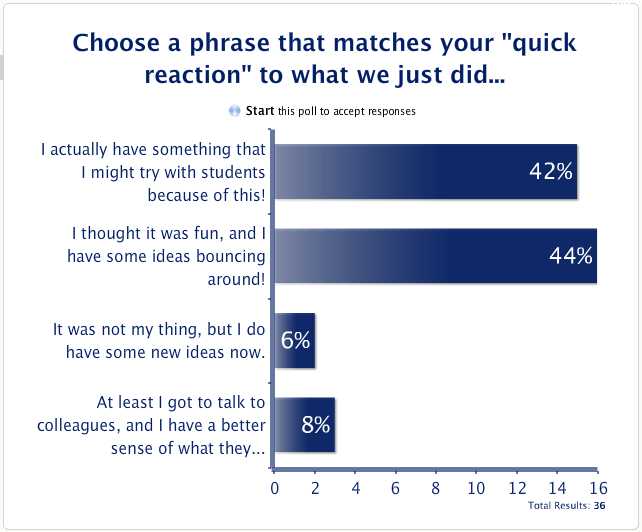
Quick Assessment Results from “Build Something Together” Project Faculty Meeting

On August 12, the JH Faculty took the next step in the “Build Something Together” Project. The essence of the meeting involved a facilitated exchange of ideas that could grow and morph into realized project-based learning plans. At the conclusion of the meeting, we used Poll Everywhere to establish a quick snapshot of people’s reactions to the meeting.

The “Build Something Together” Project

What would make a faculty meeting FUN? WORTHWHILE? FULL OF LEARNING? IDEA-PROVOKING? INSPIRATIONAL? PRACTICAL? What do people want and need to learn and concentrate on for the start of school? If there are 80 faculty, how many needs and wants are there…80? Are there trends, patterns, groupings of wants and needs? What can pull us together as a team…as a community?As a principal who wants to serve his faculty well, these are the questions that challenge and motivate me.

In one week from today, the Westminster Junior High faculty will meet for our first gathering of the 2010-11 school year. Last spring, I encouraged the faculty to read Trilling and Fadel’s 21st Century Skills: Learning for Life in Our Times. How could we connect this book with our last common read, Carol Dweck’s Mindset? What could we do with the 21st Century Skills book that would make the potential for project-based learning come alive…that would encourage a growth mindset for further developing 21st c. teaching and learning? What if we had a project ourselves? What if we built something together? How could a challenge be structured so that people might work together to build project-based learning ideas for their own classrooms and learning environments? How could we weave together the expectations that we all face, such as establishing a goal that I care about and want to pursue, such as visiting my peers and exchanging ideas about learning, such as taking risks and trying something new and different, such as showing evidence that my students have learned with enduring understanding? How will we measure if we are successful? What does success look like in this case of a meta-project for facilitating faculty development of project-based learning?

THE “BUILD SOMETHING TOGETHER” PROJECT: Coming Soon!

In the meantime, a few TED talks to inspire…

And, YES, I do see these as a package deal, which is to say…even better viewed as a synthesized whole.
PBL, PDK, and Time

Kathy Anderson, president-elect of Phi Delta Kappan International, posted this YouTube video about people’s senses of time and the effects of those differences. Very interesting.

http://www.youtube.com/watch?v=A3oIiH7BLmg

After watching, I clicked on a suggested, related video from Dan Pink: http://www.youtube.com/watch?v=u6XAPnuFjJc&feature=channel

Then, I posted this to PDK…
“I am spending considerable time researching project-based learning. Currently, I am reading Powerful Learning (Linda Darling-Hammond). According to much of the research (and a great deal of common sense), project-based learning (also problem-based and design-based) appear to provide the students with ENGAGING, ACTIVE learning for a PURPOSE…to have something to control that matters to the students and to the community. PBL also reproduces the conditions under which most of us work ‘in the real world.’ What superb training and education that might turn out to be. Thanks for sharing the video.”

To discover what motivates our students and ourselves would be a key to a great shift in education and learning!

Bright Spots

I am re-reading Chip and Dan Heath’s Switch. The concept in the “direct the rider” section about BRIGHT SPOTS is so compelling that I cannot get the idea out of my mind. Why are we so problem-solving oriented versus bright-spot-reproducing oriented? We should be recreating more of the moments when things work well, when our strengths are revealed and engaged, when our efforts are at our best. We should write and send more “class acts” than “class demerits.” What has made us so focused on locating and addressing “the broken” that it has us habituated to such behavior? At my school, we use teacher peer visits as an element of a growth system. As the peer visits model is expanding,several are resisting the idea. Much of the resistance seems to center around who will read the peer-visit notes. But the peer-visit notes are strength-based…they are bright-spots notes. Yet he habit in people seems to assume that admin is looking for what’s broken. That’s something to fix – the assumption that we are mining what’s broken versus building on what is strong. Here’s to a bright-spots movement!