When we wiselytear down the walls that we can intentionally and unintentionally erect to surround our thinking and understanding, then we can grow our neural and cardio networks in ways that nourish our heads and our hearts. Axons, dendrites, and heartstrings flourish. When we make our mental garden wall-less, we can do amazing things with others…like construct a network of gardens that grow miraculously behind walls all over a city and a world.
What are we reaping and sowing today with our decisions? What walls are we tearing down? What open gardens are we growing? How might we spread our roots and our shoots?
Plant a seed. Provide water and open up to let the light in. Help grow those seeds planted by others. And let others in to fertilize the seeds that you are planting.
Brief context: I co-facilitate a course for eighth graders; the course is called “Synergy.” Synergy is a non-departmentalized, non-graded, transdisciplinary, community-issues-problem-solving course. My teaching and learning partner Jill Gough (@jgough; Experiments in Learning by Doing) and I co-created the course and we are the two adult-learners among twenty-four student-learners. [If you want to know more about #Synergy, then you can search that category/tag on either of our blogs.]
Brief story: Yesterday, Jill posted this TED Talk on our Synergy Posterous (the collective observation-journal system for our team). Mick Ebeling’s talk is well worth the 7.5 minutes. Be inspired to do something you think impossible…
A sub-group on our team is interested in something they are calling the Graffiti Project. A few student-learners are curious about graffiti and such questions as “is graffiti art or vandalism…could it be both?” Or “why do people paint graffiti…not the quick ‘dirty word’ kind, but the elaborate, beautiful, intricate-scene kind?”
Curiosity begets a project. A project begets an investigation. An investigation begets a TED talk. A TED talk begets…
What could come from this series of path points on our journey in Synergy? Perhaps the team, ages 13 to 40-something (high 40s!), will internalize these critical questions of innovation, connection, citizenship, relationship, and possibility:
The prompt: Do you think our Synergy team’s project possibilities are accurately and fairly represented? Why or why not?
“I think they are accurately represented because it’s easy to see and understand, as well as find one in a group of many that you are passionate about. I think we should have a survey. I think they are fair to everyone’s choices, and I like that everyone got three post-it notes.” ~ BM
“I think our Synergy team’s project possibilities are more accurately and fairly represented with the idea wall system, because we thought of what projects we were most passionate about, and then as a class they were organized into groups on the wall, according to their topic. With the other system they were categorized under tags that each of us individually had tagged, in our own language, and five out of 300+ of our tags were represented with that system. I think this left out a lot of other project possibilities that many people in our class feel passionate about. In my opinion, both of these systems were flawed, but I am excited about many of the projects, and with both I was able to see one or two projects that our class had identified, that’d I’d love to start working on.” ~ OK
“I think that the project possibilities that are represented are fairly represented but we have more ideas that we can add to the wall. Also I think the tagging system was very complicated and hard to understand, but we did a good job of cleaning it up and getting everyone to use the same tagging language to tag their posts.” ~ MB
“I believe that our Synergy team’s project possibilities are mostly accurately and fairly represented, but I don’t think that’s true for everyone. Every team member has put there idea up on the idea wall, but everyone does not understand what each idea means.” ~ OV
“Everyone definitely had an equal say in what we have so far, so I think it is apparent that the data we have is fair. I think the idea wall represents our project possibilities accurately, but the Posterous tags do not. I think the idea wall works because it represents what stuck with people. It specifically represents PROJECT ideas, while the tags also represent random observations that projects cannot be done on.” ~ FS
“I don’t think that our Synergy team’s project possibilities are accurately and fairly represented through our Posterous Idea Wall. I don’t think they are accurately represented because we have over 300 posts and there are bound to be posts that are as equally important to us that we forgot about. Others aren’t represented well, because they are thrown into a miscellaneous category. When something is put in a category like this, people tend to skip over it and ignore it. For example when people are choosing project possibilities that interest them, they will probably skip over the “Other” categories and head straight to the ones that have titles. Although there are some down sides to our wall, like the ones I stated above, our Synergy class has made significant progress through this exercise.” ~ DJ
“Well, I did but now I have realized that they really aren’t. Before, I thought that they were because of the sticky notes and Posterous posts, but now I think that they are not. Today at the end of class, we tried to decide on a number of project ideas for the poll. I thought that we should vote because the final numbers were 8 and 12. Someone suggested that we use 10 because that is between 8 and 12 but some people weren’t satisfied.” ~ CC
Based on the feedback from our young learners, we have learned that we need to work with our team to create a better understanding of the “folksonomy” aspect of tagging our observation journal posts in Posterous. From Reinventing Project-Based Learning: Your Field Guide to Real-World Projects in the Digital Age by Suzie Boss and Jane Krauss:
“Folksonomy” refers to the social taxonomy or classification system that evolves as users collectively make sense of what they find on the Web. Users associate “tags” or keywords to the content they bookmark, and they can see how others have treated the same material.
The easiest way to understand the power of bookmarks and tagging is by using it. [p. 22]
We are working to develop a common language with our tags. We are learning by doing as recommended by Boss and Krauss.
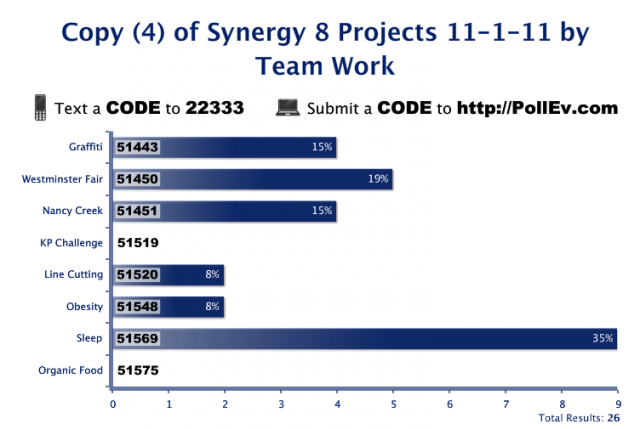
After more work and reorganizing the Post-it Notes from the idea wall, the team decided to use Poll Everywhere to formatively assess the team’s thinking and preferences. We (Bo Adams and Jill Gough) created the topics for the poll based on the top 10 tags from our Posterous blog. Our learners decided that these categories, shown below, were similar to the categories from the idea wall.
As you can see, we definitely need to work on developing a common language and understanding of tagging. School, for example, is a pretty broad topic for project selection. There were 82 posts tagged with school in our Posterous observation journal site.
Here are the results after the first poll.
Our learners discovered that their categories were too general. If you wanted to work on the KP Challenge, did you select school or cafeteria? If you were interested in organic food or obesity, did you select environment, cafeteria, or health? Fortunately, the Post-it Notes contained more details. Our learners then asked to eliminate the general categories where they showed no interest and add more specific categories to eliminate some confusion. For a quick glimpse into their discussion and work, we offer the following iMovie*.
Here are the results after the second poll.
Serving as their coaches, we now had to intervene. PowerPuff does not meet the standard of project or problem for our course. We want our learners to work on projects or problems that effect more than half of one grade in our division. Our learners were assured that we would help them work on this project outside of class if they are serious about pursuing this as a community issue. One of our learners made a motion from the floor to poll again with the category PowerPuff removed.
Again, there was discussion coupled with questions. Could the KP Challenge and Line Cutting choices be grouped together?
In groups, our learners’ next task was to use the technique of brainwriting to share, connect, and contribute to the team’s ideas of the selected topic.
Learners are now working on project concepting using a worksheet we adapted from BIE.
For the projects where there are less than 4 teammates, how will they cover the internal, team “leads” for each essential learning needed? Will these teams choose to push forward on the project they have selected, or will they choose to join forces with another team?
[Cross-posted at Experiments in Learning by Doing]
[*NOTE: iMovie video effects have been added to the movies because of a new school policy about student images on faculty blogs.]
Years ago, the Junior High School embarked on a mission to re-create, re-frame, and re-purpose advisement in our middle-school division. To make a long, and wonderful, story short, we re-crafted the backbone of advisement to provide a spine of leadership development. Sixth grade focuses on the “intrapersonal” aspects of leadership, seventh grade focuses on the “interpersonal” aspects of leadership, and the eighth grade focuses on the “extrapersonal” aspects of leadership. Because leadership, at its core, is really about service and interdependency – not egocentric, authoritarian independence – the entire program maintains shape thanks to the glue of service learning and project-based group initiatives. We call the entire scope and sequence “L.E.A.P.” – the Leadership Experience Advisement Program. What follows are two brief slices of time for pieces of the seventh-grade LEAP program and the eighth-grade LEAP program.
7th Grade LEAP Day: Pay It Forward
Yesterday, our seventh grade participated in a LEAP day called “Pay It Forward.” Here is a copy of the email summary and thanks that our grade chairs sent:
Many, many thanks to you all for all that you did to make Tuesday such an amazing experience for our seventh graders. I have received positive feedback from many of the students and faculty members. Thanks so much for the time and effort you all put into the day…here’s what we all accomplished together:
1070 sandwiches made for Atlanta Union Mission
18 canvases touched up for Hospital Art
$4,000 in coins rolled for Habitat for Humanity
Two new beds planned and created in our on-campus garden
Over 30 large trash bags (and a wallet) collected in campus clean up
175 letters written to the troops serving our country to be sent by the USO
103 cheerful artwork pieces created and laminated for people in assisted living facilities
17 double sided fleece blankets created for the Atlanta Union Mission
Impressive! It would not have happened without each one of you…so thanks! And please, as always, send along any feedback or ideas for the next go ’round!
James and Jan
Below is a short iMovie* of one of the initiatives – Hospital Art:
In eighth grade, our LEAP program is threaded with aspects of the NAIS 20/20 project – the 20 biggest global issues to be addressed in the next 20 years. Over the course of the academic year, our eighth-grade advisories take on a global issue and address it with a local project. For several years, we made the pilgrimage to Blue Ridge Assembly in February, and the trip involved a lot of indoor project planning. Since the last retreat, the grade chairs and deans and advisors decided to change the retreat to early November so that the advisory groups could focus on team building and interdependent leadership…in order to establish a stronger foundation for the project planning and implementation that will occur next in the multi-phase advisory plan.
Our leadership retreat involves a number of adventure-based, challenges or initiatives. You can peruse a set of initiative descriptions through the embedded Scribd document, and you can view a 13:00 iMovie* showing highlights of the retreat.
If you are anything akin to a regular reader here at It’s About Learning, you probably know that I am fascinated by the various, creative approaches to “schooling” and education. Because we are in more of a “learn anything, anywhere, anytime” developing culture, school will likely adjust to these cultural shifts, or school as we know it may become increasingly irrelevant. On a regular basis, I attempt to stay current with research and experiments and practices related to this school-transformation in which we are involved. Blended learning, DIY University, and unschooling are just a few of the emerging educational practices complementing, supplementing, and recreating “traditional,” industrial-era schools.
Recently, a parent sent me a link to a blog entitled The Wise Routes Project Blog, and specifically to a post entitled “Ride Somewhere Far.” Many thanks to the parent…my interest is peaked, and I thought some of you might like to join in the investigation. Enjoy. It’s about learning.


 it's about learning