In the Zone

Being a camp counselor at Camp Sea Gull altered my entire career path. At camp, Captain Lloyd, the camp director, used to tell me, “Bo, you teach kids how to swim; you do not teach swimming to kids.” Captain Lloyd was insistent that we taught children, not a subject.

Years later, my mentor in graduate school, Frank Pajares, insisted that we immerse ourselves in the writings, theories, and practices of Lev Vygotsky. Of particular importance,Dr. P wanted us to truly understand the ZPD – zone of proximal development. The ZPD is that cognitive “place” where a learner stretches to comprehend something just beyond his mental reach. Usually some coaching and scaffolding is required. Here is where learning takes place.

Now, as I reread W. James Popham’s book, Transformative Assessment,I am reminded that formative assessment is not so much an instrument or tool, as it is a PROCESS. Formative assessment provides the feedback for both learners – teacher and student – so that we can stay in the zone…the ZPD. When we are content driven, mere teachers of a subject, we don’t tend to evidence much real caring for the zone. We just have to get through the material. When we use learning targets, formative assessment, and the magic of feedback, we begin to teach the child. We start to realize the importance of differentiation because we are teaching learners who might have slightly different ZPDs.

When we teach a subject, we get the pace and methodology right for some in the class. For others, the material is too easy. For others still, it is too difficult. When we teach children, we pay attention to where they are as unique and individual learners. We require the process of formative assessment so at we can tweak, alter, and adjust instruction so as to stay in the sweet spot – in the zone – as much as possible.

Here is a great article that helps tie it all together: http://www.edweek.org/media/formative_assessment_next_generation_heritage.pdf

Bright Spots

I am re-reading Chip and Dan Heath’s Switch. The concept in the “direct the rider” section about BRIGHT SPOTS is so compelling that I cannot get the idea out of my mind. Why are we so problem-solving oriented versus bright-spot-reproducing oriented? We should be recreating more of the moments when things work well, when our strengths are revealed and engaged, when our efforts are at our best. We should write and send more “class acts” than “class demerits.” What has made us so focused on locating and addressing “the broken” that it has us habituated to such behavior? At my school, we use teacher peer visits as an element of a growth system. As the peer visits model is expanding,several are resisting the idea. Much of the resistance seems to center around who will read the peer-visit notes. But the peer-visit notes are strength-based…they are bright-spots notes. Yet he habit in people seems to assume that admin is looking for what’s broken. That’s something to fix – the assumption that we are mining what’s broken versus building on what is strong. Here’s to a bright-spots movement!

Blog Motivation

Since I began this blog, I have struggled with it. I started by thinking that I would try to write what others would want to read. Now, I realize that I will be much more successful if I write what I want to write…and trust that those who are interested will read the blog.

So what do I want to write? I want to write about Professional Learning Communities, teacher development, and education for the 21st Century. So if these topics interest you, we might have a connection.
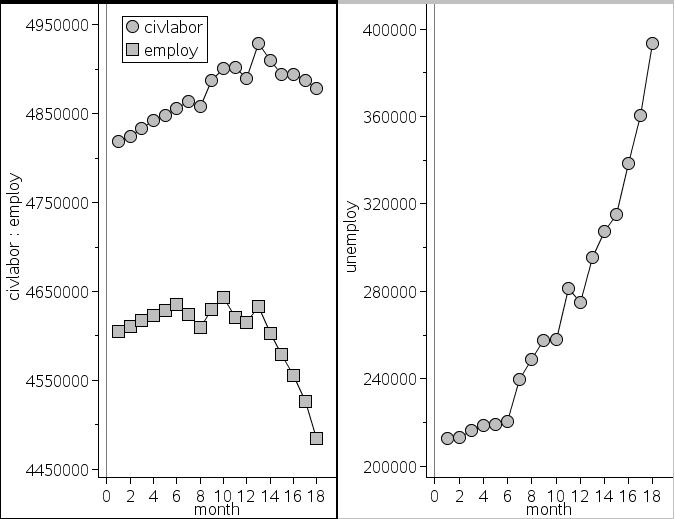
During my typical school week, I so look forward to fourth period. Why? In fourth period, I participate in a professional learning community (PLC) with five amazing teachers who are committed to learning and rethinking the ways we approach and support the classroom. For the past three weeks, we have been exploring the modeling method of instruction. We investigate, discover, record data, collaborate on interpreting the data, and formulate better understandings of the world. An example of such an investigation is illustrated below with some spring oscillation data we have been collecting. What’s more, we work together to devise how we might better create such exciting learning environments and experiences for our students.
As a result of our work in the last three weeks, I have spent the morning studying labor statistics in an effort to create a learning experience for Economics 8. The investigation has been captivating and invigorating, and I do not even currently teach a section of Economics 8. My PLC peers have inspired me to explore, to ask questions, and to seek for answers. Isn’t this exactly what we want for our students? What better way to build such opportunities than to participate in such opportunities ourselves.

Good Intentions…


With the noblest intentions, I started this blog in order to improve communications. As it turns out, I actually have to write to the blog to communicate in this manner! Looking back over the two months since my last posting, I am not sure that I could explain why I have not posted anything here on a more regular basis. When I began this blog, a trusted friend told me to start small and plan on posting once a month. I thought I could post at least once a week. Well, the friend was correct, and I have learned. Without falling into the cultural trap of declaring this a “New Year’s Resolution,” I will try to do better. I will try to write more regularly, and I will try to write things worth reading.

In terms of work, I am most involved at this time with planning for a PLC (Professional Learning Community) on 21st Century Thinking and Schooling. Beginning in January 2009, I will be co-facilitating this endeavor with Bob Ryshke, Executive Director of The Center for Teaching at The Westminster Schools. Using Daniel Pink’s A Whole New Mind as a jumping off point, we will first explore what the 21st Century will call for in terms of learning and skill development. If anyone is still reading this blog after my terrible accountability to posting, I would be interested to hear what you believe are the most critical learning tasks or skills for the 21st Century.