JH 2.11

At the opening Junior High School faculty meeting, I shared that I would be referring to us (internally) as “JH 2.11.” Like version software, such as OS 10.6 or Windows 7, the Junior High School is adopting an internal nomenclature that will help us remember that we are striving to improve and grow. The “former version” was a strong product, but we can make it better. We can learn from our experience, we can enhance features and programs, we can grow and get better.

I first played with this “JH 2.11” idea during my spring 2011 sabbatical. While I served my sabbatical, I interned at Unboundary, a strategic design studio here in Atlanta, GA. At the company, they were deliberately working to move from Unboundary 6.0 to Unboundary 6.5. They talked about the business in this manner. Consequently, the culture was dynamic, not static. There was a fundamental understanding that the company would grow and improve to the next version of itself. Unboundary would learn from experience and get better. Simply being “Unboundary” was not good enough, and simply being the “Junior High School” is not good enough. A static name can unintentionally imply that the work of the company is static. A dynamic name generates a creative tension that can motivate a team to strive for closing a gap by walking a path of kaizen – continuous improvement.

What are the keys to embarking on such a walk of kaizen? In brief, the critical key is living in the growth mindset. More specifically, though, I recently read two blog posts from colleagues spread across the country – linked with me primarily through open social media. In these two posts, I think @L_Hilt and @jonathanemartin have hit upon some superb specifics about growing in our versions in an Education 2.0 world.

Out with Professional Development, In with Professional Learning (@L_Hilt)

Become an “Eeel:” The 17 E’s of Electronic Education Leadership Excellence: Leadership Day 2011 (Hat tip to Tom Peters)

In our Westminster school motto, from Luke 2:52, we read, “And Jesus grew in wisdom and stature, and in favor with God and man.” May we strive to grow similarly.

“Bright Spot on Flexible Faculty Forum” Guest Post: Sally Finch

When Dr. Roger Bannister broke the four-minute mile, numerous other runners soon ran through the opening that he cracked in an apparent barrier. Perhaps we have a similar situation here. Thanks, to Jen Lalley, the 112-day wait time paid off, and It’s About Learning enjoyed it’s first Junior-High-faculty guest post. Now, Sally Finch has offered up an email that she sent to Dean of Faculty Thad Persons. THANK YOU to Jen and to Sally for their willingness and courage – to share with a broader audience.

Thad:
I loved the ease of registering on the multi-colored spreadsheet!  It was so user-friendly and made so much sense.

I just read Bo’s blog about how he and Jill changed topics at the last minute and got a whopping increase in attendance.  This kind of flexibility for Faculty Forum, with an “expert” speaker working along with us, and with us teaching each other, is the best kind of choice for getting back to school.  Even those sessions I could not attend but wanted to (Sophie is just across the hall from me) can be an asset in the future.

The flexibility made it possible for Marjorie and me to work together on economics, and that was especially helpful since Jay was on jury duty.  I was getting a little nervous about the technology before Thursday, but feel much better now that I have taken some baby steps on some new things and know that I have lots of folks around to help.

Thanks for a great two days.
Sally

People often pick up the phone or pound on the e-mail to complain. Fewer (it seems) take opportunity to communicate about a bright spot. For instance, we call the help desk when technology is frustrating us, and we call Georgia Power when the power shuts down. How often do we call to say, “Things worked great today! Thanks for providing the tools and the electricity!” Such positive feedback goes a long way to building a record of what works, what helps, and what needs to continue. Thanks, Sally!

FedEx Session: Blogging as Digital Portfolio

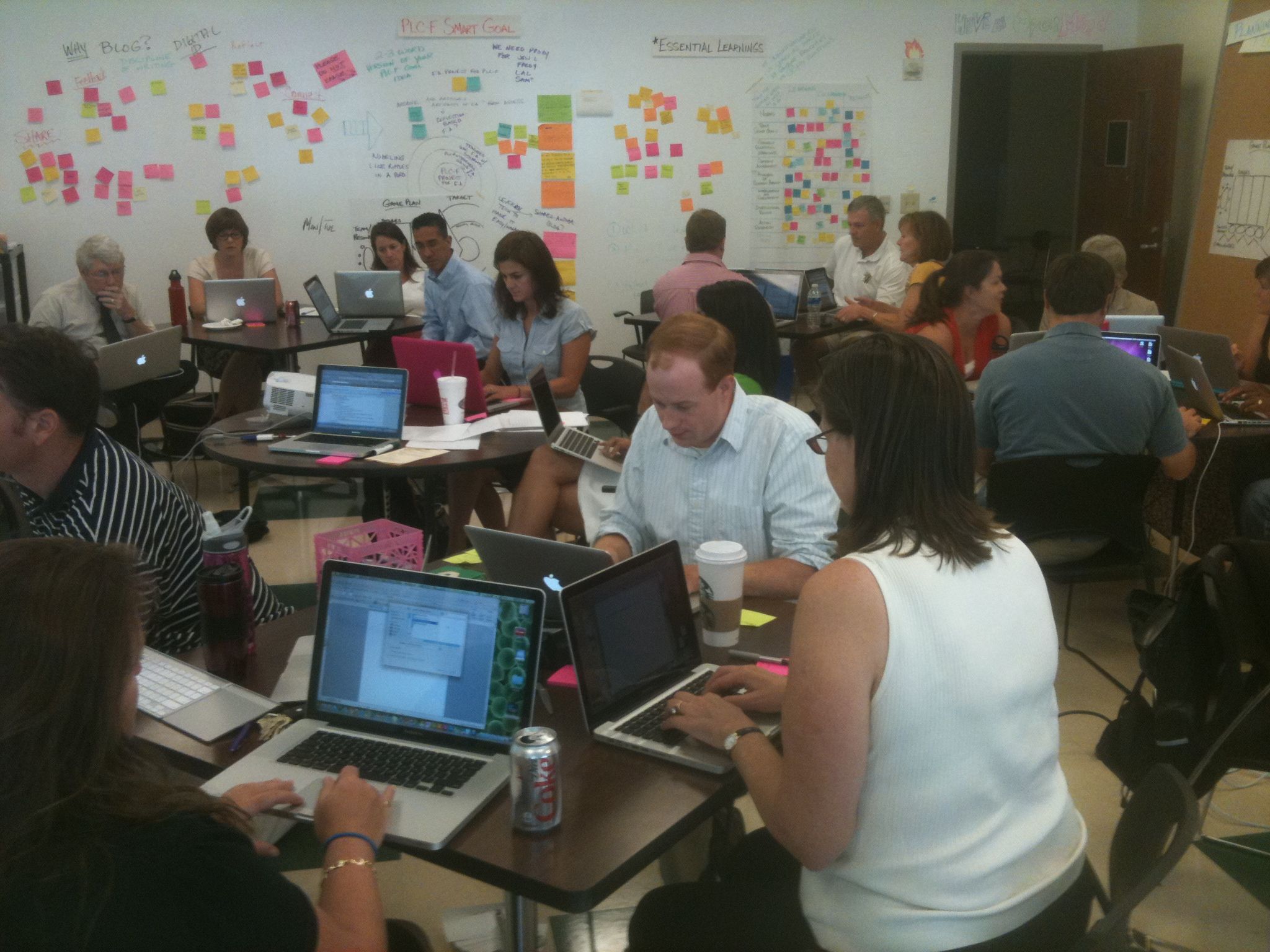
Today, as part of Westminster’s Faculty Forum, we are working in a “FedEx Day” format. Several faculty created workshops for which people could register. Various other faculty organically gathered into groups to co-labor on particular projects. Here’s a small sample of the workshop titles:

Jill Gough and I hosted a session on “Blogging as Digital Portfolio.”* Our framework plan looked like this:

  • Why to blog?
  • What to blog?
  • How to blog?

We began with a post-up gamestorm in which people recorded reasons why to blog. Each of these ideas was recorded on a Post-it note, and we posted the notes to our idea wall.

Then, we used an affinity map gamestorm to gather related Post-it notes and categorize our thinking.

Next, we used Poll Everywhere to gather some data and assess our participants:

The discussion was great, and people contributed mightily to our collective understanding about why people might blog…and what can get in the way.

In order to dive into the “What to blog?” section of our game plan, we used a Google Doc for collaborative brainstorming: http://bit.ly/py3yvb.

Finally, we walked through the steps of actually establishing a blog on our WordPress Multi-user Domain. We encountered some technical difficulties with the confirmation-email process, but our group found ways to positively engage. Some wrote practice drafts of blog posts using Word and Pages. Others drafted a directions/instructions document about what we had done in the session. A few others even split into teams for a cooperatively competitive contest about taking the “30 Day Challenge” for posting once a day for a month…to get in the habit (posts might be as short as a sentence or an image-and-question combo).

Of course, with @gcouros here, we had access to a great resource from him, too: http://bit.ly/hlmym9

Now, as I wrap up this post, there are some stragglers here still working…still learning. It’s 11:55 a.m., and we are having fun learning and working together.

* FOOTNOTE: Interestingly, Jill and I had planned a session on PBL. On Thursday afternoon, we realized we had a small list of registrants. Because of the enthusiasm over digital portfolios – generated the day before – we decided to use this formative assessment to shift our workshop plan. Our three, original registrants were very understanding and flexible, and we ended up with a full house – about 24-25 folks.

Sometimes, we just need to be asked!

Moments ago, I sent the following e-mail to the faculty with whom I have the privilege to work and learn everyday – the Junior High faculty at Westminster. I am genuinely excited to learn what they might suggest for faculty meetings and other professional-learning opportunities. Certainly, with their help, our opportunities will be better and more well-suited for us all!

Dear JH:

I need your input and contributions! Our entire JH needs your input and contributions! You are amazing professionals who are devoted to the career of teaching and learning. More than anyone, you have superb ideas about what you want to be learning professionally. You know what you need regarding “corporate professional learning” time – our faculty meetings and in-services. You are surely thinking about your goals…and you think, “If Bo would just do x at a faculty meeting, it would really help me accomplish my goal and better serve student learning!”

WE ARE SMARTER THAN ME! Rather than me individually thinking and planning for our learning time together in faculty meetings and in-services, I would like for many people to contribute to that thinking and planning. I have set up a Google Doc for us to use together to suggest meeting topics, particular content, specific pedagogies, what’s-worked-in-the-past, interesting professional questions you have, etc. [I am asking now in case I need to secure a speaker/facilitator, begin a set of action steps, etc.]

[I inserted Google Doc link here!]

If for some reason, you have any trouble on Google Docs, just email me your suggestions (I will paste them into the Google Doc). But PLEASE try the Google Doc first!

Together, our JH professional learning community can brainstorm, idea-exchange, and contribute to the form and function of JH faculty meetings and other corporate learning opportunities. You have a voice about how our meetings should be, and I hope you will exercise that voice.

THANKS!

Bo

Goal Keepers, Part 3 of 3

In this three-part set of posts about goals, I explore the general concept of goal setting and action stepping, and I drill down more specifically into my school’s new vision statement, Learning for Life, as well as my own professional goals for the year, which are a part of my school’s Faculty Assessment and Annual Review (FAAR) Plan.

In May 2010, I published a post about my student/course feedback from Synergy 8. In the post, I explain that my next Faculty Assessment and Annual Review (FAAR) endeavor will be to draft and share my 2011-12 Goals and Self-Assessment (G&S-A). As has become my practice, I send my current G&S-A draft to the Junior High Faculty, as well as to the Westminster administration. Because I ask the faculty to share their G&S-A with me, I want to share my G&S-A with the faculty. We are all in this together.

Typically, I share my draft G&S-A document with the faculty in the days approaching our return to school. While my document is not necessarily an exemplar, I do try to model an approach to completing the important process of reflecting and goal setting. And the sharing with each other is a critical step, in my opinion. If we don’t know of each other’s G&S-A, how can we work to make sure that our rafts are pointed in the same direction, traveling in the same river?

During the course of the year, if I am doing the work in the best way possible, I will keep my G&S-A in front of my view, and I will revisit and revise my goal as necessary. My goal is a work in progress – a dynamic path and pace setter, not a static document submitted-and-forgotten simply to complete a requirement.

So, in the below Scribd window, I am sharing my current draft of my 2011-12 Goals and Self-Assessment:

Additionally, this year I spent more time than usual reviewing my goals and feedback from every year that I have served as Junior High principal – since 2003. Consequently, I had the idea to organize many of those materials into a resource matrix with “everything” in one place. You can find this resource matrix here, if you are interested. I have some follow-up work to do to make the resource complete, but at least I have started! By organizing all of these materials in such a matrix, I think it visually demonstrates how all of the pieces are parts of one whole, integrated system. It’s all supposed to work together, as a whole.

Of course, I welcome any and all feedback on my developing Goals and Self-Assessment. If you have comments to share, I encourage you to do so. Various perspectives and viewpoints can only help me to understand my own goal better…and how my goal can work with the system of faculty goals to achieve our Learning for Life vision. All perspectives – faculty, administration, student, parent, other educators, etc. – are welcomed. Together, we can be great goal keepers.

A Postscript on Sharing Goals

According to this three-minute, Derek Sivers TED talk, “Keep your goals to yourself,” we run the risk of under-working on our goal when we share it with others and experience any satisfaction from doing so and mistakenly feeling that our goal is “done.” I disagree that we should keep our goals to ourselves, and I briefly explain above the main reasons why goal sharing is a good practice in my opinion. However, I understand Sivers’ bigger idea that the real work with our goals comes in the action steps and the dogged determination to follow through on our action steps and to achieve our goal. By sharing my goal, and by reviewing the Junior High faculty goals and “operationalizing” their connections, I hope that we will all positively hold each other accountable – for the good work of acting on the action steps and accomplishing our goals. I need your help and support, and I feel accountable to you all. So, I share my goal, and I look forward to the start-of-school conversations about our goals. Let’s get working – together. Our kids deserve our best, collaborative work! It’s about learning…for life!