Unknown's avatar

About boadams1

Learner. Husband. Dad. Mountaineer. Head of School at Mackintosh Academy - Boulder, in Boulder, Colorado. Have worked in transformation design, educational innovation, and school leadership for 30+ years.

Make learners conform to the room, or make the room conform to the learning? #EdSpace

$9.99

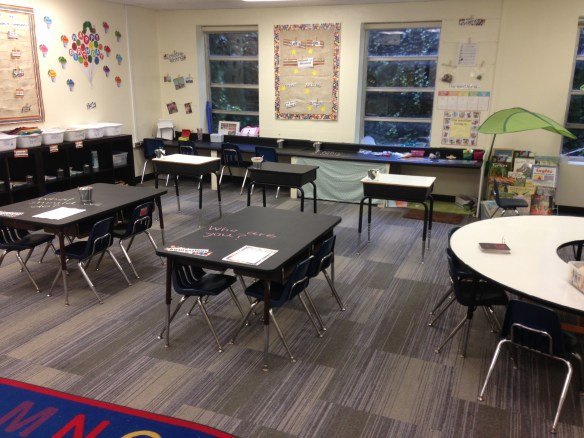
That’s what a small can of chalkboard paint cost at a hardware store nearby. With several cans of chalkboard paint and a few cans of whiteboard paint, a lower school teacher transformed the learning environment for the student learners coming to her soon.
2013-08-12 09.01.34

Instead of students “getting in trouble” for writing on the desks, Miss F altered the typical “classroom” environment so that desk writing was not only permissible, but encouraged and fun.

For 1st graders. Learning to write and express themselves through writing.

When the student learners gathered in the room for the first time, during a recent orientation day, there was much writing and drawing on desks! They owned their learning environment with those acts of defiance turned and transformed into acts of creativity.

And should the student learners tire of sitting, there are standing-level desks and exercise balls to bounce on while one learns. A far cry from “Sit still!”

What an act of transformation. To reverse the typical paradigm. Instead of expecting students to bear the lion’s share of conforming to the rules of the room, the rules of the room were re-conformed to promote the desired dispositions and learning explorations of the student learners!

And with such a flip in conformity expectations, transformations are made possible. And deep relationships forged.

2013-08-12 11.09.55 = = = = = = = = = = 

Recent, incredible resources on space re-design:

“8 Tips and Tricks to Redesign Your Classroom,” Edutopia, August 6, 2013, by David Bill (@DavidSBill) and The Third Teacher+ (@TheThirdTeacher)

#MustRead Shares (weekly)

Posted from Diigo. The rest of my favorite links are here.

#MustRead Shares (weekly)

Posted from Diigo. The rest of my favorite links are here.

Exploring educational innovation… by skateboarding with a UCLA professor.

Remember yesterday’s post on looking at adjacent domains for exploring innovation and learning? [No matter if you don’t.] Thanks to a conversation with a division head yesterday, we were reminded of Dr. Tae of UCLA.

There’s a lot to think about by going to the “skateboarding school.” [Contrast this with “bicycle school” ;-)]

TEDxEastsidePrep – Dr. Tae – Can Skateboarding Save Our Schools?

  1. Failure is normal. “It took me 58 times to get that trick.”
  2. Nobody knows ahead of time how long it takes anybody to learn anything.
  3. Work your ass off until you figure it out.
  4. Learning is NOT [always] fun. “A better word… is FLOW.” “Fun is very different from flow.”
  5. NO GRADES. “The goal in skateboarding is to learn the trick. The reward in skateboarding is landing the trick. Layering grades on top of this adds nothing to the experience at all. Skateboarding is not brought to you by the letter A.” [great visual of this point in minute 9:00!]
  6. NO CHEATING. “When learning is the goal and learning is the reward, there is no cheating.”
  7. NO TEACHERS. “Real-time meaningful feedback.”
  8. Spectrum of learning and spectrum of school are not currently aligned, equivalent, etc. [Really cool physics lesson and metaphor starts near minute 12:00!]

= = = = =

Related post:

What I learned from skateboarding at age 41 and 11/12…

Being called and curious. Being an explorer. Widening our options.

“Certainly to enter a world of terror, you should not be pushed by someone. You should be called. You should be curious. You should have the heart of an explorer.” — Philippe Petit, high-wire artist (from here)

In Dan and Chip Heath’s newest book, Decisive, they illuminate a process for making better decisions. It’s called W.R.A.P.

W = Widen Your Options

R = Reality-Test Your Assumptions

A = Attain Distance Before Deciding

P = Prepare to Be Wrong

On the Heath Brothers’ site, one can register and gain access to some great resources. One of them is a one-pager summary of the WRAP process.

For “W” —

Screen Shot 2013-08-01 at 5.56.14 AMIn looking for “analogies from related domains,” I often turn to TED and NPR. Recently, I listened to the TED Radio Hour feature called “To The Edge” – a curation of talks about exploration.

Many people talk about “fear of the unknown” and our “V.U.C.A.” world (Volatile, Uncertain, Chaotic, Ambiguous). While the future of schooling is not a “world of terror” in any way, shape, or form, in my opinion, I wonder if some view it that way, even if subconsciously.

As for me, I feel called. I feel curious.

I am an explorer.

And I am grateful to be a member of a team that believes in systemic exploration – driven by curiosity – to generate increasingly better models of school-based learning and education.

I learn a lot about my role and my calling and my curiosity by approaching educational innovation as an explorer.

How might we enhance the manner in which we systemically explore innovation in schools? 

One idea (among many) – BE an explorer! Encourage systemic exploration and nurture methods and manners to explore educational enhancement AS a school team and community.

Most, if not all, schools highlight the explorers and inventors in world and U.S. history, mathematics, science, etc. How many of us are practicing exploration and invention, as an organization – intentionally, purposefully? How are we creating time and space for exploration and invention?

Here’s to being called out on that high-wire, to that summit, for that row across the ocean. (You’ll just have to listen to To The Edge, if those references make you… curious.)