A World of #PBL Possibilities

I am training myself to see more #PBL possibilities. Through the years, and from reading such works as Dan Pink’s A Whole New Mind and Carol Dweck’s Mindset, I am convinced that being an artist largely involves practicing the acts of looking and seeing. Why would becoming a “PBL-ist” be much different?

Here are a few examples of how I am practicing being a PBL seeker, with resulting ideas for PBL. Oh…that’s project-based learning, problem-based learning, etc.

1. Using TED talks to spur thinking.

Each morning, thanks to an RSS feed, I watch at least one TED talk – it’s delivered to my computer, like a newspaper to a house. Before I even touch that beautiful red “play” arrow, I ask myself, “What is this going to show me that could be related to PBL?” This morning, I watched Geoffrey West’s “The surprising math of cities and corporations,” which I have embedded below. Throughout the talk, I imagined middle schoolers studying our city of Atlanta – understanding its historical growth, its environmental and business challenges, its political scene, etc. In my mind’s new PBL-eye, I could see students collecting the type of data that Geoffrey West describes, and I could see the students Skyping with other students in other cities as they exchanged city data and ideas. I could see them applying science thinking and sociology thinking and economic thinking to some of the issues our city faces.

2. I use my iPhone and iPad to capture pictures that spark inquiry and curiosity in me.

This week, I happened upon this growth in a nearby building. I wondered why this was growing here…what is it…how could we prevent it from growing here again? What a strong possibility for students to integrate science, math, history, and persuasive writing to enact a plan that addresses this unanticipated indoor fungi!

3. I combine #1 and #2 – I think in my mental Rolodex about what I have photographed and what I have seen on TED.

For example, with colleague Mary Cobb, I recently completed the 6th annual hanging of the Junior High School Permanent Art Collection (this is one of my greatest joys each summer!) This year, as we hung student art, we discussed Amit Sood’s TED talk, “Building a museum of museums on the web,” which I have embedded below. Can you imagine the “coolness” of students building such an online gallery of our JHPAC? Then, can you imagine this resource potentially being linked with Amit Sood’s project? The JHPAC could be another virtual gallery alongside the MoMA and the Louvre.

4. I listen to and talk with faculty.

Colleague Danelle Dietrich has become increasingly interested in various capabilities of the TI-Nspire (a graphing calculator and software). On Thursday of last week, she was sharing her excitement as she was thinking about the mathematics of leaf veins. She had some great ideas for importing leaf images and studying the vein-ation of the leaves. We started to brainstorm about the relationships of blood vein-ation to leaf vein-ation. Then, we hypothesized about the relationship of computer networks and communications veins to leaf veins and blood veins. Can you imagine students writing letters and websites to city politicians explaining their study of the communications systems of Atlanta and the need to rethink the vein-ation of our networks around town?

What ideas are you imagining? It all starts with imagination…just like a young child imagining a pretend world. We are only limited by our capacity to realize our imaginations through creative expression. And our capacities can expand – with teamwork, practice, and persistence.

Get your #PBL-lenses on!
A Tribal Revolution

In Seth Godin’s Tribes, he explains that “it takes only two things to turn a group of people into a tribe:

  • A shared interest
  • A way to communicate (24).

Godin also posits, “So a leader can help increase the effectiveness of the tribe and its members by

  • transforming the shared interest into a passionate goal and desire for change;
  • providing tools to allow members to tighten their communications; and
  • leveraging the tribe to allow it to grow and gain new members” (25).

Well, on July 25, 2011, David Wees (whom I have never met, yet I feel he is a colleague) published a blog post entitled, “The quiet revolution in education.” Via a tool like this blog, I may be preaching only to the choir, but I would encourage you to watch the TED talk that Wees embedded into his post, and I would strongly recommend that you read his post. In essence, he provides an incredibly cogent explanation of why we educators should be embracing social media tools and sharing practices so that we can “tighten [our] communication” in order to further “[transform our] shared interest into a passionate goal and desire for change.” Together all of us can “[leverage] the tribe to allow it to grow and gain new members.”

As teachers, educators, lead learners – whatever you want to call us – don’t we want a similar thing for our children? Don’t we want them to pursue their interests with passion so as to increase their knowledge and understanding of a thing so as to contribute to positive growth and development in our citizenry?

If we want it for our children, we should practice and model it ourselves! We are rearing and guiding students in a Web 2.0 and 3.0 world…we need to be Web 2.0 and 3.0 people! School should prepare students for the world in which we live – teachers should guide the way.

I believe David Wees has provided a superb “why” regarding our need as educators to connect with one another and share. What if each of us who already feel a member of this tribe reached out to an educator who is not connected in this Web 2.0 way? What if an entire faculty – 100% of us working together in a school – agreed to an experiment of being connected in this way with a “world faculty” of passionate, questioning, driven and motivated teachers…educators…lead learners? How much more resourceful could we be for our student learners?

Then, just this morning, David Wees retweeted MmeNero and her great Slideshare about Twitter for educators. Now, in addition to the “why,” we have a good link to a “what” and a “how.” With the why, what, and how at our finger tips, we can get some exciting things accomplished.

With whom will you share? Who will you bring into the tribe? The new tribe member might just tweet that one thing which could help us all reach a child that much better. Imagine the wisdom and experience that is NOT in the social media landscape. Let’s work to get those amazing voices here!


Bonus: Simon Sinek’s TED talk about the Golden Circle of Why, What, and How.


Works Cited:

Godin, Seth. Tribes: We Need You to Lead Us. Penguin Group, New York: 2008.

Goal Keepers, Part 3 of 3

In this three-part set of posts about goals, I explore the general concept of goal setting and action stepping, and I drill down more specifically into my school’s new vision statement, Learning for Life, as well as my own professional goals for the year, which are a part of my school’s Faculty Assessment and Annual Review (FAAR) Plan.

In May 2010, I published a post about my student/course feedback from Synergy 8. In the post, I explain that my next Faculty Assessment and Annual Review (FAAR) endeavor will be to draft and share my 2011-12 Goals and Self-Assessment (G&S-A). As has become my practice, I send my current G&S-A draft to the Junior High Faculty, as well as to the Westminster administration. Because I ask the faculty to share their G&S-A with me, I want to share my G&S-A with the faculty. We are all in this together.

Typically, I share my draft G&S-A document with the faculty in the days approaching our return to school. While my document is not necessarily an exemplar, I do try to model an approach to completing the important process of reflecting and goal setting. And the sharing with each other is a critical step, in my opinion. If we don’t know of each other’s G&S-A, how can we work to make sure that our rafts are pointed in the same direction, traveling in the same river?

During the course of the year, if I am doing the work in the best way possible, I will keep my G&S-A in front of my view, and I will revisit and revise my goal as necessary. My goal is a work in progress – a dynamic path and pace setter, not a static document submitted-and-forgotten simply to complete a requirement.

So, in the below Scribd window, I am sharing my current draft of my 2011-12 Goals and Self-Assessment:

Additionally, this year I spent more time than usual reviewing my goals and feedback from every year that I have served as Junior High principal – since 2003. Consequently, I had the idea to organize many of those materials into a resource matrix with “everything” in one place. You can find this resource matrix here, if you are interested. I have some follow-up work to do to make the resource complete, but at least I have started! By organizing all of these materials in such a matrix, I think it visually demonstrates how all of the pieces are parts of one whole, integrated system. It’s all supposed to work together, as a whole.

Of course, I welcome any and all feedback on my developing Goals and Self-Assessment. If you have comments to share, I encourage you to do so. Various perspectives and viewpoints can only help me to understand my own goal better…and how my goal can work with the system of faculty goals to achieve our Learning for Life vision. All perspectives – faculty, administration, student, parent, other educators, etc. – are welcomed. Together, we can be great goal keepers.

A Postscript on Sharing Goals

According to this three-minute, Derek Sivers TED talk, “Keep your goals to yourself,” we run the risk of under-working on our goal when we share it with others and experience any satisfaction from doing so and mistakenly feeling that our goal is “done.” I disagree that we should keep our goals to ourselves, and I briefly explain above the main reasons why goal sharing is a good practice in my opinion. However, I understand Sivers’ bigger idea that the real work with our goals comes in the action steps and the dogged determination to follow through on our action steps and to achieve our goal. By sharing my goal, and by reviewing the Junior High faculty goals and “operationalizing” their connections, I hope that we will all positively hold each other accountable – for the good work of acting on the action steps and accomplishing our goals. I need your help and support, and I feel accountable to you all. So, I share my goal, and I look forward to the start-of-school conversations about our goals. Let’s get working – together. Our kids deserve our best, collaborative work! It’s about learning…for life!

Goal Keepers, Part 2 of 3

In this three-part set of posts about goals, I explore the general concept of goal setting and action stepping, and I drill down more specifically into my school’s new vision statement, Learning for Life, as well as my own professional goals for the year, which are a part of my school’s Faculty Assessment and Annual Review (FAAR) Plan.

Recently, after completing our 2010 SACS-SAIS (Southern Association of Colleges and Schools – Southern Association of Independent Schools) self-study, and during engagement with our ongoing strategic planning as a school, a faculty-administration committee drafted our new vision statement, Learning for Life. In late Spring of 2011, the Westminster board, administration, and faculty overwhelmingly endorsed the new vision statement. A copy of the document can be accessed below via Scribd, and you can read a recent Westminster Magazine article about the vision here (see President’s Remarks on pages 2-3 and Cover Story on pages 6-11 of the pdf).

In a nutshell, I am thrilled about the Learning for Life vision statement! In 2011-12, I will be excited to pursue deeper understanding and implementation of such pedagogical practices as project-based learning and problem-based learning (PBL), integrated studies, and balanced assessment. I am charged up, full of creative tension, to explore schedules and spaces that promote deep learning; to work with my colleagues, students, and parents in learning teams; and to connect globally with the countless “teachers” who can help us achieve our vision.

On the ground, with sleeves rolled up, how are we going to achieve our vision, Learning for Life? Among a multitude of efforts aimed to make our vision our new current reality, I believe a community full of creative tension lies at the center. All of the people I work with want to do our best to enhance learning – what a great trait to possess at the outset and all along the way! To close the gap between our existing current reality and our new vision, we at Westminster have our developing Faculty Assessment and Annual Review (FAAR) Plan to help structure our paths, our undertakings, and our desire to improve and enhance learning. The plan has five, integrated and interwoven parts:

  • Goals and Self-Assessment
  • Peer Visits and Observations
  • Administrative Observations
  • Student Course Feedback
  • Feedback from Duties “Outside the Classroom”

During the development of our FAAR plan, a colleague and I made the following video to help explain the philosophical underpinnings of our professional learning framework.

In essence, our FAAR Plan encourages us, as faculty and administration – WE, not “us” and “them” – to set goals that are going to help us learn how to educate in increasingly enhanced ways while pursuing our collective vision as a school. The other four component pieces of the FAAR Plan are supposed to work as a system, in conjunction with our goals and self-assessment, to provide us with feedback (like that reflective mirror and our biological feedback systems mentioned in “Goal Keepers, Part 1 of 3”) which helps us see if our creative tension is steering us to reaching and achieving our goals and vision. From the feedback, if we realize our actions are not steering us closer to our vision, we can adjust course and re-direct our paths.

If you are a reader from Westminster’s faculty and administration, I hope you will carefully reflect during your self-assessment process and establish a primary goal which will motivate you, and all of us, to strive for and achieve the elements of our Learning for Life vision. What’s more, I hope you will utilize your feedback pieces as a whole system to collect and analyze the data which can come back to you from self and others in order to signal how “on target” our efforts and actions are to achieving our vision. Engaging with the FAAR Plan can be so much more than “jumping through bureaucratic hoops.” Engaging with the FAAR Plan can systematize and coordinate our individual efforts into collaborative actions that result in a realized vision – a vision for the best learning that we can provide for ourselves and our student learners.

What matters most is the mindset with which we take on this challenge! What is your mindset going to be? Will you employ a growth mindset? Will you engage with our professional learning plan in such ways that you are energized with creative tension? Will you collaborate with others so that we can work as a team to take on this exciting and invigorating journey as educators and as learners?

I hope you will! I hope you will help me stay focused as both a leader and as a participant team member. It’s about what’s best for our students! It’s about learning!

PBL: Let’s Build Something Together

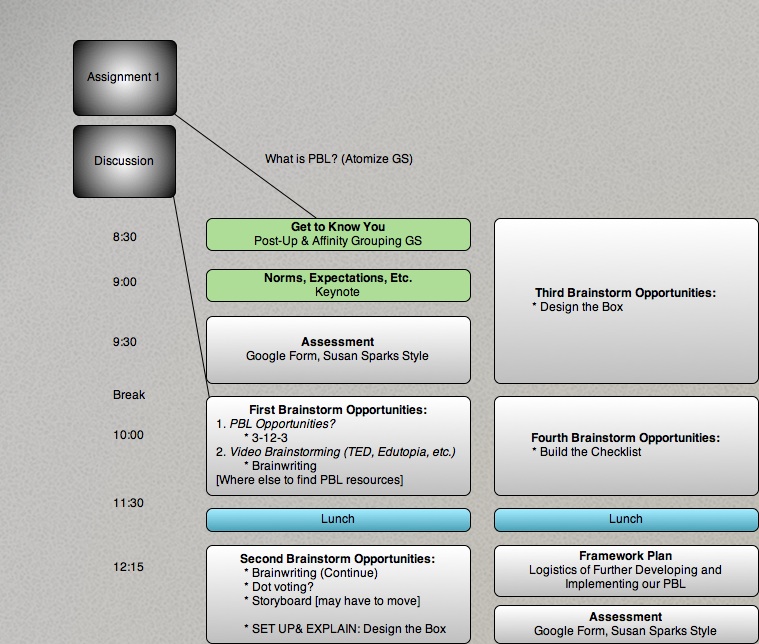
As I write this, it’s early Sunday morning. Tomorrow, on Monday, June 13, Jill Gough and I will begin Day 1 of co-facilitating “PBL: Let’s Build Something Together.” This course is a two-day (10 hour, 1PLU) summer institute through the Center for Teaching at the Westminster Schools. We have about 15 educators coming from 4-5 different Atlanta area schools. Primarily, our essential learnings – our fundamental desired outcomes – number “just” two objectives:

  1. I can brainstorm various possibilities for PBL (project-based learning).
  2. I can create framework plans for various PBL.
Here’s our Curio7 mindmap of how we are structuring the ten hours:
Whereas some people attend conferences, institutes, and workshops expecting a considerable amount of “sit-n-get” knowledge transfer, our participants will be sorely disappointed if they are wanting that typical educational conference experience. Jill and I know we will not “finish” what we are setting out to do. Monday and Tuesday will be mere beginnings.
.
You see…we really want to build something together. If we actually accomplish our essential learnings, these 15 Atlanta educators will leave committed to enacting and implementing a PBL-project in the first semester of 2011-12. We are going to learn PBL by doing PBL. Our project: build a multi-school PBL to try in the fall. So, potentially, we could have 4-5 schools putting a PBL idea into practice with students.
.
Imagine the possibilities there! We could continue to develop the project as a virtual lesson study. We could engage in instructional rounds and visit each other’s schools to observe how the project is implemented at each place.
.
Last week, at a learning opportunity at Trinity School, @gcouros challenged us all to think of ourselves as school people and lead learners. He asked us to think bigger than just our own individual classrooms. Shouldn’t we do the same for school vs schools?! Imagine what we can learn together.
.
I love being excited about something which is about to begin!