Tearing Down Walls

We live in an increasingly connected world. Yet barriers to connection continue to operate in schools. Kathy Boles at Harvard has described school as the egg-crate culture. With some exceptions, teaching can be an isolated and isolating profession, unless teachers and administrators work to be connected to other learners. It is far too easy to go into one’s classroom and teach…relatively alone…siloed. Classes right next door to each other, much less across a building or campus, often have no idea what is going on outside the four walls in which they are contained. And departmentalization makes for an efficient way to deliver content in neat, organized packages, but departmentalization is not the best parrot of the real, inter-connected, messy-problem world.

What can we do to step closer to modeling and experiencing real, inter-connected problem-addressing?  How do we communicate with each other when we are assigned classrooms where we can be siloed?  What could greater connectivity look like for learners of all ages?

Recently, learning partners Jill Gough and Bo Adams submitted a roughly made prototype of a three-minute video to apply for a speakers spot at TEDxSFED. It’s about “Tearing Down Walls.” It’s about experiments in learning by doing. It’s about learning.

Riffing, Swirling, and Boarding

Had I taken my sabbatical more than four years ago, I believe that my time at Unboundary would have seemed like a journey to a foreign land. As it is now, Unboundary is very recognizable and familiar to me because of the work in which I have immersed myself regarding PLCs – professional learning communities.

In The Fifth Discipline, Peter Senge writes:

The tools and ideas presented in this book are for destroying the illusion that the world is created of separate, unrelated forces. When we give up this illusion – we can then build ‘learning organizations,’ organizations where people continually expand their capacity to create the results they truly desire, where new and expansive patterns of thinking are nurtured, where collective aspiration is set free, and where people are continually learning how to learn together.

During my first week as a sabbatical intern at Unboundary, I witnessed the power of three collaborative tools: riffing, swirling, and boarding.

  • Riffing is improvisational brainstorming. Often team members will declare that they are riffing. This seems to bring into play a set of unspoken, agreed-upon norms – these next ideas are for building more ideas, so don’t shoot them down and don’t add them to the more-concrete draft yet. Just hear me and think with me. Try to pick up a note that you can riff on, too.
  • Swirling is perspective and feedback seeking. It is asking for input and assessment. It provides evaluation from the standpoint of mixing things up so that new lenses can be applied to the thinking and creation.
  • Boarding is communal mind-mapping. Making boards literally means putting index cards up on a tack-board wall (often movable panels) in order to outline and storyboard an idea. By utilizing a board, big-picture visualization and idea connectivity is facilitated.

Watching an Unboundary team riff, swirl, and board is akin to watching a PLC. In a PLC, team members work through the four questions: 1) what should be learned, 2) how will we know if learning is happening, 3) what will we do if it has already been learned, and 4) what will we do if it is not being learned. In a PLC, this work is accomplished collaboratively through such practices as analyzing student work, establishing SMART goals and essential learnings, engaging in lesson study, and participating in instructional rounds. By working together and breaking out of the traditionally isolated way of working in schools, PLC members are able to riff, swirl, and board their ideas…all for the benefit of learning. WE are smarter than ME. Therefore, schools need to ensure time and space for teachers to work together as lead learners, rather than continuing on the path of the egg-crate culture typical of most schools.

In the 21st century, schools and other businesses – all learning organizations – must partner together to share productive and innovative techniques. We need to expand our capacities to create the results we truly desire, we need to nurture new and expansive patterns of thinking, we need to set free our collective aspirations, and we need to learn how to learn together. We need to riff, swirl, and board…together. We need to unboundary ourselves and strive for more significance…together. Imagine the thinking that school and business could do as a team. Imagine the thinkers we would facilitate in schools – thinkers who would grow into the business leaders of tomorrow. Imagine the learning that could happen!

– Senge, Peter. The Fifth Discipline: The Art and Practice of the Learning Organization. New York: Currency Doubleday. Accessed via e-copy on Amazon Kindle App for iPad.

Shouldn’t Practice Mimic the Game?

During my life, I have participated pretty heavily in sports. Play is fun and a great way to learn. I have dabbled in all kinds of sports. As I grew up, I played a lot of soccer. Not surprisingly, preparing to play soccer involved a great deal of playing the actual game. Sure, we drilled, but the drills were just micro-parts of the whole game. In late high school, I migrated to triathlon. While I certainly lifted weights and participated in stretching and plyometrics, most of my training involved actually doing long hours of swimming, biking, and running. Practicing was direct application and immersion in the sports. On “brick” days, I actually combined two, and sometimes all three, of the sub-sports with transitions so that practice immitated an actual triathlon. Practice was a virtual mimic of the game/event for which I was preparing. Is school, in its traditional format, a virtual mimic of the game/event for which we are preparing students?

My school’s mission states that we are preparing students for college and for life. I have a pretty good idea of what college is like. I have been to several as an undergrad, a post-grad, and a graduate student. My experiences at those colleges was fairly similar to my experiences as a student in K-12 school. The formats, structures, and cultures were similar. By “life” I think we mean “work” to a considerable degree. For many of one’s waking hours of life are spent working. During the past 20 years, I have spent my career working in schools, but I have never really worked in the “business” world. As an undergrad, I trained as an economist and as a marketing-management scientist. But that’s not the same as really living the business-world life that most of our students will enter after college. How do we know that we are preparing students for the “life” part of our mission? Are you reading as much as I am that business leaders indicate that students are not so well-prepared for the work-life realities? Could it be that the the practice is not a close enough mimic of the game? Is this why UVa Med School is striving to make practice more like the actual game?

In the past three days at Unboundary, I believe I have been given a rare gift as an educator. I have immersed myself in the “business world.” I will continue to do so for several weeks. While one, short sortee into the business world makes me no expert, I do have a new perspective than many career educators don’t really get to experience. I feel like I have been able to discern another data point on the life-education graph, and doing so allows me potentially to draw a line of better fit from school to college to life.

Moreover, in the past three days, I have seen in my mind’s eye the replaying of several influencial videos that I have written about and shared in previous blog posts. Sir Ken Robinson’s RSA video has come to mind countless times. The Buck Institute videos about project-based learning, and the ongoing conversation that Jonathan Martin and I are having, come to mind. Steve Johnson’s “Where Good Ideas Come From” – both the TED talk and the RSA video – come to mind. Kiran Bir Sethi’s Riverside School comes to mind. Edutopia’s videos on High Tech High and other immersive learning environments come to mind.

Maybe more than anything, I feel empowered to continue refining and revising the Synergy 8 course. For those who are new to this blog, Synergy 8 is a new course that Jill Gough and I co-facilitate for 8th graders at Westminster. This fall, Synergy 8 experienced it’s pilot semester. In short, the course is…

  • Based on The Falconer by Grant Lichtman
  • Non-departmentalized and integrated in nature (we combine content and skills from the various departmental domains)
  • Project-based and problem-based
  • Steeped in high-level communication and presentation
  • Focused on community issue identification and solution
  • Learner-centered

Watching a team of three Unboundary pros working on a pitch, presentation and workshop design has been like watching the game or event that we are preparing Synergy 8 students to play in our practice sessions. It has been like looking in a mirror to study our form and muscle memory. It has been like preparing for life. Not “like”…it has been preparing for life.


Time Travel & Closing the Swashbuckling Gap

For the past two mornings, I have taken my 6-year old son to school. So, of course, my 4-year old son wanted me to drive him to school one morning. Today was the morning. But my youngest doesn’t have to be at preschool until 8:45, so we played!

As I finished dressing, JT asked if we could play pirates with his Fisher-Price Imaginext. He loves to play pirates with this set of toys. At first, we were very historically pure. Then, a problem arose for JT, and he must have reasoned that Spiderman was the right tool for the issue. Without missing a beat, Spiderman entered the scene. Then, air travel became a necessity for the scenario. No problem. JT requisitioned a modern-day airplane from another Imaginext set. Of course, he saw no problem with this mix-it-up mentality.
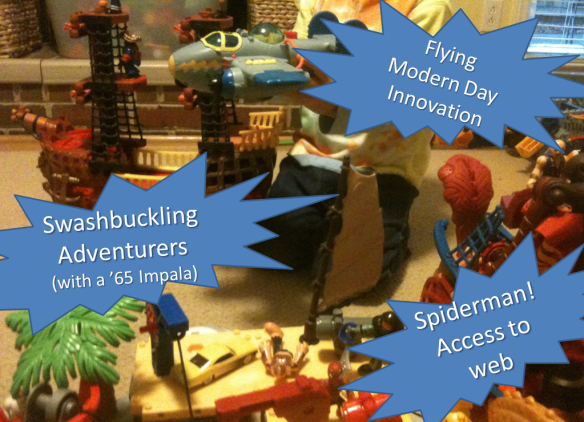
I am a bit saddened to think that JT will experience the departmentalization of thinking when he enters “real school.” If listening to teachers and students today is any indicator, this division of cognition may be inevitable (I hope it’s not!). I repeatedly hear students utter, “This is math class. Why do we have to write?” Or, “This isn’t English class, so does spelling and grammar count?” This happens with teachers, too. “I am just reading for content. The English teachers can deal with all that comma and semicolon stuff.” Or, “I am a math teacher. I am not a writer.” How dare we impose such boundaries on the human imagination and capacities of thinking. JT is a swashbuckler who sees no problems with inserting a 1965 Chevy Impala into a pirate scene – even if the figurines don’t stand a chance of fitting in the vehicle. And he wasted no time justifying the mashup with the excuse of time travel. He just mixed up the tools that he needed to use for the scenario that his imagination was making real.

Yesterday, I spent day 2 of my sabbatical at Unboundary, where I am interning at this amazing strategic studio. At 9:15, the Traffic Director (what a cool title!) informed me that there would be a 10:30 meeting for a project team working on a pitch proposal to a company considering three bids for brand positioning. I spent the next 4.5 hours with this swashbuckling trio, and I feel like I gained an entire semester’s worth of learning in a half a work day.
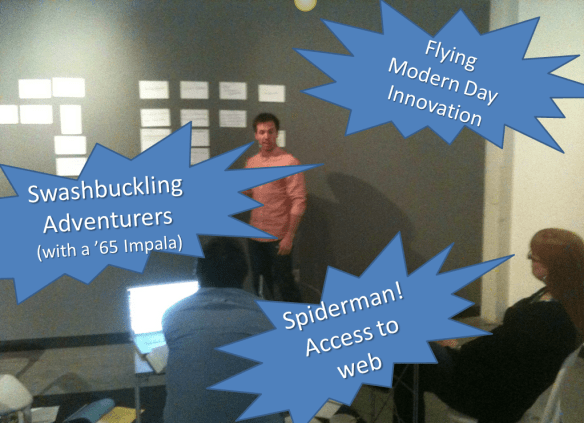
Throughout the work session, the team utilized powerful brainstorming by storyboarding on a tack-board wall. Disciplines that we would separate and segregate in schools were seemlessly engaged. No one uttered stuff like, “I am not a writer, so you’ll have to take it from here.” When drawings and sketches were needed, they were added to the cards and wall. Mistakes, errors, and failures were expected and taken for granted because they were prototyping – it’s just part of real work. No one handed them a text-book-style, neat-and-clean problem to solve. They began by defining the issue to be addressed. They identified the “problem” and worked to collectively reach a workable solution to the problem. They noted extractions they would need to make from previous and existing work – other projects. No one ever said, “that will never work.” But they did push certain ideas aside and rearrange the wall when a more exciting idea emerged. They encouraged me to participate and contribute rather than just sit, observe, and listen. They treated me like a co-pilot, not just a passenger along for the ride. They made me feel like a we. There was no sage on the stage, but there were mutual guides on the side. When creative obstacles emerged, they…joked. Metaphorically, in my opinion, they were mixing it up and mashing it up like my son JT. Consequently, new insights and possibilities emerged. When they needed to…they ate. The creative brain needs food, and there were no bells signaling that it was time for lunch. But they knew they needed brain food, as well as Brain Food. When a reasonable stopping place was located, they asked for evaluation and feedback from the Executive Director of Creative Intelligence. This trusted source never said, “Good job.” His feedback was precise, specific, detailed, and thought-provoking. There was no grade, but there was loads of assessment. Self-assessment and evaluation by the team all day long, and macro-assessment from the EDCI.

While I know I am overgeneralizing, I wonder about the gap that exists between my son’s natural mode of play and the seemingly natural way to work after college. Of course, there are parts of school that model and mimic childhood play and adult work (play?). But they are not enough. Education is about drawing out what is already there. It is like a sculptor revealing what lies within the chunk of stone. School seems too industrial, too assembly line, too departmentalized. School seems too content-delivery oriented rather than reveal-what-is-already-there oriented.

This morning, I completed my second read of Seth Godin’s Tribes. On page 137 of the hardback, Godin quotes Einstein, who said, “Imagination is more important than knowledge.” Godin continues:

Leaders create things that didn’t exist before. They do this by giving the tribe a vision of something that could happen, but hasn’t (yet). You can’t manage without knowledge. You can’t lead without imagination.

Creativity should not be segregated to art classes and fiction writing. Imagination should know no bounds. We need to unboundary the lines between departmentalized subjects. We need to combine pirate ships, Spiderman, 1965 Chevy Impalas, airplanes…English, math, science, and history. If it requires time travel, so be it. We need to lead. We need to close the swashbuckling gap.

UVa Med School: Case Study in 21st C Ed

One tweet and one email from two trusted colleagues and educators caused me to move this article to the top of my reading stack. Oh, was it worth it.

Are you confused by the term “21st century education?” Read this article about UVa Medical School, and I bet you gain extraordinary clarity. Project-based learning, problem-based learning, integrated studies, formative assessment – it’s all here! Change the topic from medicine, and the meta-example is applicable to any field or discipline. This is where I hope we are moving in education and schools!

http://uvamagazine.org/features/article/adjusting_the_prescription/

[Added 3-5-11 @ 8:17 a.m.]
Megan Howard’s To The Lighthouse blog post, The Rx for Education?, is an excellent resource with even more article reference and discussion possibilities.

[Added 3-12-11 @ 7:32 a.m.]
Karl Fisch on “The Learning Studio” at UVa Med.