Being a student of your own school. #LearningWalks #InstructionalRounds #Pedagography

We are a School of inquiry, innovation, and impact. Grounded in Christian values, we prepare all students to be college ready, globally competitive, and engaged citizen leaders.

Mount Vernon Presbyterian School Mission

How are you studying your own school? In what ways are you being a student of your own school?

Certainly you send folks to conferences like bees sent to collect pollen. It’s likely that you send faculty to other schools to learn from their practices, too. Incredible stories continue to emerge from systemic school visits (see bullets below). Of course, there are countless virtual opportunities, as well. All of these techniques are critical parts of professional learning, for sure.

But how are you ensuring you have an effective “honey production” capacity, back at school, with all of that pollen you are collecting? Are the bees only set up in their own relatively isolated honey-production facilities (“classrooms”), or are you intentional about connecting those glorious hexagons into a fully optimized honeycomb (“learning community”)? How are you tapping the wisdom and experience of your faculty as they intentionally live at the nexus of research and practice?

MVPS Norms Promote Productive Postures

At Mount Vernon Presbyterian School and the Mount Vernon Institute for Innovation, we are intentional students of our own school. As a School of inquiry, innovation, and impact, we are as purposeful about living out those qualities in ourselves as adults as we are about nurturing them in our student learners. And that makes all the difference.

Our norms empower us in numerous ways to take on this work and define the postures to help us collectively succeed:

  1. Start with Questions
  2. Fail Up
  3. Assume the Best
  4. Share the Well
  5. Have Fun

From such postures and commitments to inquiry, innovation, and impact, we study ourselves in a number of systemically connected ways. Two primary methods include learning walks and instructional rounds.

Learning Walk and Instructional Rounds

design as changing existing situations into preferred situations

– from Debbie Millman interview with Joe Marinek

Mount Vernon is a community of educational designers. Consequently, we feel emboldened to use design to intentionally and purposefully change existing situations into preferred situations. As designers and design thinkers, we create and employ various auto-ethnography tools to help us meet the actual needs of the users for whom we are designing. These tools help us in optimizing our honey production.

Learning walks provide us with broad surveys of our teaching and learning ecosystem. Instructional rounds provide us with deeper dives into our pedagogical practices. And our particular brand of learning walks and instructional rounds enable us to map our learning operations as a school.

  • Shelley Clifford, Head of Lower School, shares practice of learning walks with parents
  • The “MVPS Learning Walks and Instructional Rounds” primer document, available on Scribd and embedded below, gives an overview of these integrated practices at Mount Vernon. At the bottom right-hand corner, you will find some additional resources linked, so that you can explore things more fully. Below the embedded Scribd document, there is a link to Bo’s Diigo library list for “Instructional Rounds,” as well as a Twitter archive of a winter #ISEDchat on instructional rounds, moderated by Chip Houston.

Innovating Instructional Rounds –> Pedagography

At Mount Vernon, we are innovating the practices of learning walks and instructional rounds. Learning walks have been a part of the MVPS culture for awhile.

This year, though, we began piloting new iterations of prototypes for learning walks, and we added instructional rounds to our repertoire. Almost immediately, we started to innovate instructional rounds beyond how they exist at any other school.

In the Middle School, our Heads of Grade identified a wildly important goal for themselves, and they worked with the Head of Middle School Chip Houston, the Director of 21C Teaching and Learning Katie Jones, the Director of the Center for Design Thinking Mary Cantwell, and me (the Chief Learning and Innovation Officer) to establish a system of observing each other for intensive feedback and discussing the feedback to develop practice.

We relied heavily on the instructional rounds work of Elizabeth City and Richard Elmore, we threaded in Japanese lesson study, and we also incorporated a mapping project into our IR work. While observing, we committed to collecting data that would allow us to more accurately map our teaching and learning core, just like Lewis and Clark mapped the Louisiana Purchase with the Corp of Discovery, or just like Google is working to map the Earth. We call this learning-culture mapping “Pedagography,” which is derived from work I initiated and led at Unboundary called “Pedagogical Master Planning.”

As a team of eight, we embarked on a journey of engaging in pedagography. Chip, Katie, Mary, and I served as the first four-person observation team for the Heads of Grade – Stephanie Immel, Maggie Menkus, Amy Wilkes, and Alex Bragg. During the visits, we collected narrative notes that draw on clinical observation as a methodological basis. These notes are reviewed by the observed teachers, and the recordings serve as the lenses through which we reflect on practice and debrief as a team. These Middle School Heads of Grade pioneered this new approach to instructional rounds and pedagography, and they provided invaluable insights into the development of the practice.

To conduct a thorough pedagography, in addition to the narrative notes field, we use a number of other capture prompts that we aggregate over time to help us see more holistically our teaching and learning ecosystem. Currently, we call the entire Survey Monkey tool “Proto 3,” and we are in the process of iterating to Proto 4.

Survey Monkey Tool – Proto 3

Expanding the Instructional Rounds Practice

After tremendous first-semester work among the #MVMiddle Heads of Grade IR Pilot Team, Houston decided to expand the practice to a widened circle of educational innovators. Leveraging the experience of the pilot team, additional Middle School faculty were engaged in another start-up of the pedagography experiment.

Additionally, we decided to expand the work into another division, as well. Head of Lower School Shelley Clifford and Director of 21C Teaching and Learning Nicole Martin pulled their Think Tank and Heads of Grade into the instructional rounds + pedagography. Like ripples in a pond, more teachers were being invited into this honey-production capacity building.

Conducting the Instructional Rounds Debrief

For the initial pilot of instructional rounds in the Middle School, we made the decision to jump in and get started immediately. Whereas some schools spend months prepping and training for new initiatives, Mount Vernon thrives in a “lean start-up” and entrepreneurial energy, and we believe in shipping innovations and learning by doing and iterating.

In the fall, the debriefs of the instructional-rounds observations were relatively unstructured, and we experimented with various methods for debriefing as we evolved the experiment. We learned a great deal from those debrief sessions, in terms of our meta-cognitive approach, and we applied that learning to the Lower School expansion.

For the Lower School, we started the debriefs as we did in the Middle School – the observed teacher reviewed the field notes and began the first debrief by thinking aloud about the notes and observations. Quite rapidly, though, we’ve moved to a developing protocol that asks the observed teacher to highlight the key reflections in the narrative and prepare a problem of practice objective to dig into during the debrief. Because of the hour-long time frame of the debrief and the need to discuss multiple observations, we focus each teacher debrief at about 10-15 minutes. Most recently, we’ve added “chalk talk” to our debriefs, and we systemically review the dynamic of the curriculum, instructional methods, learning space setup, and student engagement.

The Lower School Heads of Grade – Eileen Fennelly, Sherri Kirbo, Andrea McCranie, Chris Andres, and Jenny Farnham – have been an amazing team of rounders and pedagographers, especially in the ways that they are accelerating the protocol advancement of the debriefs.

What has also been profoundly rewarding is a bit of serendipity. At the same time that the Lower School was taking on the instructional rounds piloting, they also launched three book-study cohorts focused on Carol Dweck’s Mindset. As we jumped into more intensive feedback surrounding the instructional rounds practices, we found it incredibly helpful to also be studying the growth mindset as an entire division of faculty making honey together.

Beginning to Explore the Pedagography Maps

This year at the NAIS (National Association of Independent Schools) Annual Conference 2014, I unveiled some of the data visualizations that we are starting to build from our pedagography at Mount Vernon. Grant Lichtman and I partnered for a session that explored Zero-Based Strategic Thinking and practices such as pedagography that can be utilized in such self-study as a school learning community.

Chip Houston, Shelley Clifford, and I are already planning to devote an entire session at next year’s NAIS Annual Conference to the practice of instructional rounds and pedagography (provided our proposal gets accepted).

Recently, Houston, Clifford, Nicole Martin, and I spent time digging into the aggregate data that we have collected from 350 ethnographic visits and observations across two divisions. In the near future, we’ll reveal more about what we are learning from these mappings of our teaching and learning ecosystem.

Using External Visitors, Too

During this academic year, Mount Vernon has hosted over 40 schools for visits to our campus. Early on, we realized the incredible advantages and benefits to inviting our visitors on learning walks with us. As a final leg of these host-visitor learning walks, we debrief the visit using such visible thinking routines as “See-Think-Wonder” and “Rose-Thorns-Buds.” The insights provided by our visitors are proving invaluable as we compare and contrast what they observe and share with our own archives from instructional rounds.

More to Come – A Mea Culpa

Reading back through this post, I realize how incomplete it is as a true record of the incredible work that the Middle School and Lower School leaders have been engaging to study our school and develop our learning community. However, I’ve been about to burst at the seams to start telling the story here, so I hope you’ll forgive the errors of omission committed by me in my excitement. Any gaps are the fault of my writing and not the fault of the incredible professionals forwarding this work —

Chip Houston, Katie Jones, Shelley Clifford, Nicole Martin, Mary Cantwell, the Middle School Heads of Grade, the Middle School IR Network Group, the Lower School Heads of Grade, Emily Breite, Kelly Kelly, and a number of others who support our work.

We look forward to sharing more of the well with you as we continue to innovate around professional learning and practice at Mount Vernon Presbyterian School and the Mount Vernon Institute for Innovation.

#MVimpact Mount Vernon Presbyterian School’s Transdisciplinary Capstone Projects Expo

Print

From a letter to parents from Tyler Thigpen, Head of Upper School at Mount Vernon Presbyterian School:

Dear Upper School Family,

When a representative from Dartmouth College was on our campus Monday, an Upper School student astutely asked, “Beyond test scores and GPA, what can set me apart as a candidate to your school?” The representative responded simply, “That you make an impact.”

Speaking on behalf of the Upper School faculty and staff, we could not be prouder of your students who have done just that – i.e., “made a dent” – over the course of this year. Led by mentors, Upper School students, via their Transdisciplinary Capstone Project work, have collaborated, empathized with others, failed fast to iterate, actively used knowledge, and ultimately engaged real world issues as compelling contexts for learning. Tomorrow’s EXPO is both a showcase and also celebration of the impact students have made. And you are invited to drop in anytime between 9:15 a.m.-10:45 a.m. to see and celebrate the wins.

To highlight just one such project, I invite you to visit Wedding Wells, an emerging nonprofit, led by seniors Shelby Garde, Addie Goins, and Judge Jones, and juniors Gareth Tremege and Hannah Zenas, that aims to link the love of selfless American couples bound to be wed with underprivileged men, women, and children in dire need of safe drinking water.

If you are unable to visit the EXPO in person, you can follow the action on twitter via the hash tag #MVimpact.

Storify archive of #MVimpact.

This slideshow requires JavaScript.

This slideshow requires JavaScript.

* With enormous gratitude and genuine awe for the @MVPSchool Project Managers (Kristyn Anderson, TJ Edwards, James Campbell, and Zach Strother), the #MVUpper Faculty extraordinaire, and, especially, the student innovators, collaborators, creative thinkers, communicators, solution seekers, and ethical decision makers. YOU MAKE A DIFFERENCE!

= = = = =

Real-World Impact: Guest Post @TylerThigpen #MVPSchool #MVIFI #MVImpact, January 16, 2014

Be Present: Mount Vernon Plays to Connect #SXSWedu Session & Creative Mornings Atlanta on #Childhood

How are you being present – being in the present – and playing to connect?

On Tuesday, March 4, thanks to Mary Cantwell, Trey Boden, a number of folks @MVPSchool, and the organizers of SXSWedu, I enjoyed a fabulous opportunity to facilitate a Playground Session at SXSWedu, in the “Hands On” category.

Screen Shot 2014-04-13 at 4.40.08 PM

Our game plan for the session can be found on Scribd and Google Docs. And Mary (@scitechyedu) captured much of the fun, in pictures, with her post “Mount Vernon Plays to Connect @ #SXSWedu.”

By playing, we were not preparing for anything in particular or readying ourselves for the future. We were playing to be present – to be in the present – and to connect with our fellow playmates, or learners. We were playing to connect with our inner child, our beginner’s mind, and our innate storyteller. We were playing to #HaveFun and thread connections among ourselves and others.

We were playing to…play.

Like kids on a playground.

Like we did when we were immersed in our own childhoods.

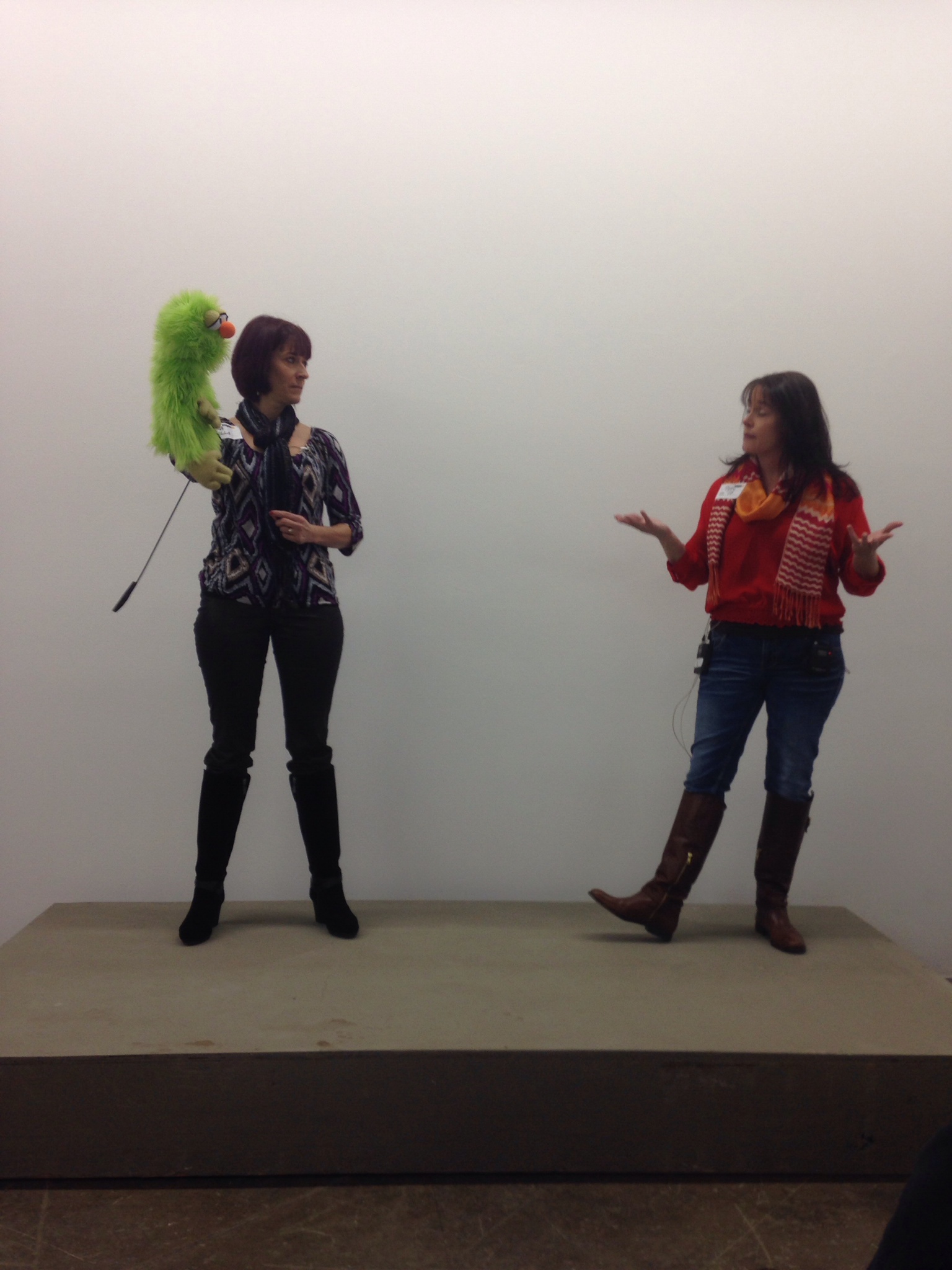
At the end of January, Shelley Clifford and I attended a Creative Mornings Atlanta. The theme was “Childhood,” and we heard Aretta Baumgartner and Patty Dees speak about puppetry arts as a way of reconnecting with our childhood — being fully present and playing to connect. As Aretta captivated us all, she strung us together in a game that put us in the role of puppets. And our biggest challenge was to BE PRESENT. To let go of our egos and to simply enjoy playing.

puppetry


During the #SXSWedu Playground session “Mount Vernon Plays to Connect,” we reiterated this point about the power of play — there is great energy and fun in being present and being in the present. Amidst the joy of doing so, we connect to a great many things, and, more importantly, to a great many other people.

When we play, we are like children embracing their childhood — playing to learn, playing to connect, and playing to…play.

Be present. Be in the present. Embrace your childhood. Connect. Go play.

Innovative School Seeks Innovative Leader

HEAD OF UPPER SCHOOL
Position Description

Innovative school seeking innovative leader. Mount Vernon Presbyterian School is accepting applications for the position of Head of Upper School (Available June/July 2014). Head of Upper School reports directly to Head of School and collaborates with Chief Learning and Innovation Officer and School division leaders.

Mission and Vision

We are a school of inquiry, innovation, and impact. Grounded in Christian values, we prepare all students to be college ready, globally competitive, and engaged citizen leaders. Established in 1972, Mount Vernon Presbyterian School, serving 900 students in preschool through grade 12, is located in the heart of Sandy Springs, Georgia within the metropolitan Atlanta area. Located on the 30-acre Glenn Campus, the Upper School (grades 9-12) student body has more than doubled in size during the last five years and is projected to exceed 300 students in 2-3 years.

We are building something exceptional here. The School is in the midst of a new era of exploration and innovation, under the guidance of an energized staff, Board, and faculty leadership as well as committed and connected families. As an outward expression of our inward passion, the 2012-2017 Strategic Plan is driven by a fundamental MVPS question: How might we innovate school to meet the needs our students and our world? The School has been aggressive in launching key programs to position our students as realizers of our mission: Mount Vernon Institute for Innovation(MVIFI), Mount Vernon Mind, Council on Innovation, Center for Design Thinking, Innovation Diploma, Interim international travel opportunities, transdisciplinary education capstone project, College and Work Readiness Assessment, Write Now, and //fuse to name a few.

Roles and Responsibilities

Amplifying the mission and executing the vision of the School, Head of Upper School plays a creative and collaborative role:

  • cultivating and nurturing strong relationships within the School community–students, faculty, parents and other partners.
  • designing a vigorous, relevant, and innovative learning and assessment map for each Upper School learner–students, as well as faculty.
  • employing a variety of evidence-based and innovative approaches and methodologies in order to engage and motivate students of this generation.
  • exercising an innovator’s DNA–observing, questioning, experimenting, networking, and associating.
  • providing professional learning opportunities supporting individual staff needs/organizational goals.
  • co-chairing Research & Design (R&D) teams.
  • developing partnerships with corporate sector, non-profit community, and civic organizations.
  • researching, identifying, and advancing innovative programs.
  • retaining and attracting high performing teaching candidates.
  • overseeing the day-to-day operations–schedule, meetings, events, calendar, and facility spaces.

Interested candidates should send a cover letter, resume, and link to professional portfolio to employment@mountvernonschool.org.

Not a #Snowcation, but a #Snopportunity @MVPSchool #MVPSchool #MVIFI

If you’re connected to a school in Atlanta, GA, and if your school name is on some local news channel today with the word “Cancelled,” are you considering it a…

#Snowcation, or a

#Snopportunity?

Screen Shot 2014-02-11 at 11.52.17 AM

It’s fascinating to me how many schools have discussed for years such topics as “21st Century Education,” “Blended Learning,” “Virtual Learning,” “Online Learning,” “Digital Learning,” “Connected Learning,” etc., yet when a would-have-been-in-school-anyway Tuesday turns into a snow day, so many at the school see the day as a day off from school-connected learning.

Perhaps it’s due in some way to the language one’s school uses. For sure, a #Snowcation communicates a very clear cultural expectation about the relevancy of school-connected learning when the school people don’t actually meet in the same physical space because of some winter-weather occurrence. On the other hand, to say that “learning is open” even if school is closed communicates an altogether different way of believing. As Peter Block said, “All change is linguistic,” and a school community’s language – even in the seemingly small moments – can either promote the status quo or dynamism.

Perhaps it’s due in some way to the culture of innovation that’s been created and nurtured (or not) at one’s school. I mean, after all, a snow day is a day to kick the feet up and forget about school, right? Because that’s the way it’s always been. Or it could be an opportunity – a #Snopportunity – for a school that’s deeply invested in leading into the future of education — to “ooch” (as the Heath Brothers describe it in Decisive) some possibilities and prototypes for school-connected learning, even when the school community is not gathering at the same physical campus for the day.

Of course, when a school regularly practices design thinking and iterative prototyping, it becomes relatively easy to see a snow day as a chance for extraordinary research and experimentation – all in the “ordinary” way that the school usually approaches windfall chances to learn and create and enhance common practice. Such has become a part of the school’s (Innovator’s) DNA.

And for a school that not only pays attention to the research and development of educational practice, but also contributes to it, it comes as no shock or surprise that the future of education is about learning flows and not just the physical campuses of school houses. So, when a snow day occurs, such a school sees and seizes opportunities to further a deepening understanding of how school and learning can be brought even closer together as ever-eclipsing Venn circles.

I feel genuinely blessed to serve at such a school. And I feel an obligation and responsibility to share our practices – the practices of an entire community of professional learners, innovators, and extraordinary educators.

Sharing Mount Vernon’s Practice

Screen Shot 2014-02-11 at 12.11.08 PM

Systemic Communication from Division Heads & Directors of Teaching and Learning

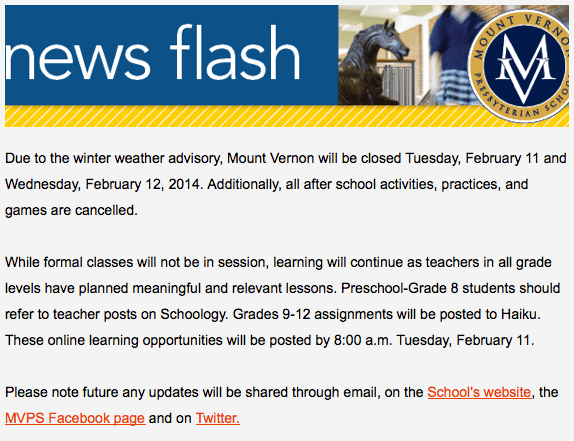
High-value communication and collaboration happen regularly within and among the divisions at Mount Vernon. And the educators act as a team, moving strategically together. So, when the decision was finalized to close the school campuses for Tuesday and Wednesday, the Division Heads and Directors of Teaching and Learning distributed communiques to the faculty. Below is one such message from our Upper School Dean of Academics and Director of Teaching and Learning.

On Feb 10, 2014, at 5:10 PM, Emily Breite wrote:

Hello everyone,

I trust you have seen the news that Mount Vernon’s buildings will be closed tomorrow and Wednesday in the interest of safety. However, as Tyler outlined in his earlier email, we will still treat these days as learning days with the expectation that our students be demonstrating their learning and that we be available to support them as they do so.

Instructions for Faculty and Students:

1. Students will continue with learning exercises and assignments that teachers have posted on haiku by 8 am on Tuesday morning at the latest. Those can be due virtually while we are away or can be due when we return to school. Given that most of the ice is expected on Tuesday evening (from what I hear), it may make sense to have some work due to you by the end of the day Tuesday.

2. For each day that we are away from the building, teachers will hold two face-to-face sessions through Google Hangouts for 5-10 minutes for each of their preps at some point before noon to communicate about the learning plan for each day and to answer student questions. Holding two sessions will allow us to handle the capacity of Google Hangouts (15 people can hangout together at a time) and minimize conflicts for students.

For example:

8:30-8:40 – Honors Biology
8:45-8:55 – Honors Biology
9:00-9:10 – Biology
9:15-9:25 – Biology

You could also break this up into 5-10 minute chunks over four hours, if that works better for your situation. Obviously this will be a bit of an experiment and we will not be giving students official absences or tardies, but I do think we need to make sure students know that this sort of virtual interaction is the expectation and to follow up if they do not engage. (Again, if there are widespread power outages, hangouts may not be possible.)

If you have a special situation that would prevent you from being able to engage with students for 5-10 minutes a few times each day, chat with your Head of Grade and me about a solution. One idea might be to make a little video (capture is one app you can use) to give students an overview of what they’ll be doing and then being accessible via email. A little bit of face-time is the goal.

Below is Mikey’s how-to video for facilitating Google Hangouts and he sent a few from Trey just a few minutes ago.

Thank you for all of your efforts to help us make use of these days. Stay safe!

Emily

Google Hangouts

Even before the above messages were fully crafted and sent, other internal communications at Mount Vernon were bouncing around to provide support and coordinated understanding around our approach to this #Snopportunity.

For example, as mentioned in Ms. Breite’s message, our Director of IT and our Creative Director established resources for faculty wanting to capitalize on Google Hangouts:

Team,

In case of inclement weather, Google Hangouts On Air are a great tool for connecting with students virtually. I have created three video tutorials around Hangouts On Air and a video on the general philosophy of Hangouts and the classroom.

Here is the link to the playlist.

http://www.youtube.com/watch?v=1OGVm2y_gRY&list=PLmaqQXVvvf1FyHdml5-A8KGUiT5er9sUA&feature=share

There are three videos at different lengths:

Google Hangouts New Comers – Longer One
Google Hangouts On Air New Comers – Shorter
Google Hangouts Gurus – Super Short Version
Google Hangouts in the Classroom – Philosophy

As always let me know how I can help.

Trey Boden
Creative Director
Mount Vernon Presbyterian School

For more insight into one of the many Google Hangouts facilitated by MVPS faculty, see the On Air GHO from Trey Boden and his Transformational Leadership class, and read the feature in the Atlanta Journal-Constitution.

Middlebury Language

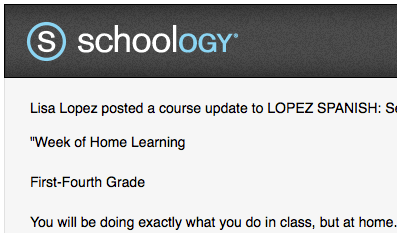
Because Mount Vernon regularly employs the MiddleburyInteractive program to create a blended learning environment for world language instruction, student learners were able to engage various elements of their language acquisition, just as they do when they are in the school house.

Screenshot of a small portion of a thorough Schoology post from a Spanish teacher.

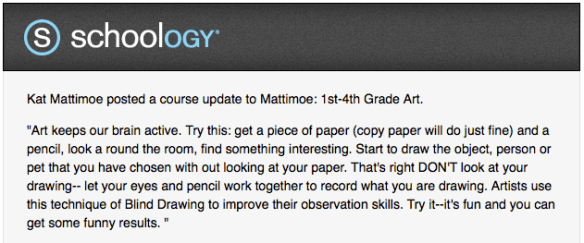
Screenshot of a small portion of a thorough Schoology post from a Spanish teacher.

Learning Management Systems (LMS) – Haiku, Schoology & Orchestration

In a recent leadership podcast from Andy Stanley, Stanley details the importance of striving for clarity in the face of complexity. One way Stanley explains that a complex organization can promote clarity is to “orchestrate and evaluate” – to routinize certain processes and procedures while being diligent and committed to constantly evaluating and bettering those routines.

For my sons, in first and third grades, school-connected learning at home (a.k.a. “homework”) benefits from the routine of Schoology. (As noted above, the Upper School uses an LMS called Haiku.) Each week, long before Monday, my sons’ teachers post the week’s homework outlines and expectations. Because of this technology-enhanced routine, we could continue on today, even during our #Snopportunity.

Third Grade
We are a School of inquiry, innovation, and impact. Grounded in Christian values, we prepare all students to be college ready, globally competitive, and engaged citizen leaders… Even on snow days! As you have heard, school is closed, but learning remains open! We are excited to share some learning opportunities for you and your child to enjoy together.

Literacy

Reading: Read your fantasy book and log your reading. You should be reading a minimum of 30 minutes each day. Read with your pencil in hand to help process the story’s information. Jot down major ideas, happenings, plot twists, character strengths, etc. as you read. Bring your notebook back to school to share with your reading partner.

Writing: Write out loud! “Story tell “ your final totally made up fairy tale to a parent, sibling or friend. Remember to use your storyteller voice thinking about what your characters are saying and doing. Plan through the beginning, middle, and end of your story. Use your parent as a writing partner! What feedback can you glean from them?

Spelling: The students have a prefixes study guide in their homework folders. They should be reviewing the meaning of a morpheme, prefix and base word. They should also review our weekly red words (iron, honest, honor, guess, guest, guard). Complete the Prefix Word Hunt with your family. Brainstorm words that begin with dis, un, pre and in/im. Please bring the word hunt back to school to share with your classmates.

Math
Continue to explore division:

  • review math facts and complete Practice 8-2 (check handouts from backpack)
  • Complete the Daily Spiral Review for 8-3 (check handouts from backpack)
  • Please continue to work on multiplication and division facts with flashcards, iXL and other sites like www.iknowthat.com.

Complete: iXL F.3, F.5 (Multiplication 2s and 4s), G.5, G.6 (division facts to 12 and division patterns)3, F.5 (Multiplication 2s and 4s), G.5, G.6 (division facts to 12 and division patterns)

Design Thinking Challenge (Snow Jam emergency car kit)
Finish either making your “low resolution” prototype or drawing. Remember to add length measurements so we can get the right scale. Bring in drawings and/or prototypes.

Optional Enrichment Learning Opportunities
Winter Olympics
Typing Club
DIY Opportunities
1.https://diy.org/skills/yeti
2.https://diy.org/skills/writer
3.https://diy.org/skills/meteorologist
4.https://diy.org/skills/journalist

Snow day (Tuesday).pdf 65KB VIEW

Mon Feb 10, 2014 at 7:41 pm

And because the faculty are well-practiced in connected learning, they are accustomed to online-enabled interactions with the children. For example, when the art teacher Ms. Kat posted this #Snopportunity for drawing, I so enjoyed watching my email notifications “light up” with the conversation threads happening among Ms. Kat and her students as they traded stories and coaching about what they were drawing around their houses.

Screen Shot 2014-02-11 at 1.19.29 PM

Twitter

Of the 145 faculty and staff at Mount Vernon, about 120 are users of Twitter. So, a snow day does little, if anything, to deter the connected learning and communication among our community of educators. By searching the hastag #MVPSchool, you can see some of the interactions and exchanges that have happened as collective habits of minds engaging this #Snopportunity. As another example, you could peruse a Storify that details another #CarpeOpportunity moment two weeks ago during the snow and ice that hit Atlanta during the last days of January.

These are but a few of the ways that Mount Vernon calls on its Innovator’s DNA to take advantage of a #Snopportunity. In closing, it’s also worthwhile to see how our Communications Team encourages school-connected learning at home to be shared and showcased among our community…

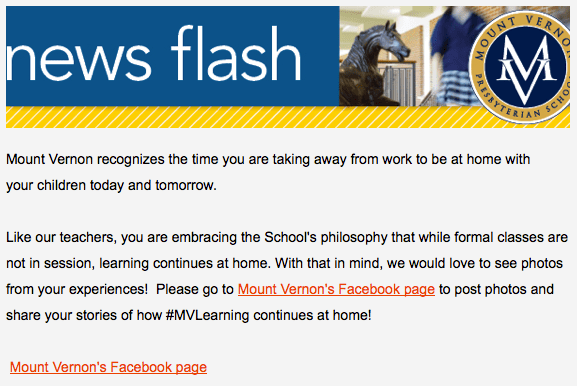
Screen Shot 2014-02-11 at 12.41.00 PM
= = = = = = = = = =
RELATED:

“Snow Days Turn Into E-Learning Days for Some Schools,” EdWeek, January 31, 2014, accessed via e-newsletter February 15, 2014.

“Classes move online when schools close,” Atlanta Journal-Constitution, February 13, 2014, accessed February 15, 2014.

“Snow Day Thoughts for Educators–and Parents, Too,” Peter Gow, The Interested Child, February 13, 2014.