GOOGLE and the JHS

Recently, I have been struck by the number of people who are talking about Google’s “philosophy” of encouraging engineers to take up to 20% of their at-work time to pursue projects of their own. Here are a few of the hits produced if one Googles the topic:

According to many of the stories, some of Google’s greatest innovations have been born from this 20% time. Rather than assuming the typical hierarchy of organization would provide vision and mission to “require” a workplace of innovation, the admin and management merely provide encouragement for an attitude of “bottom-up” leadership (I hate that term and what it implies). The admin and management simply encourage the professionals to pursue personal interests and they provide time for that pursuit to happen at work. As I read the blogs and article linked above, I became intrigued by the idea of “grouplets.” Rather than individuals pursuing personal projects, engineers were banding together to work collaboratively with this 20% time.

At Westminster, in the Junior High School (JHS) in particular, we have been on a multi-year journey to restructure professional development. We are using the professional learning community (PLC) model and principles to create a new infrastructure for teachers (our “learning engineers”) having the opportunity to work collaboratively together. We have taken a bit of an aggressive approach, and we believe that job-embedded time must be created for such collaboration.

Typically, teachers carry a five-class student course load. For example, a math teacher, in the past, would have five sections of student classes. In the more recent history, we have transitioned one of those periods to be a PLC period. In essence, we have created something akin to Google’s 20% time. One of five sections, transitioned to serve as a PLC period for teacher collaboration, equates to “20% time.”

Through the PLCs, teachers are innovating! Just having a guaranteed time to discuss all of the complexities of teaching and learning is such a positive development. However, much more than discussion is happening. With these four hours per week (we have a rotating schedule and every period meets four times per week), teacher teams are re-exploring writing as thinking, formative assessment ideas, second-chance testing, four-point rubric development, technology integration, content understanding in various fields, and the list goes on.

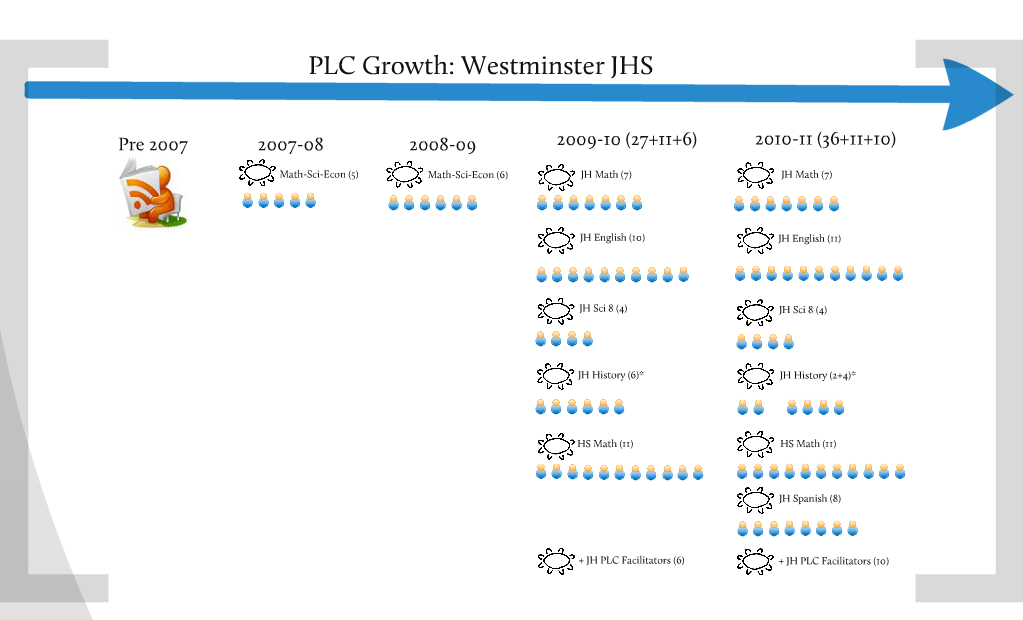
But I wonder if the 42 (of 74) teachers currently involved in formalized PLCs (we plan to work toward 100% integration for ALL teachers) see their PLC period as this Google-esque 20% time. I believe some do, for sure. But do all of them? Have I exercised my leadership in such a way that it is obvious and communicated clearly that PLC time can be for assessing student learning and creating innovations for enhancing that learning?

So many opportunities, so many possibilities! By striving to “democratize” the work day for careful study of student learning and possible educational innovations, don’t we increase the likelihood for better teaching and learning? In fact, without the 20% time in schools for the commited, motivated teachers who strive for their own continued learning and that of their students, will we really improve education, in any considerable ways, during this second decade of the 21st century?

Here’s to a New Year’s resolution for “20% time” in our schools…for the countless, dedicated teachers who simply need time to collaboratively explore, discover, innovate, and educate!

Figure 1: Formalized PLC Growth at Westminster, 2007-2011
Move…Learn

“Move and the way will open.” Enjoy this brief Garr Reynolds’ post and think of ‘moving’ as ‘learning.’

Grades – A Measure or a Rank

Is a course grade a measure of a student’s learning? Is a course grade merely a way to rank students for whatever gateway comes next? Can a course grade be both and do a good job at each task?

Recently, a good colleague sent me a link to a New York Times Education article on grading at University of North Carolina, Chapel Hill. The article begins like this…

It could be a Zen koan: if everybody in the class gets an A, what does an A mean?

The answer: Not what it should, says Andrew Perrin, a sociologist at the University of North Carolina, Chapel Hill. “An A should mean outstanding work; it should not be the default grade,” Mr. Perrin said. “If everyone gets an A for adequate completion of tasks, it cripples our ability to recognize exemplary scholarship.”

The article author Tamar Lewin goes on to explain that UNC is considering adding more context to its grading – a median average to accompany the mean average, as one example. In my opinion, the more context that can be added to a grade, the better! A grade devoid of meaningful context is not worth much. Why? My answer: because grades mean so many different things to different people.

Just read the article to get a snapshot of the confusion surrounding grades. I am not sure that such a thesis was intended by the author, but that is what the article concisely points out for me. For the schools that declare something like “no more than 35% of students can receive A’s,” they are clearly siding that grades are merely rankings. Relative achievement numbers so that the students can be lined up against a wall from “best to worst” – at least as well as such can be done with the likely imperfect instruments used to evaluate student learning (in theory).

But shouldn’t grades be real measures of learning? In the ideal, shouldn’t a grade give a learner an indication of how he/she performed relative to a clearly articulated standard…a mutually visible quality criteria (mutual in that the teacher and the student can see the same target equally well)? In this case, a grade is an absolute achievement number, not a relative achievement number. Such a grade would indicate to a student how he/she measured against a clear learning goal – NOT how he/she measured simply relative to other people.

What if Mr. Perrin taught a seminar course of 20 students, and all twenty students happened to be the “best” 20 students on campus? (Just go with me for a minute.) If Mr. Perrin had established and made known to his students (better yet…established with his students) the clear learning targets, AND if the 20 students had all achieved at the highest levels according to those clearly established targets, THEN shouldn’t all 20 get “As?”

Granted, if all 20 got As, it would make it very difficult for a receiving institution to know which one of the 20 students was “the best of the best.” But don’t grades fall short of their true meaning and intent when we use them as simple, imperfect rankings? If used for their true meaning and intent, shouldn’t the grades be for the primary purpose of the RECEIVER of the grade?! Should not the grade be an indicator to the receiver – the earner – of the grade that “Oh, I understand this material and this set of skills – the grade indicates that to me’? Or should the grade just be…”Oh, I am ranked 8th of 20 in this course. I was not in the top 35%. I must not know the material that well”? What if all of the top 8 MASTERED the content targets…the course objectives…the quality criteria? Is it just “too bad” for that 8th student?

Maybe the course instructors don’t really know what the clear targets are. Or maybe they don’t know how to articulate clear targets to the students. Or maybe they just didn’t articulate any targets to the students. Or maybe the targets are complex enough that simple numerical averages are not enough to communicate one’s understanding of the material and skills. Does my weight, alone as a number, indicate my level of health? Does my BMI, as a stand-alone number? Or would more context be helpful?

More context of the learning objectives is needed. Kudos to UNC for realizing that more context is needed. I hope Mr. Perrin considers that grades might be best used for communicating to the learner rather than to the next gateway through which the learner must pass. No wonder students “grade grub.” If the grade is just a relative benchmark for lining me up so that I can be “assessed” for the next program, then I would grade grub too! I am a learner – why would I not learn such a behavior if the grade just indicates a ranking. To grub a point is the most simple way to increase my rank – a decent plan A to move up the ranks. How can we blame students for such a behavior if we create the system that promotes such behavior?

BUT…if grades were a measure of my learning compared to clear targets, then “grade grubbing” might come more in the form of such questions as, “What did I not know as well on this content?” “How could I learn it better next time?” I love it when I hear these types of questions!

Vlogging is Thinking – PBL

Today, my post comes in the form of a “vlog” – a video blog. The vlog is highly imperfect and is very much a working draft, but I wanted to experiment with some “thinking out loud,” some synthesis of thought, some home video, and a Buck Institute resource. Hopefully, this vlog post  can spur some continued thinking and conversation about project-based learning – something I think about rather incesantly already.

Sabbatical Opportunity

Recently, on Wednesday, December 15, 2011, the president of my school Bill Clarkson announced a spring sabbatical for me. In brief, I will spend five to seven weeks focused on the exploration of school purpose and significance in the 21st century. Part of my concentration will be spent at Unboundary, and I am fortunate to be immersed in my internship during TEDxAtlanta Creativity. Additionally, my concentration will be spent visiting and observing other schools – to see how they are addressing learning in the 21st century. I am hoping to research further how we can transform schools from the industrial model detailed in Ken Robinson’s RSA Animation.

Having recently watched Science Leadership Academy‘s Diana Laufenberg deliver a compelling TEDx talk about authentic learning and exploration, I hope to gain a few more stones on the path to helping schools look more like what she advocates:

Certainly, some determined colleagues at Westminster have been working on a similar path. See John Burk’s and Jill Gough’s recent posts…they are in the blog roll at the right.

If anyone has other suggestions for educators to watch, schools to visit, books to read, ideas to explore, etc., I am open to your thoughts.

Below is the full text of the letter announcing my sabbatical.

December 14, 2010 

Dear Westminster Faculty and Parents:

Recently, the personnel committee of the board of trustees and I granted Bo Adams, principal of the Junior High School, a five-week sabbatical, which will begin on Saturday, March 5, 2011. Bo will return to his full duties at Westminster on April 11, 2011. Additionally, Bo will take a second phase of his sabbatical during a week in June and a week in July, which will bookend Bo’s typical four-week, summer vacation.

During Bo’s sabbatical, he will conduct a multipronged research study of secondary-school education in the twenty-first century. As one dimension of his study, Bo will serve a mentored internship at Unboundary, the company lead by Westminster parent Tod Martin, which assists businesses in defining one’s unique purpose and significance in the global, corporate landscape. Unboundary also coordinates and hosts TEDxAtlanta. In another dimension of Bo’s study, he will visit various secondary schools identified as benchmarks of educational excellence. While working with Unboundary staff and conducting his observations at other schools, Bo will be tweeting on Twitter (@boadams1) and posting to his blog, It’s About Learning (http://its-about-learning.blogspot.com/). As Westminster has just completed a SACS-SAIS self-study, and as we look toward our sixtieth anniversary and our next strategic plan, Bo’s sabbatical will provide further resources and insight for our school to continue positioning Westminster for the best possible education we can provide to your children in the twenty-first century.

While Bo conducts and enjoys his sabbatical, the Junior High School will be lead most ably by his immediate administrative team: Betsy Spruill, Director of Studies; Chuck Breithaupt, Dean of Boys; and Leslie Ann Little, Dean of Girls. If you have questions about Bo’s sabbatical, he is happy to respond to phone calls or emails.

Sincerely,

Bill Clarkson

Many thanks to Bill and the personnel committee for allowing me this incredible opportunity!