Pop-Up Courses, like Pop-Up Restaurants… CHANGEd: What If…Weekly

Pop-up Restaurant

On the Tuesday before Thanksgiving, my wife and I had a date to go see Lincoln. The movie was playing at Atlantic Station in Midtown, so we met up at Atlantic Station for a quick bite to eat before the show.

As we were walking, we noticed a “Pop-Up Restaurant.” I had no idea what a Pop-Up Restaurant was, but this one shared its definition right on the glass of the front door. I also looked it up on Wikipedia – Pop-up Restaurant. This particular Atlanta Pop-Up Restaurant also had it’s own entry online – “New Pop-Up Restaurant Opens In Atlantic Station.”

Well, if you know me, you understand that just about everything I see makes me think of project-based learning and educational innovation. I’ve somewhat trained myself to think, “How could that relate to school innovation?” It’s a sort of game that I play with myself.

So…what if we had Pop-Up Classes at school? What if we created time and space to invite students and teachers to offer quick-pitch courses that could be opened and operated for low cost, for a limited amount of time? A sort of mash-up between school as we know it and flash-mob learning. “Owners” and “chefs” could share their passions and their “offerings,” and others could partake in the mental nourishment. It could be a great way to try out ideas and methods, just like the Pop-Up Restaurants provide R&D experimentation for foodies. It sounds fun to me.

What do you think? Do you know any schools doing anything like this? I’d love to learn about connected examples.

Book Review: Bringing Innovation to School @SuzieBoss @SolutionTree

There has been an explosion of interest in and writing about innovation. By no means have I read all of the latest works on innovation, but I have read quite a bit – books and articles by Tony Wagner, Clayton Christensen, Steven Johnson, Tom Kelley, and Peter Drucker. Most recently, I have completed my first round of studying the book Bringing Innovation to School: Empowering Students to Thrive in a Changing World, written by Suzie Boss and published by Solution Tree. For those who subscribe to “seeing is believing” and respect storytelling as a vivid means for seeing more clearly how we might innovate schools and prepare our next generation of innovators (Boss, 1), this is a #MustRead.

From the very first line of the introduction, Boss shows us innovation in schooling by telling us real stories. The first tale begins in Bertie County, North Carolina, with Emily Pilloton’s elective-course project called Studio H – “a hand’s on immersion in the design and build process with an emphasis on local problem solving” (1).  Having seen Pilloton’s TED talk, “Emily Pilloton: Teaching design for change,” I was immediately warmed and invited in by Boss’s initial fuel and kindling for the book. I knew that Boss was committed to presenting high-quality examples, and I wanted to listen to and engage in more of Boss’s storytelling.

Whereas many books primarily present summarized theory and garnish the conceptual with brief examples pushed to sidebars, Boss treats the real-life stories as the main dishes, and she peppers the well-told tales with summarizing remarks and connections to big-picture innovation strategies. In some ways, Boss flipped the typical book, much like all kinds of educators talk of flipping the classroom. I loved this approach and methodology. Many of her stories involved educators and schools that I follow closely through blogs, Twitter, and the news. Some of her stories involved educational leaders that I have come to regard as friends. A number of her stories were brand new to me. All of her stories – and there are many of them – taught me things I did not yet know, filled in gaps about things I had wondered, and inspired in me an even deeper desire to investigate more robustly and learn more. Boss’s book strikes me as one of those rare finds that I know I will pick up time and time again to find a particular story as I connect its dots to another case I am working on, to review my notes and highlighting as I am making my own meaning about innovation in schools, and to return to a dog-eared page as I am ready to explore in more detail the robust set of resources that Boss accumulated in one place.

In the curation of her book, Boss organized the learning arc in a wonderful manner. “Part I: Setting the Stage,” creates a clear understanding of innovation and makes a compelling case for the critical nature of marrying education and innovation. Throughout “Part II: Building a New Idea Factory,” Boss weaves together her case studies – fabulous stories that balance ideal amounts of individual length and collective insightfulness. She wows the reader with what’s already being done, as well as with what’s possible, in regards to creating space for students to be immersed in and empowered by motivating, exciting work that honors their capacity to make a difference now and grow into the knowers and doers that our world demands. And Suzie Boss means to disrupt our own complacency. As an advanced organizer, she wrote in the section intro, “As we take a closer look at these schools and classrooms in the following case studies, put on your own critical lenses and consider: Which ideas are you ready to borrow now? What seems possible longer term? What feels out of reach in your current situation (and why)? Each case study ends with practical suggestions for how to get started” (51). This is meant to be a book of action. It’s a destination and travel book with images and narratives that make one want to venture out and arrive posthaste. What’s more, “Interspersed with these examples are five Strategy Spotlights to further expand your innovation toolkit” (51). Not only does Boss inspire us to go and do, but she also provides parts of the map to get to those places – enough pieces to help us feel we’ve already started and well on our way. In “Part III: Moving from Thinking to Doing,” Boss reiterates even more directly the importance of sharing ideas and leveraging networks for innovation progress. She also details eight action steps for impacting systems-level innovation. This third of the three sections is the shortest and took me the longest to read – I had trouble deciding what not to highlight, as it was all underlining-worthy.

At the end, Boss provides three appendixes, too: A) additional resources for design thinking, digital gaming, innovation and invention, project-based learning, and social innovation; B) an innovation rubric; and C) a discussion guide that could facilitate endless, powerful reflections and planning for motivated groups of administrators, faculty, parents, and/or students.

In Gary Hamel’s great new book, What Matters Now, he writes, “We owe our existence to innovation. We owe our prosperity to innovation… We owe our happiness to innovation… We owe our future to innovation… Innovation isn’t a fad—it’s the real deal, the only deal. Our future no less than our past depends on innovation.” And in Suzie Boss’s Bringing Innovation to School, she relays a rich repertoire of stories of how we might pay our indebtedness to innovation by investing in it more purposefully and pervasively in our educational system – for our dear children.

P.S. You can also read Suzie Boss’s work on blog sites for Edutopia, Stanford Social Innovation Review, and Huffington Post. I highly recommend her postings. She tweets to @SuzieBoss.

Bo Adams (@boadams1) serves as Director of Educational Innovation at Unboundary, a transformation-design and strategic studio in Atlanta, GA.

___

Boss, Suzie. Bringing Innovation to School: Empowering Students to Thrive in a Changing World. Bloomington: Solution Tree, 2012. Print.

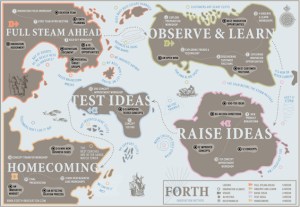
Gijs van Wulfen’s map for innovation

This map from Gijs van Wulfen, one of LinkedIn’s thought leaders in innovation, is worth exploring. In van Wulfen’s Nov. 12 article, “The best innovators are need seekers,” he summarizes Booz & Company’s three fundamental innovation strategies, and van Wulfen adds his own Fourth innovation method. Definitely worth exploring.

Associating: Borrowing from Booz & Company to Think about Educational Innovation #pedagogicalmasterplanning

In The Innovator’s DNA, one of the five secrets of innovation is ASSOCIATING – connecting seemingly disparate ideas, from various fields, in new and compelling ways.

Recently, Booz & Company released their 2012 Global Innovation 1000. In their research and study, they found that the majority of new ideas are generated in relatively traditional ways:

  1. Direct customer observation
  2. Traditional market research
  3. Feedback from sales and customer support

In terms of converting ideas into implementable offerings, they show that internal means appear to rule supreme:

  1. Proof of concept work
  2. Rapid/virtual prototyping and preference testing
  3. Advanced development review teams

There is a discipline to front-end innovation. As I’ve cited before, many innovation leaders say that innovation is a combination of creativity and discipline. In the next breath, most say that humans are naturally creative; our critical work in schools is to help them grow in these natural capacities and exercise those “muscles.” To be creative is in everyone, particularly those who practice creating things of value! Where we fall short in the magic combination is more in the discipline of regularly practicing the skills of creativity development. We’re not strategic and process-committed enough to sustain innovation.

In our schools, how much are we committing to these studied, effective processes:

  1. Direct customer observation? Do our schools purposefully observe the ways that people learn best – our children learners and our adult learners? Is this a function that we embed into the daily life of our schools? Are we studying the skills and content that prove most valuable in life after formal schooling?
  2. Traditional market research? Do we study the brain research? Do we study the practices that are leading to the most successful learning for different kinds of learners? How do all members of a school community even know the market in which they live and work everyday? Do we understand the search internal and the search external for what works? Do we examine other fields for insights about innovation and advancement in practice? Do we listen to what business and culture say learners need to be able to do in 2040?
  3. Feedback from sales and customer support? Do we purposefully and intentionally SEEK feedback from students, parents, alums, faculty, business, government, NGO, social entrepreneurs, etc.? On a regular and consistent basis and show that we are listening and using the feedback to improve practice?
  4. Proof of concept work? How are we systemically studying the innovative concepts that some teachers are implementing? Are the innovations working? For whom? In what conditions?
  5. Rapid/virtual prototyping and preference testing? How are we embedding into our daily habits the lessons from design that prove the value of rapid, iterative prototyping and using fast failures to improve and further develop? What are our cycles of trial and implementation and redesign in schools? Do we support student rapid prototyping and promote risk taking? Do our assessment strategies promote such or do they cause reticence and fear of failure?
  6. Advanced development review teams? How are we meaningfully establishing and empowering such teams in our schools? Are we creating hybrid research-practitioners that are serving as R&D within, between, and among schools? Do we build and nurture and maintain the feedback loops within our own schools?

Education should be on that Booz & Company list! We should be leading the way! We have to plan for doing so. We have to innovate our purpose and raise our trajectory. I know we can do it…with the discipline it takes.

Contrarians and rebels in your organization – are you nurturing them or neglecting them?

For schools that aim to innovate and improve, the people who work in such schools will have to grow comfortable with internal opposition. Schools live at an interesting and paradoxical intersection. All at once, schools tend to be excellent at building conformity, while functioning in such a way that breeds sub-system metamorphosis.

Much of the structure of traditional school exists to create conformity. Bells, dress codes, grading systems, faculty induction, etc. – they function to establish standardization and uniformity. However, most schools continue to practice a brand of professional development that breeds “rebels.” We send faculty to conferences, and the faculty return with great excitement to try something new and relatively non-conventional. Just yesterday, I attended an SAIS (Southern Association of Independent Schools) event on flipping the classroom. A few teachers from a smattering of schools attended, and they will return to their hives to disrupt the norm.

How might schools better create honey-production systems for these worker bees that return to the hive with new pollen? How might we grow more accepting and even promoting of internal opposition?

A recent article on Fast Company’s Co-Design,  “How To Nurture Your Company’s Rebels, And Unlock Their Innovative Might” by , offers great insights in this regard.

Similarly, I would argue, the contrarians and rebels, the people on the fringes of organizations who question and deviate from the status quo, which so often leads to inertia and inflexibility, are huge assets for any organization. Those who disagree with the present often see the future more clearly.

How are you nurturing the contrarians and rebels? How are you tapping into the future seers within your organization? Are you feeding their curiosity and factoring in their ideas to your pedagogical master plan, or are you intentionally or unintentionally squashing their experimental energy and enthusiasm?