Are you wondering how to engage students in more real-world learning? Are you looking for inspiration for and examples of project-based learning that connects students and adults with authentic issues challenging our citizenry? I am. John Hunter, Jamie Baker, and The Martin Institute help me do so…
“World Peace Game Creator John Hunter Named Martin Institute Fellow”
Press release from January 5, 2012, by The Martin Institute for Teaching Excellence…gives details of partnership between Martin Institute and John Hunter, provides information on film about John Hunter’s classroom approach, and offers dates for summer institute on developing curriculum and instruction that innovates like the World Peace Games
“#PBL examples, courtesy of TEDxWomen”
Blog post from January 11, 2012, on It’s About Learning – about finding examples and inspirations for PBL…links to two other posts about PBL
Whatever it is I think I see becomes a PBL to me! [sung to the tune of 1977 Tootsie Roll commercial embedded below]
If you were alive and watching TV in the mid to late 1970s, then perhaps you remember this 30 second advertisement from Tootsie Roll…
Simply replace “tootsie roll” in the jingle with “PBL.” Occasionally, my wife and sons will catch me singing this around the house. Truly, just about everything I see becomes a PBL idea to me. This visioning, though, is the result of purposeful and deliberate practice, as I have tried to grow in my capacity to develop “uppercase PBL” opportunities.
On January 4, 2012, I published a blog post about “Contemplating pbl vs. PBL.” In the post, I constructed a two-by-two matrix that helps explain how I think one can move along a spectrum of “lowercase pbl” (essentially project-oriented learning) to “uppercase PBL” in which learners are addressing genuine community challenges and engaging with authentic audiences of co-interested citizens. But how does one even think of such capital PBL ideas?
Based on countless conversations over the past few years, I get the feeling that more than a few educators struggle with the notion of originating and implementing uppercase PBL ideas. Actually, I think the struggle resides more in the implementation than in the origination, but that may need to be its own separate blog post. For now, let’s stick to the topic of originating, or concepting, the uppercase PBL ideas – creating the grand challenges that tend to integrate studies and promote community engagement from our student-learners and ourselves.
A Habit of Seeing and Recording
Concepting and brainstorming ideas for PBL is as simple as developing a habit of seeing and recording. Some may feel that such is easier said than done, but I believe it is really that easy. To form a habit, of course, one must commit to trying and rehearsing. Anyone with vision can develop a habit of seeing and recording, but it does take practice – just like anything else. In today’s world, though, the tools at our disposal make it easier and easier to develop a habit of seeing and archiving potential PBL ideas. Keeping a digital observation journal is a fabulous practice and discipline, if you want to build a resource pool of possible PBL opportunities.
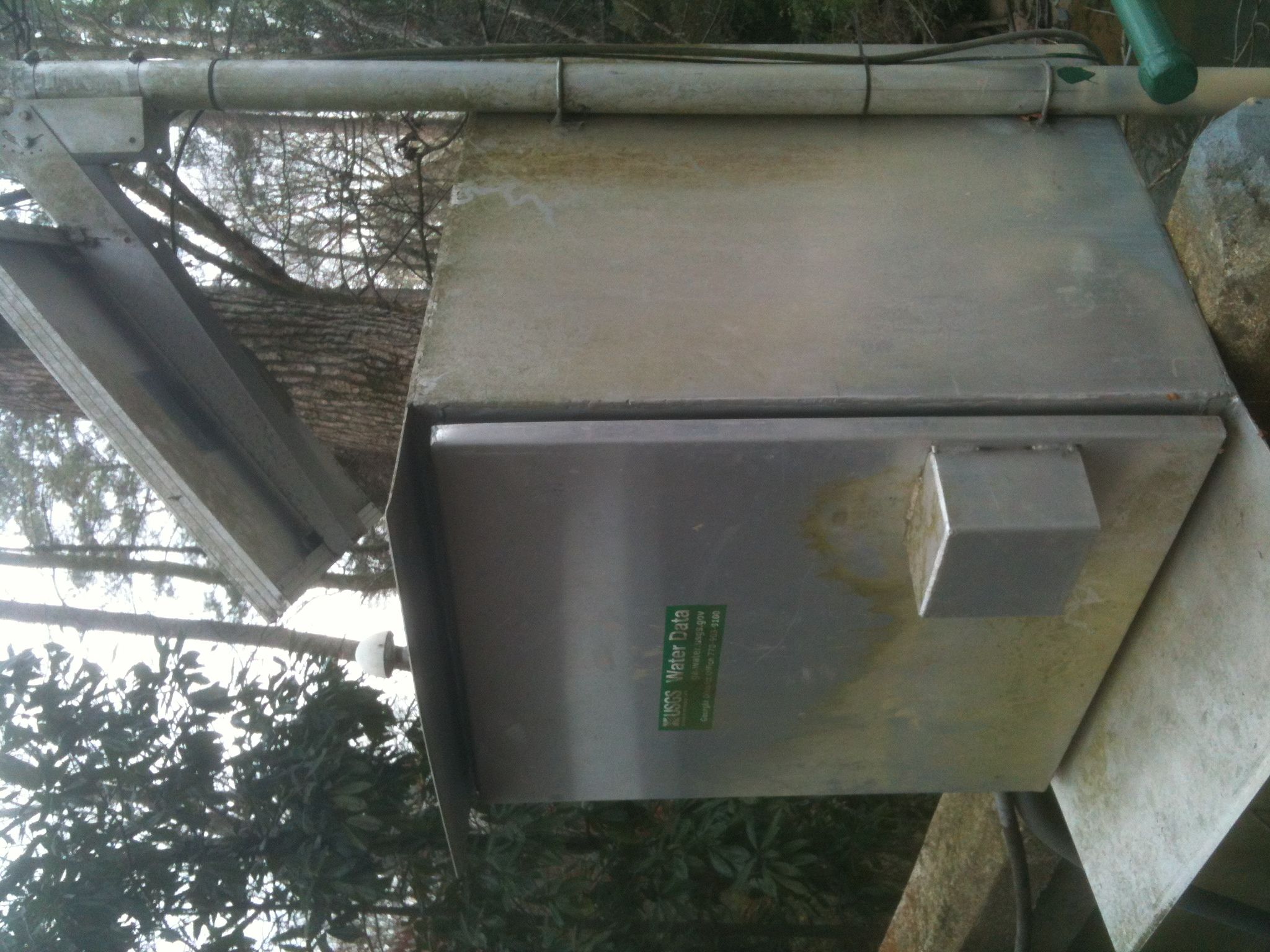
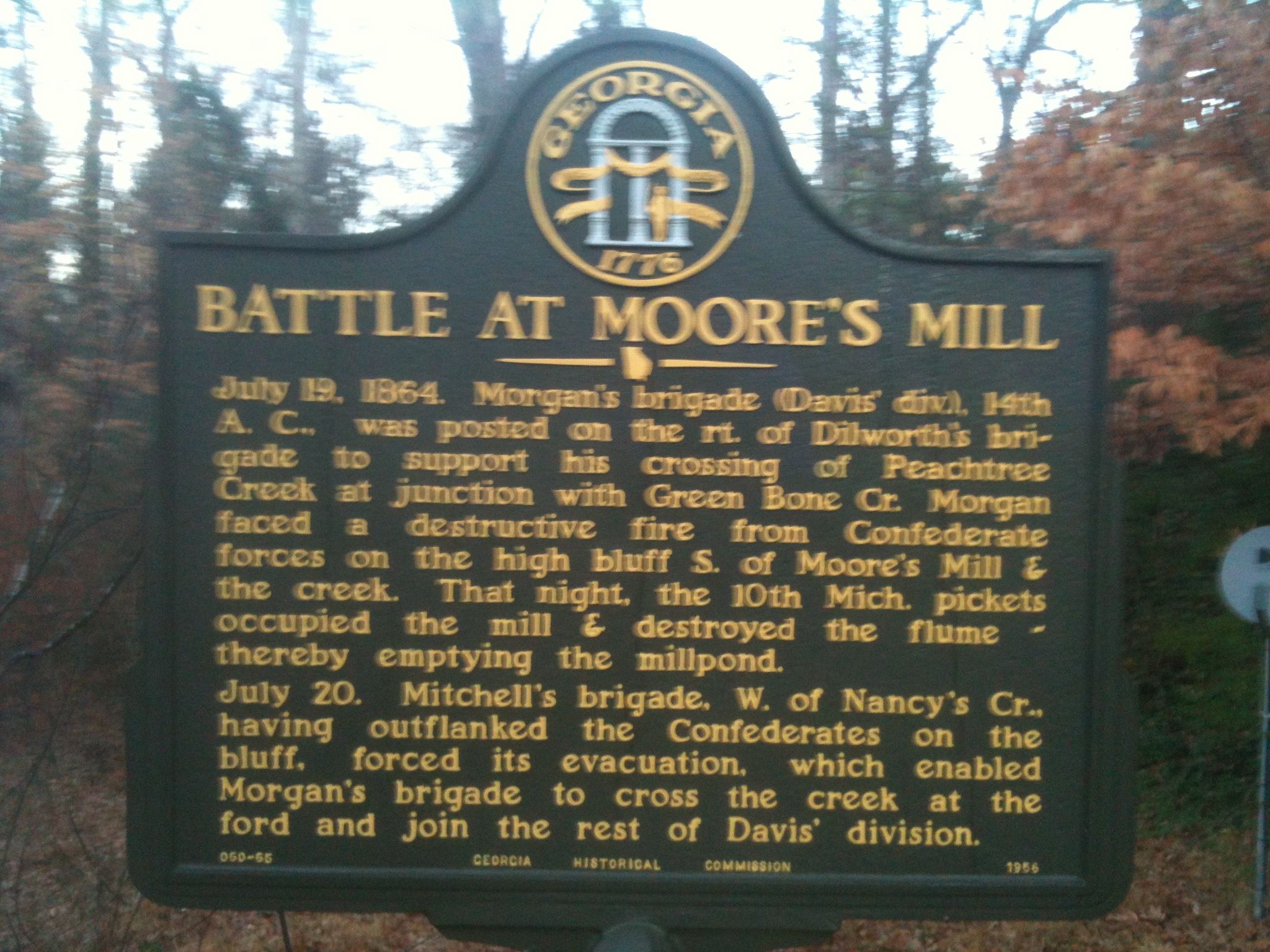
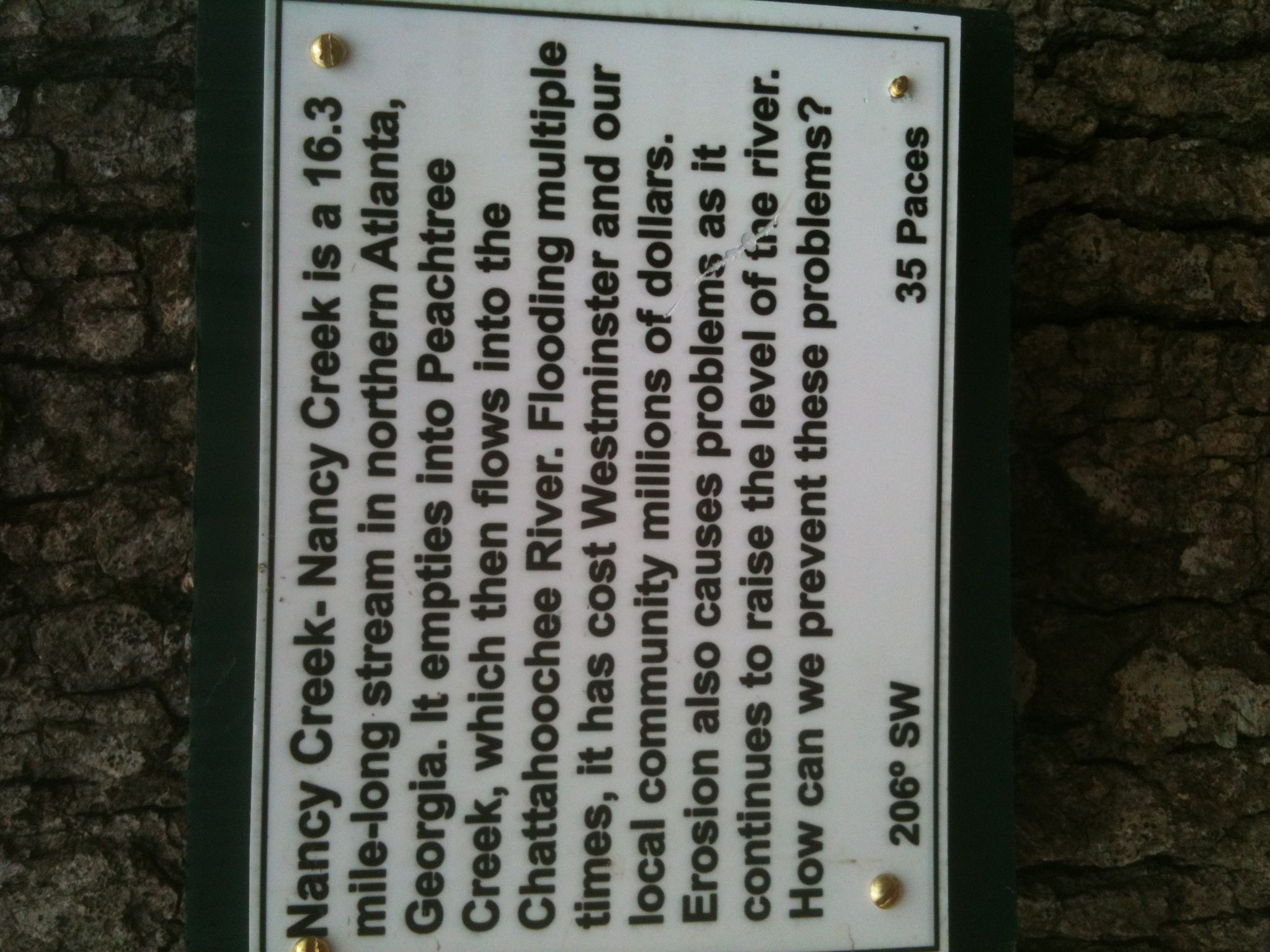
I imagine there are countless ways to keep an observation journal. In essence, though, an observation journal is simply a space in which to record thoughts, questions, and images about the things that one sees while walking around. Because I almost always have my iPhone in my pocket, I rely heavily on this tool to keep my observation journal. As I walk around school and the greater Atlanta area, I often take pictures of things that raise my curiosity. For example, over the Christmas and winter break, I walked my dog quite a bit, and I captured the following images around a few bridges traversing Nancy Creek – the bridges are very close to my school, and Nancy Creek runs through my school campus.
Just from recording these images with my iPhone, I am wondering about fieldwork investigations of the science, math, economics, and history of Nancy Creek. Myriad questions come to mind…
What is the water quality of Nancy Creek? How does it change over a year’s cycle? What kind of life is supported by Nancy Creek? Is it safe for my boys and dog to play in Nancy Creek?
What data is collected by that big metal box? How does it collect the data? Where does the data go? Who uses the data and how is it used? How could schools help the organization named on the sticker? Could students participate in this data journalism of Nancy Creek?
What was the significance of the Nancy Creek area during the Civil War? What is it’s economic and ecological significance now?
Often, to record these images and questions, I upload my pictures and observations to an email-based blog system called Posterous. Then, with categories and tags added, I am developing a significant library of PBL ideas. In Synergy, we use a group Posterous account (see related post) so that all 26 of us are contributing to the pool of potential project ideas. During the first semester, we accumulated over 400 observation-journal posts. Out of those posts, we developed six projects together.
Imagine if a school faculty and/or the entire student body employed such a school-group Posterous (or any such collaborative tool for seeing and archiving) to collectively organize a virtual fleet of observation journal ideas! The PBL opportunities could be endless!
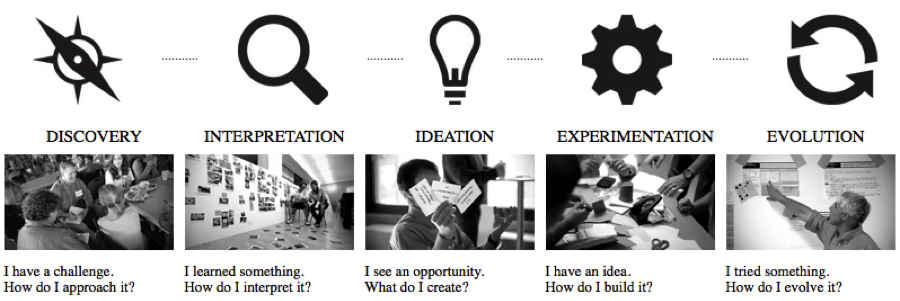
To develop such a habit of seeing and recording is to follow the initial practices espoused in design thinking:
At Design Thinking for Educators, where the above image was screen captured, this five-stage process of designing is more fully explained. For now, though, just think of observation journaling as a means into “discovery and ideation.” As one takes pictures and records questions for one’s observation journal, one is also engaging in a bit of “interpretation.” By posing questions and potential research curiosities, we begin to interpret what we are seeing, as we begin to formulate what projects could emerge from such wondering. To engage in such design thinking is to return to our roots as childhood learners. As Robert Fulghum has said, “LOOK!” may be the most powerful word we articulate (after mama and dada, of course!). And Mary Ann Reilly, in a recent post about “Making Art & (In)Forming Life,” reminds us of the power and potential of observation. We just have to re-open our eyes to that which we might have started to take for granted. We need to teach ourselves to see again…with that childhood enthusiasm for discovery!
A Key for Innovation
Relearning and leveraging our amazing human capacity for seeing is not just a fun way to generate ideas and enjoy the possibilities of challenge in school curricula and instruction. Seeing – as a multi-step, complex system of discovery, interpretation, and ideation – may be the key to educational innovation. In my eyes, innovation is about dreaming, teaming, seaming, and streaming. To dream is to envision. To dream is to “see” with more of our senses and being. To dream is to contemplate what could be.
May we dream big for our schools and our students. May we dream big for the challenges our world faces. Here’s to seeing…together.
What are the conditions necessary for “learner-preneurship” in schools? How can we establish, maintain, sustain, and promote entrepreneurial-type innovation in the strategic designs, daily operations and purposeful activities that define “school?”
On December 28, I was blessed to receive a Twitter DM from Jamie Baker (@JamieReverb). Jamie has invited me to co-present at the NAIS 2012 Annual Conference, along with her other teammates Grant Lichtman (@GrantLichtman of The Falconer) and Lee Burns (@PDSHeadmaster). I am thrilled to join such a team of inspired educators and dynamic, innovative thinkers and doers.
W8. Move from “Why Innovate?” to “How?” — Become an Entrepreneurial School Entrepreneurs know how to innovate. Discuss how to innovate at your school by developing the entrepreneur’s mindset in the board, head of school, administrators, teachers, and students. Cultivate understanding in the entrepreneur’s innovation process, building capacity by moving through resistance, and developing organizational habits of innovation. PRESENTERS: Jamie Baker, Reverb Consulting (TN); A. Lee Burns, Presbyterian Day School (TN); Grant Lichtman, Francis Parker School (CA); Bo Adams, The Westminster Schools (GA)
For the next several weeks, I imagine that I will be writing and thinking even more deliberately and intentionally about innovation in schools. To write is to think, and I look forward to developing my thinking here in this blog and elsewhere.
Given that “WE are smarter than ME,” I am curious what you think about the opening questions in this blog post. Do you have ideas about what makes some schools more “learner-preneurial” and innovative than other schools? Do you have hypotheses, research, thoughts, and opinions about how innovation can become more nurtured in the ways that we work in schools? I hope you will take some time to share your thinking in the comments below – your resources, your ideas, your questions, your own blog posts and writings about the topic of innovation in schools. Here’s to our ideas colliding in a Steve Johnson coffee house of sorts.
Thanks for sharing. WE are smarter than ME!
PLEASE JOIN THE IDEATION HERE (and elsewhere)! On New Year’s Day, here’s to a 2012 full of innovative ideation and implementation!
Happy New Year! It’s About Learning!
[Note: An interesting story about the power of PLNs – I will meet Jamie Baker and Lee Burns for the first time face-to-face at our February 29 NAIS session. While we “know” each other online and while we will certainly video-conference in the weeks ahead, it is the power of “the world’s best faculty lounge” that has brought us together for this work!]
Working to understand better the functions and processes of PLCs (Professional Learning Communities) – this is a constant pursuit and area of deep investigation and learning for me. I am coming to believe, more and more, that high-functioning PLCs are like some hybrid-cross consisting of the following parts: chefs, surgical teams, and jazz musicians.
The three TED talks below are interesting and intriguing in their own, content-specific right. However, I think all three offer metaphorical meta-lessons about the nature of PLCs – teams of teachers working to learn with each other for the ultimate purpose of enhanced student learning. All three TED talks, when woven together into a common braid, speak to the power of CREATING SOMETHING NEW AS A TEAM. Great PLCs are like the innovative team of chefs at Moto – stretching concept and experimenting for fulfilling and engaging one’s appetite and taste buds (analogous to quenching the thirst for knowledge and wisdom). Great PLCs are like the collaborating surgeons who have discovered that luminescent dyes can be employed to light-up that which needs to be preserved and that which needs to be cut out (analogous to curriculum re-design and systemic formative assessment practices). Great PLCs are like the improvisational harmony of a jazz quartet that measures their successes by their level of responsiveness rather than by any sort of fixed-mindset worrying about mistakes (analogous to the thoughtful development of teamwork and use of RTI – response to intervention). Collectively, the three talks also point to the balance of art and science that seems essential to crafting the alloy which is a team of people working together to CREATE.
The Creation Project
This past semester, the English 7 team of the Junior High PLC developed a student-learning challenge about the nature of creation and creativity. This team of teachers acted in that careful blend of artists and scientists, and they utilized the professional practices of lesson study and instructional rounds to develop a common lesson and common assessment for their classes of English. Instead of simply sitting and being consumers of creation-archetype understanding, the students would become world creators themselves. [This reminds me of a recent post from Jonathan Martin: “Fab Labs and Makerbots: ‘Turning Consumers into Creators’ at our School.” Who knows…this may even partially inspire the next iteration of the world creations described below!]
Below you can find a Scribd document that provides more details about the learning challenge created by this team of teacher-learners. To me, they behaved something like that team of innovative chefs at Moto…that team of integrated-thinking surgeons pioneering the use of luminescent surgery…that team of improvisationally-responsive jazz musicians. This team of teachers is creating together in harmony – they are prototyping a product, as well as a process for using lesson study and instructional rounds to derive a better dish, a more successful surgery, a more beautiful harmony. They are innovating and creating. This stretch will provide potential for a further stretch next time. Their muscles are learning to work this way – a way that has been foreign to egg-crate culture schools for far too long.
“I’m passing along the “nuts and bolts” of our “What in the World?” Creativity Project, which is the product of our collaborative work in the 7th PLT…what a gift!”
What In the World – Creation Project (used with permission)
I am working on a blog post about this Creation Project – from the principal’s point of view. I plan to include the actual assignment document, and I am hoping to have a few more artifacts that point to ways that we (teachers, educators, etc.) can work on “teachers working in teams” and “integrated studies.” I think your peer visit serves as a superb artifact of how ideas and lessons can “seep” and “ooze” across disciplinary borders when teachers visit each other’s classrooms. [Brief backstory (from email to teacher requesting permission to use this peer visit)]
Now, we have a teacher of the subject of history interacting with a teacher of the subject of English. What interconnected learning and integrated studies might emerge from this seed? In other areas, we have World Cultures teachers teaming with Science 6 teachers to create a semester learning-challenge on global climate change in various world regions. We have PE and biology teachers crafting ideas of courses devoted to the understanding of the human body from an integrated approach through anatomy and exercise physiology.
We have distributed R&DIY “culinary, jazz-fusion luminescence” developing among our learners – teachers and students. Those are ideas worth spreading. Additionally, those teachers are inspiring me to think about the worlds that I would contribute to making. Hmmm….
Listening. Responding. Refusing to bully one’s ways. Pulling ideas. Improvising. Innovating. Working with the color and emotional palette. Collaborating in concert with one’s team and one’s band. Making beautiful music. [Watch the TED below, and more of those phrases may be put into greater context.]
I think a lot about what school could be like. I love school. I have always loved school. But I think school can be better.
This morning, I viewed the four TED talks that were awaiting me in my RSS reader:
I learned about “Captchas,” and I learned about spider-silk biomimicry. I learned about MRI-focused ultrasound for non-invasive surgery, and I learned about jazz improv. But I learned about so much more than just these things. As a whole, I learned about people working to make things better…to make things more beautiful. From the whole, I learned some meta-lessons about innovation and improvisation.
When will school reflect the ideas that Stefon Harris espouses in his talk? When might we see the only “mistakes” in school as those moments which reveal that we failed to respond as deep listeners? Where are these types of innovations and improvs happening in order to enhance schools in ways that we are working to enhance language translation, armor and connective fibers, medical procedures, and jazz music? Where is the real R&D? Where are the jam sessions? Rest assured, there are some! There must be more!
I believe teacher teams – PLCs (professional learning communities) – can function very much like that quartet that is playing with Stefon Harris. I have been blessed to be a part of such a team in the Junior High at Westminster for quite some time. But we might need to think of ourselves less as pianists, drummers, bassists, and vibraphone-ists – less like history teachers, math teachers, science teachers, and English teachers. We may need to think of ourselves more like a quartet…a band – more like teachers of children, problem-finders and problem-solvers, innovators and improvisationalists, and challenge-facers. Then, our efforts could begin to work more like pulling ideas and listening and responding. And we administrators should be making space and time for such work. We should not restrict with regulations. We should be more concerned with pedagogy and practice than with lawsuits and legal. We should facilitate – make easier to accomplish.
Schools that operated as such would not make mistakes on the bandstand – we would make music!
How would you listen and respond to this riff? What would you add to this palette of thinking? Will you play an E or an F#? How will I consequently listen and respond? Let’s make schools better…let’s tune them to create more beautiful music!



 it's about learning