When I served as a camp counselor at Camp Sea Gull, I became convinced that I wanted to be a teacher. As I began my career in teaching, I could hear in my mind Captain Lloyd’s insistence that I was to teach children how to swim rather than teaching swimming to children. Twenty years later, as I strive to adapt for teaching in the 21st century, I continue to hear those wise words from Captain Lloyd—to place emphasis on the child above the subject matter…to personalize my teaching.
When I began playing soccer, my first sport, I was immediately hooked by the sense of team—team fun and team accomplishment. Throughout my life in sports, even in the more individual-oriented sports, I am struck by the fact that I accomplished my top achievements on teams and with the help of others. As I study and participate in 21st century teaching and learning, I am convinced of the importance of teams…collaboration is essential.
When I reflect on my peak learning experiences, I realize that there are many and that they share some common traits. Most likely, my uppermost peak learning experience involves being a parent. As a parent, what I do matters to me and to others, I have to address real-world issues that have consequences for me and others about whom I care, and I have to use all of my best thinking from multiple areas in an integrated fashion. However, if I replace “as a parent” in the previous sentence, the rest of the sentence describes my other peak learning experiences, too. For instance, “as a college freshman,” “as a first-year teacher,” “as a husband,” “as a principal,” etc. are all times during which I have been most engaged as a learner, and they all possess the element of authenticity.
In education, most people are engaged in dialogue and discussion about “21st century teaching and learning.” Some seem to be energized and excited by the term, while others appear to shudder at the mention of the phrase. Healthy debate exists around the exact meaning of 21st century education, as people try to develop a common understanding of what we mean by that phrase.
As for me, I am one who is energized and excited by the discussions concerning 21st century teaching and learning. For certain, we are educating our children today for many tomorrows in the 21st century—a century with marked distinctions from the previous century. I believe that 21st century education possesses three essential, inter-related characteristics: personalization, collaboration, and authenticity—the bold words from the first three paragraphs. Imagine them as the three strands of a strongly braided rope.
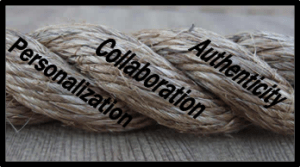
Twenty-first century education is about personalizing instruction. In short, I believe that the recent past in education has been defined by an industrial-age model. Analogous to an assembly line journey, students traveled through hallways, with about hour-long stops in classrooms, to be filled with math, then English, then history, etc. However, in the past twenty years, we have learned 95% of what we know about the human brain and how they work. The brain is not a cup to be filled with knowledge, and people possess very diverse, dynamic, and distinct brains (Robinson 2009). In part, the 21st century movement in education is about transforming the factory model to the personal model—facilitating growth for each participating learner rather than merely teaching a subject to an audience. In fact, the movement is largely about returning to a focus on personalized learning instead of a concentration on standardized teaching. Much of the progress in this first attribute of 21st century education depends on assessment—employing methods that allow teachers to collect a more accurate account of what individuals have actually learned and to adjust our paths based on the results. One assembly line cannot serve the diversity of learners. We need to personalize education to a greater extent.
What people can achieve individually pales in comparison to what they can achieve collectively. A high functioning team is a thing of beauty and wonder, largely because of what a team can accomplish that an individual cannot. An appreciation for teams explains part of why we love sports and marvel at great bands and orchestras. Since Peter Senge’s work, first detailed in The Fifth Discipline, organizations have moved more and more to collaborative models. Learning is social, and we understand that co-laboring can produce superior results to working alone. As we move away from some of the assembly-line features of education, we can establish learning environments that leverage the advantages of working together in collaboration. In the more global community of the 21st century, identifying the issues and solving the problems that exist will demand various partnerships, groupings, and teaming so that we can utilize collective strengths and abilities. Education should assist students in developing these teaming skills that are essential for the present and the future.
To borrow further from the sports world, the best coaches have known for a long time that practice should resemble the play for which we are preparing. Not since I was in school myself has my brain worked for an hour as a math brain, then for an hour as an English brain, then for an hour as a history brain, etc. In reality, my brain—each of our brains—works in an integrated fashion because the disciplines of thought are integrated and interconnected. For a 21st century education, schools need to design ways for students to practice the integrated thinking that occurs naturally in “real life.” The practice needs to resemble the play for which we are preparing. An authentic learning experience integrates the disciplines.
Additionally, an authentic learning experience possesses relevance. We are all most engaged as learners when we care about what we are learning, when we see a value and purpose for what we are learning, and when we understand how to use what we are learning to contribute to whatever situation we face. Moreover, we are more engaged as learners when we hold a certain level of control about what we are learning and doing. In large part, 21st century education encourages project-based learning so that students can apply developing knowledge, in an integrated and realistic manner, to real-world issues about which they care. When learning is authentic, it answers the age-old question, “Why do we have to learn this?”
So, where is technology in all of this? Isn’t 21st century education all about technology? I believe that technology is a toolbox with which we can make teaching and learning more personalized, more collaborative, and more authentic for our children who are growing up in a highly digital world.
The Junior High School at Westminster has long stood as a strong educational community. Part of the reason that the Junior High has been and continues to be so strong exists in the reality that the Junior High is willing and able to examine its practices and to explore enhancements and developments in education. We are a professional learning community, and we will set our sights high for the 2010-11 academic year. Years ago, the blind mountaineer Eric Weinmeier visited the Junior High. He captivated the students and teachers with his story of summiting Mt. Everest. In his remarks, he explained that his rope—his life line—was his most important piece of equipment. As we venture further up the climb of 21st century teaching and learning, we want to equip our students with a rope—a life line—braided together from the strands of personalization, collaboration, and authenticity.
I am so proud and blessed to work with the Junior High faculty, students, and parents. Within this community of learners, I am energized and excited for the year ahead, tied in with each and every one.
Bo
Robinson, Ken. The Element. Penguin Group, New York: 2009.

 it's about learning