Every year, I engage in a “360° review” as part of my annual evaluation as a principal. As part of the review, I invite hundreds of faculty, parents, students, and administrators to contribute to a survey which solicits feedback about various aspects of my job performance. In short, I want to learn and grow. I think I do good work with considerable effort, but I hope I am not yet the principal that I will learn to be. When we stop growing, we stop. And more mirrors on the bus provide a deeper, richer view of what’s around us.
Collecting feedback is not unique. However, I always share the results of this particular survey. Certainly, this survey data is not the only feedback I get. However, it is the most formalized way that I collect feedback from a large set of constituents and people who deserve to share a collective voice in my learning and growth. Interestingly, sharing out the results seems to be a rather unique practice. For me, it seems natural to complete the loop…to connect the dots…to round out the circle of community.
This week, I sent the following email to all those I invited to participate in my formal feedback collection (the survey):
On Feb 7, 2011, at 1:03 PM, Bo Adams wrote:
Dear All (BC field):
On Jan. 6, 2011, I invited you to take part in providing me with formal feedback about my job performance as principal of the Junior High at Westminster. Thank you to the many of you who chose to participate. Of course, I welcome feedback from all of you, at any time; the survey was just one method for feedback.
As has been my practice for all eight years of my principalship, I like to share the overall survey results with you. Here is a link to a PDF of all 37 pages – a summary from Dr. Clarkson and 36 pages of the survey monkey results.
[link was here.]
Overall, I found the feedback to be very positive and encouraging, and the various voices all give me good things to think about as I continue to learn and grow in my work to serve the Junior High School and Westminster at large.
Thanks,
Bo
Approx. 50% of JH faculty responded [37 of 80]
Approx. 10% of JH parents responded [42 of 400 sampled]
Approx. 25% of Admin responded [7 of 30 sampled]
Approx. 60% of Synergy 8 students sampled responded
Why do I feel so strongly about sharing out the results of my feedback and evaluation?
I believe it helps those who participate to “calibrate” their feedback with the whole…the collective voice.
I believe it shows that I have nothing to hide – I value all the voices who contribute for one reason or another. I am the principal and/or colleague for 100% of the people from whom I solicit feedback…not just the ones with whom I agree.
I think networked (three-way) feedback is stronger than mere two-way feedback.
Sharing solicits more feedback and conversation. Already I have received 12 follow-up emails, 4 phone calls, and 6 drop-by visits. We get to interact with the feedback so WE can continue to understand each other better, each person’s perspectives better, each person’s work better.
I ask my faculty to share their student-course feedback with me. Shouldn’t I model a reciprocal respect by doing the same? Shouldn’t I be cautious – nay, resistant – to doing something to/with others that I would not do to/with myself?
Schools around the United States, as well as throughout the world, are discussing “21st century education.” Some are getting on with it, and some are spending considerable time just debating the name of the movement. The version of the phrase which seems to cause some folks the most consternation is “21st century skills.” From what I gather, some people get irritated because few, if any, of the skills named in any such list have just now become important simply because it is after January 1, 2001. [Some distractors even want to debate the actual start of the 21st century!] Of course…these skills have ALWAYS been important, but they are increasingly important now.
As for me, I say that those who want to spend time debating the best moniker to unite us all under a mutually agreed-upon banner are distracting the real essence of what students, educators, parents – ALL LEARNERS – should be discussing. Forget about the name! It is simply a categorical title to get us all talking about a set of shared language, shared knowledge, and shared values. Let’s spend our time talking about what’s best for learning in the 21st century…at least for the next 80 or so years! Can we just get on with what really matters?!
My vision, simply stated, for 21st century teaching and learning:
The 20th century is thematically characterized by the Industrial Age. My vision for 21st century education accepts that learning is not about assembly lines, production widgets, efficiency, and adult convenience. Learning is integrated! Let’s really examine sending our most precious commodity (see…our language is even habituated from an Industrial Age !) – CHILDREN – down an assembly line of siloed instruction in math, science, history, English, etc. The brain is a beautifully complex network of integrated systems. It is a SYSTEM! So should be school! [see Ken Robinson’s RSA]
The 20th century is thematically characterized by “sit and get” instruction. My vision for 21st century education accepts that learning is project-based. Before people seat us in rows and columns of desks among four walls, we learn through “projects.” After formal schooling, we learn through projects. Learning is project-based! Context precedes competence. And there is a spectrum of “project-based.” The most advanced projects are those that integrate the all-too-departmentalized subjects, those that develop from STUDENT-learner QUESTIONS and INQUIRY instead of teacher-driven decisions, and those that make a real, authentic, relevant difference in this world – a world that begs for problem identifiers and problems solvers who recognize that great ideas emerge in “coffee houses.” [see Kiran Bir Sethi’s TED talk, Linda Darling-Hammond, Steven Johnson’s TED talk and/or RSA]
The 20th century is thematically characterized by an overemphasis on assessment OF learning. My vision for 21st century education accepts that assessment is FOR learning. Assessment is FOR learning! We need to utilize assessment carefully and thoughtfully to maintain a strong, healthly lifestyle and attitude about learning. Autopsies are for dead people, and they don’t offer much assistance to those on whom the service is being performed. If we only do one thing for learners in the 21st century, we should assist their (OUR!) development of the growth mindset over the fixed mindset. [see Robert Marzano, Tom Guskey, James Popham, Rick and Becky DuFour, Bob Eaker, Paul Black and Dylan Wiliam, Alfie Kohn, Bill Ferriter, Joe Bower, Jonathan Martin, George Couros, and the list goes on, etc.]
“What?!” you say. “He didn’t even mention technology. What a fool!” Technology is just a tool to help us accomplish the three points above…it is a means, not an ends, even in our digitially-dominated world.
Let’s get on with it already! It’s about LEARNING!
While I have not done any real, substantive research into this etymology, I understand that the term “principal” comes from “principal teacher.” Like a principal violinist or principal trumpet in a symphonic orchestra. I am a principal. I consider myself to be a part of the body of players with instruments. Yet, I am often likened to the conductor or director. Such is why I strongly prefer the title of principal – it reminds me everyday that I am amongst the musicians with instruments in hand. While I see the conductor or director of an orchestra as an accomplished musician, there is something different about standing up front, facing a different direction, and waving a wand rather than a wielding a stringed instrument, a woodwind, or piece of brass. Yes, I am a principal…teacher. A principal…learner. A principal…educator.
Consequently, I feel a visceral reaction rising from within me when I hear things that imply or directly name “us” and “them” thinking. Recently, a colleague of mine sent me a tweet (with no intent to incite, I am certain) that made reference to “admin” and “faculty” participating in something together, and I responded with this…
However, at the same time, I empathetically understand the thinking that “my principal evaluates me, so he/she is not really ‘one of us.'” I will not give up the career objective, though, to “be one of us”…co-teacher, co-learner, co-educator. I want to be in the band with the faculty. I am a (principal) teacher, a (principal) learner, a (principal) educator.
In my efforts to break down this industrial, hierarchical, twentieth-century, mental model of “us” and “them,” I believe that the way principals conduct (ironic, I realize) observations is critical. The shortest, most concise summary of my thinking on this issue comes from Kim Marshall’s extraordinary article, It’s Time to Rethink Teacher Supervision and Evaluation. If you have not read the article, I encourage you to do so. I think it is profoundly powerful. Here’s a hook that I hope grabs you:
The theory of action behind supervision and evaluation is that they will improve teachers’ effectiveness and therefore boost student achievement.1 This assumption seems logical. But the vignettes above raise a troubling question: what if the theory is wrong? This article takes a close look at this possibility and explores an alternative theory of action.
Marshall listed and explained 10 reasons why the traditional model of supervision and evaluation is ineffective:
1. Principals evaluate only a tiny amount of teaching.
2. Microevaluations of individual lessons don’t carry much weight.
3. The lessons that principals evaluate are often atypical.
4. Isolated lessons give an incomplete picture of instruction.
5. Evaluation almost never focuses on student learning.
6. High-stakes evaluation tends to shut down adult learning.
7. Supervision and evaluation reinforce teacher isolation.
8. Evaluation instruments often get in the way.
9. Evaluations often fail to give teachers “judgmental” feedback.
10. Most principals are too busy to do a good job on supervision and evaluation.
As Marshall transitioned from describing the problems and shortcomings to detailing the practices that can actually improve instruction and learning, he wrote:
I’ve argued that the theory of action behind supervision and evaluation is flawed and that the conventional process rarely changes what teachers do in their classrooms. Here is an alternative theory: The engine that drives high student achievement is teacher teams working collaboratively toward common curriculum expectations and using interim assessments to continuously improve teaching and attend to students who are not successful. Richard DuFour, Mike Schmoker, Robert Marzano, Douglas Reeves, Jeffrey Howard, Grant Wiggins, Jay McTighe, and others believe that this approach is a critical element in high achievement. I agree, but with a proviso: if a school adopts this theory, it must change the way teachers are supervised and evaluated. If it doesn’t, the principal won’t have the time, energy, and insight to get the engine started and monitor it during each school year.
Then, Marshall provided a set of bullet-points, on page 732 of the Phi Delta Kappan article, that significantly define what I strive to accomplish in my principalship – a philosophy in short order, rather than a checklist. Moreover, he created 12 steps to linking supervision and evaluation to high school achievement:
1. Make sure the basics are in place.
2. Decide on the irreducible elements of good teaching.
3. Systematically visit all classrooms on a regular basis.
4. Give teachers prompt, face-to-face feedback after every classroom visit.
5. Require teacher teams to develop common unit plans and assessments.
6. Require teams to give common interim assessments.
7. Have teams report on student learning after each unit or quarter.
8. Arrange for high-quality feedback on lessons for teachers.
9. Create a professional learning culture in the school.
10. Use short observation visits to write teachers’ final evaluations.
11. Include measures of student learning gains in teachers’ evaluations.
12. Use a rubric to evaluate teachers.
While I do not believe in or adhere to a rigid, all-points adoption of Marshall’s 12 step plan, I have tried to serve in my role as principal teacher by doing the following as overarching goals and action steps:
1. Create a culture of collaboration.
Since the 2007-08 academic year, the Westminster Junior High School has embarked on a journey to provide job-embedded, collaborative teaming for 100% of the faculty. Over this multi-year process, we are currently providing formalized teaming opportunities for 42 of the 74 teaching faculty. I hope to provide such for everyone in the Junior High, but it just takes time. Each year, we try to increase the number, the percentage, and the opportunity. And our model is agressive – a built-in period for teaming that mimics the student schedule for learning. Because student classes meet for 55-minutes a day, 4-days a week, so do the “teacher classes.”
When we only had one formalized PLC, I attended everyday as a co-learner, a co-participant. Now that we have five formalized PLCs in the Junior High, I am unable to attend every meeting, everyday. So, I schedule a minimumof one team meeting per PLC per week. Consequently, I am able to hear the planning and strategizing of the teams. I am able to participate in their discussions of the 4 Big Questions (1. What should students learn?, 2. How will we know if students have learned?, 3. What will we do if students already know it?, and 4. What will we do if students are not learning it?). I wish I could fill my schedule with ALL of the team meetings! Participating with my orchestra is the richest time of my week. These teachers are extraordinary, and I learn more about teaching and learning from these team meetings than from any other professional development in which I facilitate or participate. Collaboration is essential, and it enables me to know what people are thinking and learning. And it allows others to know about what I am thinking and learning. We develop relationships with those with whom we spend time talking. And at its core, teaching and learning are relational. First and foremost – RELATIONAL. Building relationships demands collaboration. An administrator worth his or her salt will work tirelessly to make such collaboration the norm rather than the exception.
2. Create more opportunity for conversations about teaching and learning.
On this front, the Junior High School has undertaken a multi-pronged re-envisioning as part of the developing Faculty Assessment and Annual Review Plan. To increase opportunites to talk about our teaching and learning, we have engaged in peer visits for more than six years now. [There is an interesting story here for another blog post.] Systemically, we have opened our doors in order to break down the isolating nature of teaching in an “egg crate culture.” Peer visits can occur between two faculty members, but we have also provided for instructional rounds, so that teams of teachers can enlist multiple lenses for feedback and discussion about teaching and learning practices. Additionally, we begin each year setting goals and engaging in self-assessment. With these reflections, we talk together about our aspirations and plans to reach them. I always send out my reflections to faculty, and I enjoy conferences with each and every faculty about their reflections. Until this year, all of these conferences occurred with individual faculty members. Now, teams can conference together with me about their team and individual goals. Faculty also collect student-course feedback. A faculty committee designed a process that has guided our programmatic inquiry of students’ perceptions about what and how they are learning. As principal, I use a similar model for my own evaluation, and I always share the results of this annual collection of feedback with the faculty.
Ideally, all of these pieces should work together as a whole system to enhance the conversations we are having about our teaching and learning. And our plan is a formative assessment plan for growth and development more than for purposes of evaluation. If engaged in the spirit with which this system is designed, the Faculty Assessment and Annual Review Plan is meant to work as an ongoing system of practicing and scrimmaging. For such is the universal method of learning and growing.
3. Create an understanding that the administrators are learning, too!
As learners, don’t we prefer to have things done with us, instead of having things done to us? In the old model of teacher supervision and evaluation that Marshall wrote about, administrators were failing in large part because they were doing supervision and evaluation TO teachers instead of WITH teachers.
On Wednesday of this past week, I was given a rare gift. Two sets of regular weekly meetings were canceled, and I found myself with four hours of windfall-profit time. What did I do with this time? I learned. I tried to practice some of the observational tactics suggested by Marshall, and I tried to get wrapped up even further with being the principal teacher, the principal learner, the principal educator.
From 8:15 a.m. until about 11:30 a.m., I practiced some mini-observations. Here was my process:
1. Take my iPad and my Flip camera and find a classroom. Prioritize classrooms of teachers who sit in formalized PLCs.
2. Spend 10-15 minutes observing in the classroom, take some notes using Quick Office on the iPad, and record a 30-90 second video.
3. Go to the next classroom.
4. After three mini-observations, use Box to transfer iPad notes to the “cloud” so I could pick them up from my office PC. Return to my office for a “download” and sharing of feedback. Copy and paste my notes into an email, transfer the video to my PC, and attach the video to the email. Send the three emails to the individual teachers and copy the department chair and the dean of faculty.
5. Start the next round of three mini-observations.
During the morning, I observed 11 teachers in 10 classes. More than anything, I practiced a new method of observation that I think complements Marshall’s article and our developing Junior High culture better than my previous methodology. When the morning concluded, I had provided immediate feedback to 11 teachers…teachers with whom I regularly sit in team meetings. There was past context and collaboration for the observations. They were part of the system. Also, I had a master document of all the observation notes, and I produced a Camtasia video of all the observations together.
I sent the following request to the observed teachers:
Dear All:
THANK YOU! This morning I was able to visit 10 classes and 11 faculty in three class periods. I appreciate you letting me come in quietly and stay for about 10-15 minutes. You had no idea I was coming, and I used a Flip video camera without prior explanation, and you seemed nonplused. By now, you should have received my brief notes and any video I shot in your room (BC and AG are exceptions because of our decision for me to return later when the sun would cooperate).
I want to make sure that you know these types of visits are NON-EVALUATIVE. They are as much about my learning as anything, as we continue to develop our Faculty Assessment Plan, which is intended to be formative assessment. I try to offer observations, not judgements, as I attempt to provide another set of eyes and ears for you so that YOU can reflect on your practice with more data and feedback. I welcome any questions/feedback from you about the helpfulness (or lack thereof) of the notes and the video.
NOW THE REQUEST: I hope you will consider letting me share the observation video, at the least. I have compiled the smaller videos into an unedited, complete video of my morning. Also, I hope you will consider an additional request of allowing me to share the observation notes as a one-document transcript. Of course, from the earlier emails, you know I have shared already with [the Dean of Faculty] and your Dept Chair. However, I would like to share the video, and perhaps the notes, with the full ALT (Academic Leadership Team) and FAAR (Faculty Assessment and Annual Review task force). We have studied Kim Marshall’s article about rethinking classroom observation (attached if you get interested), and I am trying to learn more about how this type of observation practice could work. I read a lot about various observation methods, and I think we can learn so much from each other by sharing our practices and ideas.
Also, I would like to blog about the morning, but I would not use your real names in any post that I blog.
So, can you let me know:
* Bo can/cannot use my video.
* Bo can/cannot use my portion of the observation-notes transcript.
* Bo can blog about his learning from the morning.
Feel free to talk with others from this group, and take your time (a few days) if you want to think about it. I really appreciate your time and consideration!
Bo
Everyone gave me full permission for my requests. THANK YOU! I think we principal teachers can learn so much by sharing our own practices and being more transparent with each other, and particularly with our faculties – the rest of our orchestras. Here’s the resulting video from my morning:
Two things I wish I had done differently:
1. Use some PLC meeting time to have teacher teams establish what they would like for me to concentrate on during my visits – ask the teachers to own the process by giving me my “marching orders.”
2. Set a debrief meeting in which all of the teachers and I watched the collective video together to look for “whole-morning” trends that become apparent when we see all of the sections as one video voyeuristic.
My learning was further enhanced when I read this article, My Students Help Assess My Teaching. Threads of the same tapestry seemed to come together. Can we eventually use the excellent “look fors” in the article as a way to study such mini-observations together? There is real possibility here, I believe.
If you have read this far, bless you. This post is concluding in a place that I did not anticipate when I started. Probably, I would be better off to press “Save Draft” and to return later to polish the writing as a coherent, cohesive whole. But I am ready to push “Publish.” Writing is thinking, and I am ready to think out loud so that, hopefully, others will think with me. I hope that my own faculty might read this “thinking out loud post” and offer comment. I hope that other teachers and principal teachers will survive the 2600+ words and offer comment. For I am a principal teacher, a principal learner, a principal educator. And I don’t have all the answers. But I am interested in playing with my orchestra of fellow teachers, learners, and educators.
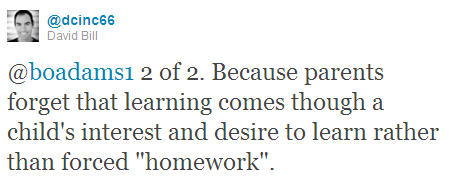
By the calendar, epiphany has ended. On this 12th day of January, though, we Atlantans just experienced our third snow day…SCHOOL IS CLOSED! Already, as a principal of a middle school, I am receiving texts, tweets, and emails asking, “When will we return?,” “Will we make up these missed days?,” “Could the make-up days interfere with our family vacations?,” “Can your teachers send some homework for my kids to do?” I actually received more than one message posing this last question. When I tweeted about this parental request, I received this immediate reply:
Of course, not all parents have forgotten that learning starts with curiosity and interest. Could it really be possible that even a few have forgotten? While I have never met @dcinc66, he is a member of my PLN, and I believe he has a valid point.
Another member of my PLN is my oldest son, PJ. During our third snow day this week, PJ insisted that we build a robot. After watching the 1980s classic (at least to me) Short Circuit, PJ began saving kleenex boxes, old food boxes, toilet paper rolls, and any other discarded piece of trash that looked like a robot part to him. Today, PJ made it clear that it was prime time to put his corrogated collection to good use. PJ’s brother JT entered the fray, and we three Adams boys felt transported to the robo-lab.
Learning is the hallmark of humanity. When I feel most engaged, I am learning. When PJ and JT are most engaged, they are learning. For me, epiphany continued today. PJ reminded me that learning most often looks like a project. The best learning happens when we choose to explore and discover.
After our robot skeleton was complete, PJ and JT became interested in heartbeats. After all, in Short Circuit, Number 5 was alive! With a stethescope, we measured our heart rate at rest and after a few laps around the house. A fourth snow day was just announced. Tomorrow, I will not be surprised if the boys ask to shock the kleenex boxes to see if we can jolt Number 6 to life. I think they just assigned themselves their own homework.
Bo Adams serves as principal teacher for the Junior High at The Westminster Schools, in Atlanta, GA. First and foremost, he considers himself a dad. Close behind on the list, he thinks of himself as a “learner-preneur.”
As a middle school principal who does not face the direct pressures of the AP debate, I realize that I may possess a “too-simple” understanding of the discussion. However, I admire the dialogues that a few colleagues of mine are precipitating on their blogs: Quantum Progress and Experiments in Learning by Doing. Addtionally, I found the recent New York Times article on AP to be fascinating. I sent the following email to the PLC (professional learning community) facilitators at my school because I think the article illuminates two important discussions about PBL (project-based learning) and EL (essential learnings – the process of deciding “What students need to learn”).
If you have not read the NYT piece on AP, then here is link to it. I have pasted in two quotes from the article that I think are interesting in relation to the discussion about 1) PBL (project-based learning), and 2) ELs (essential learnings).
A committee of the National Research Council, a part of the National Academy of Sciences, called attention to these problems in 2002. It criticized A.P. science courses for cramming in too much material and failing to let students design their own lab experiments. It also said the courses had failed to keep pace with research on how people learn: instead of listening to lectures, “more real learning takes place if students spend more time going into greater depth on fewer topics, allowing them to experience problem solving, controversies and the subtleties of scholarly investigation.”
And to the delight of teachers who have gotten an early peek at the plans, the board also makes clear what will not be on the exam. Part or all of at least 20 of the 56 chapters in the A.P. biology book that Mrs. Carlson’s class uses will no longer need to be covered. (One PowerPoint slide explaining the changes notes sardonically that teachers can retire their swift marches through the “Organ of the Day.”)


 it's about learning