PBL: Let’s Build Something Together

As I write this, it’s early Sunday morning. Tomorrow, on Monday, June 13, Jill Gough and I will begin Day 1 of co-facilitating “PBL: Let’s Build Something Together.” This course is a two-day (10 hour, 1PLU) summer institute through the Center for Teaching at the Westminster Schools. We have about 15 educators coming from 4-5 different Atlanta area schools. Primarily, our essential learnings – our fundamental desired outcomes – number “just” two objectives:

  1. I can brainstorm various possibilities for PBL (project-based learning).
  2. I can create framework plans for various PBL.
Here’s our Curio7 mindmap of how we are structuring the ten hours:
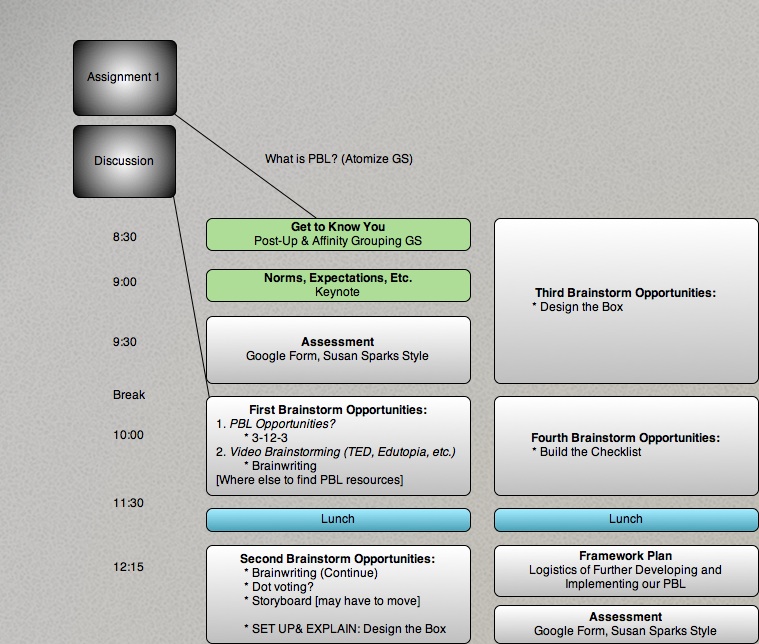
Whereas some people attend conferences, institutes, and workshops expecting a considerable amount of “sit-n-get” knowledge transfer, our participants will be sorely disappointed if they are wanting that typical educational conference experience. Jill and I know we will not “finish” what we are setting out to do. Monday and Tuesday will be mere beginnings.
.
You see…we really want to build something together. If we actually accomplish our essential learnings, these 15 Atlanta educators will leave committed to enacting and implementing a PBL-project in the first semester of 2011-12. We are going to learn PBL by doing PBL. Our project: build a multi-school PBL to try in the fall. So, potentially, we could have 4-5 schools putting a PBL idea into practice with students.
.
Imagine the possibilities there! We could continue to develop the project as a virtual lesson study. We could engage in instructional rounds and visit each other’s schools to observe how the project is implemented at each place.
.
Last week, at a learning opportunity at Trinity School, @gcouros challenged us all to think of ourselves as school people and lead learners. He asked us to think bigger than just our own individual classrooms. Shouldn’t we do the same for school vs schools?! Imagine what we can learn together.
.
I love being excited about something which is about to begin!

Can you spare 27 minutes for learning and world peace?

Do you have 27 minutes to devote to both educational reform and world peace? Do you? Just 27 minutes of your life. Twenty minutes is for watching the TED talk below –  John Hunter on the World Peace Game. Two minutes is for reading my words here, which I try to make brief and get out of the way. Five minutes is to share the talk with another person or other people via whatever means you want. I would be willing to guarantee you that you will find value in the 27 minutes you spend doing so. Make it in the video to…

7:20 and you will see a teacher show an artifact of a simple game board that he designed so that he could avoid lecture, avoid dry textbook methods, and engage students in something we all love to do – play games.

8:00 and you will be wanting to build the enhanced prototype yourself…I do!

16:30 and you will see profound learning from a child that cannot be easily tested, but demonstrates self-evident assessment.

18:45 and you will contemplate the power of “spontaneous compassion” and a realistic hope for when these students earn the leadership positions of the world.

John Hunter shows the power of story, the power of dealing in questions rather than answers, the power of project- and problem-based learning, the power of 21st century skills leading the efforts of a classroom, and the power of a teacher who innovates and keeps learning. These are ideas worth spreading.

Many thanks to the colleague who shared this talk with me and our Junior High History PLC.

This post is cross-listed at Connected Principals

Be like bamboo

I learn so much from Garr Reynolds. There are countless lessons in his recent TEDxTokyo talk. Before I write too much about the myriad things I am learning and re-learning from his talk, I hope you will watch and find that still water in which to reflect yourself. Domo arigato, Garr.

Connecting JHPAC and GOOGLE Art Project

We moved into our current Junior High School building on August 3, 2005. I had been principal for two years, and I had a dream of helping establish a permanent art collection for student art when we moved into our new space. With the help of JHPAC (Junior High Permanent Art Collection) Director Mary Cobb, the art teachers, the students, and their parents, we now have over 340 pieces of student work in the collection. One of my favorite times is when Mary and I hammer nails and hang art each summer!

Now I have a new dream! I want to partner our students with GOOGLE and Amit Sood to supplement our JHPAC with this type of dynamic view and experience…

Can you imagine how cool that would be?! Our students could design and implement it…

Update on TEDxKids@BC Excitement!

On May 13, I posted about the excitement that a couple of eighth graders expressed about the possibility of engaging with TEDxKids@BC. One person commented on that post – Goran Kimovski, who is with TEDxKids@BC. THANK YOU, Mr. Kimovski. If nothing else even happens, I appreciate you taking time to comment, communicate, and excite! Such is a bedrock of learning, isn’t it?
.
Over the past weekend, a veritable flurry of communication exchanges occurred among the two eighth-grade learners, Ms. Gough, and me (Ms. Gough and I are part of the Synergy 8 team with these two eighth graders). After about 13 prototypes of a formal communication to Mr. Kimovski, here is what the eighth graders sent…
Dear Mr. Kimovski,
    We would first like to thank you for responding to Mr. Adams’s blog post in such a quick and inviting manner. Secondly, we would like to submit a proposal for the TEDxKids conference. Please let us know what would be the best way to do that, whether it be sending our thoughts to you via email or submitting some sort of application. We’d love to talk to you via skype; anytime from 2:40 to 3:30 EST is fine on our end, what time works for you? Below is a summary of our ideas and thoughts for this conference.
    School that cultivates a love of learning:
– increased student discussion less teacher lecture
– improvement and retention rather than  learning for test and grades
– incorporating technology to reach all learners
    Over this academic year, we believe that we have grown as students and in our beliefs of what makes up good schooling and what school ideally should look like. Also, as participants of a prototype course, called Synergy, we had the opportunity to explore the concept of “ideal school” further. We would like the opportunity to let others know about what we, as students, feel about this important issue of education, and the evolution that’s necessary to better serve the needs of learners.
Thanks once again,
T. S. and S. Z.
If for no other reason (and there are many!), I am thankful for social networking media used for educational purposes. Connecting learners with passionate, critical topics for exploration and discovery and possibility…that’s what is required for innovation and improvement.
.
What are you excited about? With whom are you connecting? With whom are you exchanging ideas and possibilities? Who is on your team to help push the change and improvement we desire in the world? How are you spreading ideas? What ideas are you catching that others are spreading?
Get connected. It’s about learning!