Snow and ice days cause wailing and gnashing of teeth in School 3.0

As I breezed the Twitter stream awhile today, I noticed a number of people from various reaches of the United States hailing that their school had already been announced CLOSED on Jan. 6 due to inclement weather – snow and ice!

Just one example:

Well well my former Michigan co-workers already have school closed for tomorrow. They r deep n snow! Their bragging has begun lol [emphasis mine]

Like you maybe, I’ve heard about strange rituals like children wearing pajamas inside out and flushing ice cubes down the toilet to encourage the elements to delay or cancel school.

So, of course, I cannot help but wonder:

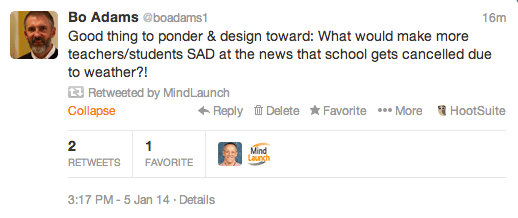
What would make school so great as a learning-and-engagement community that teachers and students would actually be sad, devastated even, when school was canceled for inclement weather?

Screen Shot 2014-01-05 at 3.34.39 PM

We should design for that emotion! For that desired user experience!

And if school canceled simply provides more time for people to do other things that get neglected “due to” their professional/school lives – hence the excitement about the cancelation, then we could learn from those insights, too! But I imagine that’s not all that’s at stake. How ’bout you?!

[Selfish blogger’s note: I so wish hundreds…thousands of people would fill the comments with examples of what school would/could be like that would make them sad if it got canceled due to weather. And then I wish we would make those schools happen more!]

+ + + + +

RELATED POST FROM THE PAST:

CHANGEd: What if schools factored in experiment days like snow days? 60-60-60 #6

#MustRead Shares (weekly)

Posted from Diigo. The rest of my favorite links are here.

QUILT POST: 2014 themes – One body, How are you smart, Rewild [ed], Creating great learners, Slowing to change

Predicted primary themes in my blog posts in 2014:

  • interdependence
  • avoiding labels; supporting all learners to find their Element; fighting the fundamental attribution error; identifying how we are smart over how smart we are
  • rewilding school to more closely align with education and learning
  • curiosity-driven, persistently gritty, learner-centered engagement
  • slowing down to accelerate and amplify change; pedagography – making better maps of where we are and where we intend to be

Patches of a common quilt, for sure…

From a speech given in September 2005, at Thunderbird School of Global Management:

We are more than six billion people and we are suffering from complex global problems, many of them man-made. The world is one-unit, one body, but our minds still think in terms of we and they. In reality, however, there is no such thing as us and them. We are one body. So the destruction of one part is the destruction of the whole. We must make an effort to recognize that the “others” are also part of humanity, that my future depends on your future. We may find some comfort in the notion of independence, the idea that we control our destiny and can take care of ourselves, but that idea only exists in our mind. In reality, we are all interdependent.

– the Dali Lama, as quoted in Being Global: How to Think, Act, and Lead in a Transformed World, by Angel Cabrera and Gregory Unruh

– reminded me, too, of Roman 12:4

.

Derek Paravicini and Adam Ockelford: In the key of genius (TED talk)

.

George Monbiot: For more wonder, rewild the world (TED talk)

.

From “Creating Great Students,” Ben Johnson, Edutopia, Dec. 23, 2013

We know (and have known for a long time) that the best all-around way to get students to learn is student-directed learning (also known as student-centered), but after all this time, we are still trying to get the teachers to quit doing so much direct instruction and engage more students with inquiry, project-based learning, and experiential learning.

.

From “Teachers: How Slowing Down Can Lead to Great Change,” Elena Aguilar, Edutopia, Dec. 11, 2013

If we slowed down, we could reflect on what we’ve been doing and what’s been working; we could ask questions, explore root causes, and we could listen to each other. And if we engaged in some of these practices, there’s a greater likelihood that we’d uncover authentic solutions, make some significant changes, feel better about our work, and deliver some sustainable results.

Comfort and creativity – part of why I am compelled to explore, create, repeat

From Explore, Create, Repeat – an interview with Marco Cibola

I think it’s very important to never stop learning. There’s a tendency, especially when I’m busy and working for clients, to just become a machine that churns out work that builds a portfolio of clones. There’s a certain comfort and security with repeating what you know and giving the client what they expect. But it can also get boring and unsatisfying. It can feel stagnant. I think that curiosity and going into the unknown is what makes work interesting. I love problem solving, but not when I’ve already solved the problem.

Modifications in brackets made by me, practicing “association” as an innovation skill, and hypothetically creating a riffed quote for myself:

I think it’s very important to never stop learning. There’s a tendency, especially when [we’re] busy and working [in the ambitious school-calendar cycles], to just become a machine that churns out work that builds a portfolio of clones. There’s a certain comfort and security with repeating what you know and giving the [student(s)] what they expect. But it can also get boring and unsatisfying. It can feel stagnant. I think that curiosity and going into the unknown is what makes [school and learning and education] interesting. I love problem solving, but not when [we’ve] already solved the problem.

The Heath Bros advice on New Year’s resolutions

From the “erratically-published newsletter” of Chip and Dan Heath*:

4 RESEARCH-BACKED TIPS FOR STICKING TO YOUR NEW YEAR’S RESOLUTION

Every New Year brings two proud traditions: Making resolutions and then, shortly thereafter, breaking them. Often the full cycle doesn’t take more than a few weeks, which allows well over 11 months to plot the next year’s resolutions.

The research on resolutions is damning: A study of 3,000 people led by Richard Wiseman, of the University of Hertfordshire, found that 88% broke their resolutions. (Even people who resolved merely to “enjoy life more” failed 68% of the time.)

If you want to buck humanity’s sorry performance record, here are four research-based tips to improve your chances of keeping your resolutions:

1.Look for your bright spots.

Psychologists tell us that we are wired to look at the negative. One famous study concluded that, when it comes to the way we think, “bad is stronger than good.” So when it comes to changing our lives, we’ll tend to ask ourselves, “What’s the problem and how do I fix it?” But often we can benefit more by asking a different question: “What’s working and how can I do more of it?” In other words, we can learn from our own “bright spots.”

Nwokedi Idika, an American graduate student in computer science, was a chronic procrastinator. He’d set a goal to work six hours per day on his thesis but found that he only hit the target sporadically. Rather than bemoan his failures, though, he examined his bright spots: What is different about the days when I do manage to complete my six hours? And what he discovered was that, in almost every case, he’d been working early in the morning. So he turned that realization into a strategy: He started setting his alarm for 5:30am every morning.

The early-morning approach worked like a charm. “When I’m up that early, I have no motivation to check email, Facebook, or Twitter because nobody is up to send email or update his/her status,” he said. He defeated procrastination by cloning his bright spots. (Idika became the first African-American student to earn a PhD in computer science at his university.)

2. Make one change at a time.

Over the last 15 years, a series of studies in psychology has confirmed a sobering result: Our self-control is exhaustible. The research shows that we burn self-control in many different situations: when controlling our spending; holding in our emotions; managing the impression we’re making on others; resisting temptations; coping with fears; and many, many others.

Why is this important? Because any life change will require careful self-monitoring and self-regulation—in other words, self-control. Self-control is the fuel that allows change to succeed, but it is limited. For that reason, you will have a better chance of success if you can focus on one change at a time. If you try to change jobs and exercise routines and relationship habits all at once, you are more likely to stall, because you’ve run out of “fuel.”

3. Turn that one change into a habit.

Steve Gladdis of London found that he was constantly falling behind on his personal “to do” list. “Looking at the list on my phone now,” he said, “I need to hang those pictures, phone a friend I haven’t spoken to in a while, extract that box from the back of the shed, investigate child-friendly mousetraps, the list really does go on and on.”

He resolved to create a daily routine: Every morning, like clockwork, he’d finish one task. “Once I’m on a roll, it seems easy to carry on. I remember to look at my list for today’s task because I’m used to doing it, and I almost look forward to ticking off that day’s chore,” he said.

Habits are effective because, once established, they no longer burn self-control. (Think about how little mental energy it requires to take a shower, or make your morning coffee, or to carry out any of the other habits you’ve acquired.) You’ll be more likely to keep your resolution if you can turn it into a habitual behavior—something that happens in the same time and place on a regular cycle.

4. Set an “action trigger” to start your habit ASAP.

What’s the best way to start a habit?

Let’s say you’re trying to exercise more. You might declare to yourself: Tomorrow morning, right after I drop off Elizabeth at dance class, I’ll head straight to the gym for my workout. Let’s call this mental plan an “action trigger.” You’ve made the decision to follow a certain plan (exercising) when you encounter a certain trigger (the school’s front entrance, tomorrow morning).

Action triggers like these can be surprisingly effective in motivating action. The psychologists Sheina Orbell and Paschal Sheeran studied a group of patients in England with an average age of 68, who were recovering from hip or knee replacement surgery. Some of them were asked to set action triggers for their recovery exercises—something like, “I’ll do my range-of-motion extensions every morning after I finish my first cup of coffee.” The other group did not receive any coaching on action triggers. The results were dramatic: Those patients who used action triggers recovered more than twice as fast, standing up on their own in 3.5 weeks, versus 7.7 weeks for the others.

Psychologists have compared action triggers to “instant habits” because what they do, in essence, is make our behavior automatic when the trigger moment comes. Seize that power for yourself: Jump-start a new habit by setting an action trigger.

—————————————

Good luck with your Resolutions, everyone, and here’s hoping for a fantastic 2014!

Happy New Year,

Chip & Dan

* One can subscribe to the Heath Bros. newsletter on their resources page.