“So let us put it all back together, not forgetting ultimately what it is for.”

If our small minds, for some convenience, divide this glass of wine, this universe, into parts — physics, biology, geology, astronomy, psychology, and so on — remember that nature does not know it! So let us put it all back together, not forgetting ultimately what it is for.

Richard Feynman, as shared on Maria Popova’s Brain Pickings

Snow and ice days cause wailing and gnashing of teeth in School 3.0

As I breezed the Twitter stream awhile today, I noticed a number of people from various reaches of the United States hailing that their school had already been announced CLOSED on Jan. 6 due to inclement weather – snow and ice!

Just one example:

Well well my former Michigan co-workers already have school closed for tomorrow. They r deep n snow! Their bragging has begun lol [emphasis mine]

Like you maybe, I’ve heard about strange rituals like children wearing pajamas inside out and flushing ice cubes down the toilet to encourage the elements to delay or cancel school.

So, of course, I cannot help but wonder:

What would make school so great as a learning-and-engagement community that teachers and students would actually be sad, devastated even, when school was canceled for inclement weather?
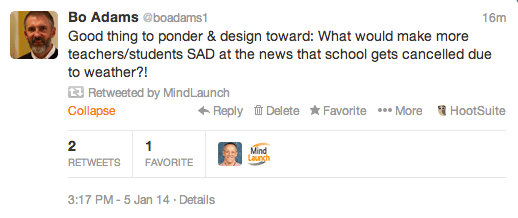
Screen Shot 2014-01-05 at 3.34.39 PM

We should design for that emotion! For that desired user experience!

And if school canceled simply provides more time for people to do other things that get neglected “due to” their professional/school lives – hence the excitement about the cancelation, then we could learn from those insights, too! But I imagine that’s not all that’s at stake. How ’bout you?!

[Selfish blogger’s note: I so wish hundreds…thousands of people would fill the comments with examples of what school would/could be like that would make them sad if it got canceled due to weather. And then I wish we would make those schools happen more!]

+ + + + +

RELATED POST FROM THE PAST:

CHANGEd: What if schools factored in experiment days like snow days? 60-60-60 #6

#MustRead Shares (weekly)

Posted from Diigo. The rest of my favorite links are here.

QUILT POST: 2014 themes – One body, How are you smart, Rewild [ed], Creating great learners, Slowing to change

Predicted primary themes in my blog posts in 2014:

  • interdependence
  • avoiding labels; supporting all learners to find their Element; fighting the fundamental attribution error; identifying how we are smart over how smart we are
  • rewilding school to more closely align with education and learning
  • curiosity-driven, persistently gritty, learner-centered engagement
  • slowing down to accelerate and amplify change; pedagography – making better maps of where we are and where we intend to be

Patches of a common quilt, for sure…

From a speech given in September 2005, at Thunderbird School of Global Management:

We are more than six billion people and we are suffering from complex global problems, many of them man-made. The world is one-unit, one body, but our minds still think in terms of we and they. In reality, however, there is no such thing as us and them. We are one body. So the destruction of one part is the destruction of the whole. We must make an effort to recognize that the “others” are also part of humanity, that my future depends on your future. We may find some comfort in the notion of independence, the idea that we control our destiny and can take care of ourselves, but that idea only exists in our mind. In reality, we are all interdependent.

– the Dali Lama, as quoted in Being Global: How to Think, Act, and Lead in a Transformed World, by Angel Cabrera and Gregory Unruh

– reminded me, too, of Roman 12:4

.

Derek Paravicini and Adam Ockelford: In the key of genius (TED talk)

.

George Monbiot: For more wonder, rewild the world (TED talk)

.

From “Creating Great Students,” Ben Johnson, Edutopia, Dec. 23, 2013

We know (and have known for a long time) that the best all-around way to get students to learn is student-directed learning (also known as student-centered), but after all this time, we are still trying to get the teachers to quit doing so much direct instruction and engage more students with inquiry, project-based learning, and experiential learning.

.

From “Teachers: How Slowing Down Can Lead to Great Change,” Elena Aguilar, Edutopia, Dec. 11, 2013

If we slowed down, we could reflect on what we’ve been doing and what’s been working; we could ask questions, explore root causes, and we could listen to each other. And if we engaged in some of these practices, there’s a greater likelihood that we’d uncover authentic solutions, make some significant changes, feel better about our work, and deliver some sustainable results.

Comfort and creativity – part of why I am compelled to explore, create, repeat

From Explore, Create, Repeat – an interview with Marco Cibola

I think it’s very important to never stop learning. There’s a tendency, especially when I’m busy and working for clients, to just become a machine that churns out work that builds a portfolio of clones. There’s a certain comfort and security with repeating what you know and giving the client what they expect. But it can also get boring and unsatisfying. It can feel stagnant. I think that curiosity and going into the unknown is what makes work interesting. I love problem solving, but not when I’ve already solved the problem.

Modifications in brackets made by me, practicing “association” as an innovation skill, and hypothetically creating a riffed quote for myself:

I think it’s very important to never stop learning. There’s a tendency, especially when [we’re] busy and working [in the ambitious school-calendar cycles], to just become a machine that churns out work that builds a portfolio of clones. There’s a certain comfort and security with repeating what you know and giving the [student(s)] what they expect. But it can also get boring and unsatisfying. It can feel stagnant. I think that curiosity and going into the unknown is what makes [school and learning and education] interesting. I love problem solving, but not when [we’ve] already solved the problem.