Connections! English and Art

I really don’t have time to be writing a post, just now, at this moment. However, a team of English teachers in the Junior High School  included me on an email distributing a rubric for a current exploration of the god-teacher archetype, and I am blown away! I feel positively compelled to sing their praises.

Why am I blown away?

  • The rubric is designed for facilitating a detailed feedback to student learners.
  • The rubric is designed for providing feedback about the visual attributes of an assessment submission related to some complex understanding of the archetype.
  • The rubric was developed from the 6+1 Writing Traits Rubric, and the connections among the written word and the visual image are astounding – the direct comparison between the two assessment tools is so cool.
  • The developing teachers worked in PLC to advance their response to the critical questions: 1) what should students learn?, and 2) how will we know if they are learning?
  • The developing teachers include English teachers and an art teacher – the paths to developing project-based learning and integrated studies are more and more becoming the visible, rather than hidden, routes to improved instruction and learning. Collaboration is increasingly important to us as we seek to enhance learning at deep levels.
  • The sharing of the instrument was quick and assumed.
  • I understand how intense this type of assessment work can be, so I appreciate the effort that this extended team put into the process.

I could keep writing bullet points all afternoon. I am so appreciative of these teachers – these lead learners – finding ways to innovate, create, repurpose, and design. THANK YOU!

Prayer, Purpose, and PBL

This morning, at the monthly PAWS (Parents Association of the Westminster Schools), I was fortunate enough to give an opening prayer and a brief presentation on my upcoming sabbatical (March 5 – April 11). A web-post version of my slide deck (Power Point) can be accessed below for those who could not attend or for those who might be interested from beyond the immediate Westminster community. Of course, I spoke during the slide presentation, so the slides are not meant to be stand-alone resources.

Many thanks to PAWS and Katrina Newton for allowing me the time with you at your meeting. I highly value the partnership between school and home, and I thank PAWS for all it does to support learning at Westminster.

Additionally, I am forever grateful to Westminster and Unboundary for allowing me to experience such an incredible sabbatical opportunity.

A Big Week for Visual Arts in the Junior High

This week, two extraordinary art exhibits opened in Atlanta. Well, probably more than two opened in Atlanta, but I am particularly interested in these two:

  1. Junior High art students exhibited their creations in Broyles Art Center at The Westminster Schools. Each student who is enrolled in Junior High art selected a single piece of their work (and/or a teacher selected it) to display in the Gaines Foyer of Broyles. Here’s a short video for a visual reference…
  2. Students, from both Westminster and Lovett, ranging in age from kindergarten and pre-first, through middle school and junior high, as well as high school, witnessed special selections of their art open at the High Museum of Atlanta. The student art hung under the same museum roof as special exhibits of Henri Cartier-Bresson and Toulouse Lautrec. The turnout was superb, and I was overwhelmed with pride for the students who had created such powerful visuals for their views of the world and the ideas within their minds.

Thinking Out Loud: Tribes

In the old paradigm of writing and publishing, a writer essentially worked to have all of his or her ideas formed and packaged before publishing. Such was required – all of the thinking on paper had to be relatively complete before it went to press, experienced the magic of publication, and landed on a shelf.

With blogging, as well as with other social media, the power of the printing press has been democratized to the masses. For some, that is frightening. I often hear choruses of “Anybody can get something on the Internet now. Used to be only experts could express their ideas onpaper. Now any yokel can press publish.”

For me, getting to think out loud is exciting and empowering. Sure, sometimes thinking out loud means that a blog post possesses that feeling of “unfinished-ness.” However, it is this unfinished-ness that excites me. By thinking out loud, I can amplify my current thinking and incorporate others’ thinking – if they will just take the risk to think out loud, too, and share. WE are smarter than me. Steve Johnson’s “coffee house” has a better chance of materializing if we are congregating and sharing our thinking. With a growth mindset, I worry not about what people will think of my unfinished, unrefined, unpolished post. I want to grow. Growing requires sticking your neck out. It’s not about looking silly. It’s about learning.

Of course, I am not telling you readers anything you don’t already know. Rather, I am simply finishing a preface to what I really want to write about this morning – but, gloriously, my thinking is not finished on this next topic. By sharing some initial thoughts, those thoughts stand the chance of being read and amplified by a Jonathan Martin, a Lyn Hilt, a Bill Ferriter, a John Burk, a Jill Gough, an Anna Moore, or a colleague that I have yet to meet – either in reality or in virtual space. I can leverage my PLN if I will just risk letting them in to my thinking.

So…

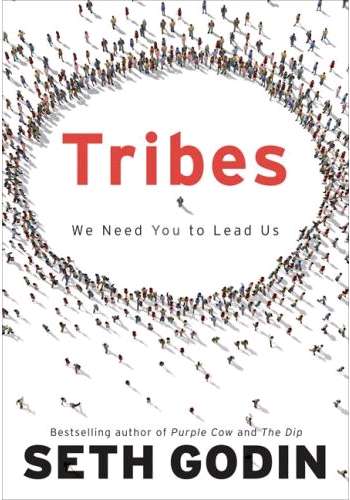
This morning I am re-reading Seth Godin’s Tribe. Many of you may know that I am a stack reader – I will digress if I explain that strategy of my reading. I could just highlight some passages and take some notes, but then those highlights and notes would only benefit me. Additionally, those highlights and notes could not be amplified by others whose thinking could magnify my own. So…I am recording some ideas here – unfinished, unpolished ideas. Here’s to the potential of amplification. If nothing happens to these ideas, I am no worse off. However, if even one reader chooses to comment, question, argue, or postulate, then my thinking can be improved.

  • On page 83 of the hard-copy of Tribes, Godin writes, “When you fall in love with the system, you lose the ability to grow.” Many people probably think that I love PLCs. They would be wrong. I love learning. I think schools and education should be ALL about learning. Over the last century or two, I worry a bit that schools may have fallen in love with the system of efficient operations and teaching. I have faith in people as learners, but I do believe that learning is a social activity. If teachers do not have time together – job-embedded time, not just their own time – then it is too easy to get in a repititious rut of teaching the same things, the same ways. To explore, experiment, wrestle with ideas…we need fellowship, time to think out loud, a tribe with whom to work. I am not in love with the system of PLCs. I am in love with learning. Show me a system that promotes learning better, and I will follow.
  • Folks who are not really studying PLCs seem to fall into the trap that PLCs ARE the meetings, the structures, the frameworks. PLCs are about the principles of learning. Call them whatever you want, structure them however you want…as long as the focus is on deep, mearningful learning. In our PLCs at Westminster (at least most of the current, formalized PLCs), we put things through four filters: 1) what should be learned?, 2) how will we know if learning is happening?, 3) what will we do if learning is not happening?, 4) what will we do if the learner already knows this? These questions guide all learning – student, adult, teacher, admin. ALL LEARNERS.
  • Godin uses pp. 79-85 to explore an extended metaphor comparing and contrasting faith and religion. Godin remarks, “Faith is critical to all innovation. WIthout faith, it’s suicidal to be a leader, to act like a heretic.” We MUST believe in the work and the change we are bringing about. Preserving the pre-existing structures, the worked-in-the-past frameworks, is not leadership. It’s management. Leadership revolves around learning. Learning is, by definition, about change. Leading and learning cannot love the status quo – to do so would admit that we have achieved all that we can achieve. We are as good as we can get.

More later. My thoughts are unfinished…

Godin, Seth. Tribes. New York: Penguin Group, 2008.
Interesting Follow Up on Summa Cum Laude

On Tuesday, February 22, I published a blog post (Junior High End-of-Year & JH Celebration 2010-11) announcing several changes to the end-of-year schedule for Junior High, including details about transitions from “JH Honors Day” to “JH Celebration.” On Tuesday, that post received 831 “hits” or views.

At the time of this writing, the post has received 958 views in total. However, not one viewer has left a comment on the post. (The comment listed is simply a tweet mentioning the post – a “ping back” of sorts.) Not even one viewer commented on agreement with or disdain for the decisions and changes. Over 1300 parents and educators were sent an email with a link to the post. Not one comment. I find that fascinating.

Nevertheless, I have received other forms of communication about the changes to Honors Day – now called Junior High Celebration. Approximately 55 people have communicated with me about the changes:

  • Overall, I would characterize the communications as mostly positive. About 40 contacts have expressed appreciation and agreement with the changes. About 5 contacts sought clarity about how summa cum caude is calculated. About ten contacts have expressed concern. I appreciate that people are using email, phone calls, and face-to-face opportunity to provide feedback. Some communications are more respectful and tactful than others, but I appreciate that people are communicating. Even if I disagree with what they communicate, I appreciate that they are communicating. If people don’t communicate, it is terribly challenging to know what folks are thinking and feeling.
  • Yesterday, however, one parent used the phrase that people are “up in arms” about the changes. This alarmed me and surprised me. I certainly don’t want people to be “up in arms.” What shocked me is that my “recon” tells a very different story.
    • Not one person left a comment on the blog.
    • Of the 55 communications I have received, about 40 have been positive and supportive of the changes.
    • None of the grade chairs have reported any upset or disagreeing parent communications.
    • Only one teacher has reported a conversation with a student who was concerned with the changes.
    • Two PAWS (Parents Association of the Westminster Schools) representatives have communicated to me that people are upset. From what they tell me, though, I feel like there is confusion about the summa cum laude decision.

Consequently, I want to try explaining the summa cum laude decision another way…

  • For as long as I have been at Westminster (16 years), we have designated an Honor Roll and a Merit List. Summa cum laude, in some ways, is simply an extention of this long-standing system.
    • To earn Merit List distinction, a student must maintain a GPA of 80 or higher, with no grade below 75.
    • To earn Honor Roll distinction, a student must maintain a GPA of 88 or higher, with no grade below 75. [During my time, this GPA requirement rose from 87 to 88 with virtually no challenges to the change.]
    • At the end of semester one, 480 students achieved Honor Roll. 56 achieved Merit List. 23 did not receive either distinction. This is a fairly typical spread. However, the change in policy last year to “no zeros” has had a slight effect.
    • During the year of discussions about honors and awards, teachers and parents and students communicated that the Honor Roll does not seem “discerning” enough. Many wanted a “third tier.”
    • To my knowledge, we have never had a strong parent objection to the existence of an Honor Roll/Merit List system based on GPA. There is some faculty concern about the existence of this system.
  • For as long as I have been at Westminster, Junior High Honors Day has recognized just 6 students (one from each grade and gender) for “Highest Academic Average.” In most cases, the difference between receiving this honor and “finishing second” has been caused by just hundredths of a point. And grading practices among teachers are not perfectly uniform. With the summa cum laude system, we can have multiple “valedictorians” from each grade and gender group. Just as with Honor Roll and Merit List, if you earn the grades – through hard work, solid assessment performance, diligent effort – then you are eligible for the distinction. The standard for achievement is clear and visible. It is no longer a behind-the-scenes, head-to-head competition for hundredths of a point. We have ended the sense of “there can only be one.” If we had had the summa cum laude tier last year, about 40 middle school students would have earned the honor.

Below is a simple poll. I hope you will take a few seconds to provide some feedback. [I will blog about the change in departmental awards ASAP.]