For the past two mornings, I have taken my 6-year old son to school. So, of course, my 4-year old son wanted me to drive him to school one morning. Today was the morning. But my youngest doesn’t have to be at preschool until 8:45, so we played!
As I finished dressing, JT asked if we could play pirates with his Fisher-Price Imaginext. He loves to play pirates with this set of toys. At first, we were very historically pure. Then, a problem arose for JT, and he must have reasoned that Spiderman was the right tool for the issue. Without missing a beat, Spiderman entered the scene. Then, air travel became a necessity for the scenario. No problem. JT requisitioned a modern-day airplane from another Imaginext set. Of course, he saw no problem with this mix-it-up mentality.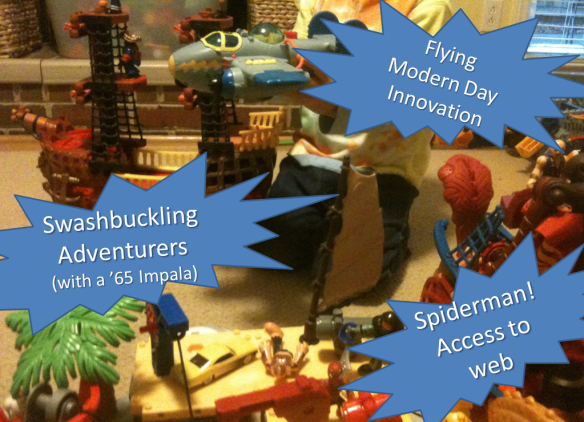
I am a bit saddened to think that JT will experience the departmentalization of thinking when he enters “real school.” If listening to teachers and students today is any indicator, this division of cognition may be inevitable (I hope it’s not!). I repeatedly hear students utter, “This is math class. Why do we have to write?” Or, “This isn’t English class, so does spelling and grammar count?” This happens with teachers, too. “I am just reading for content. The English teachers can deal with all that comma and semicolon stuff.” Or, “I am a math teacher. I am not a writer.” How dare we impose such boundaries on the human imagination and capacities of thinking. JT is a swashbuckler who sees no problems with inserting a 1965 Chevy Impala into a pirate scene – even if the figurines don’t stand a chance of fitting in the vehicle. And he wasted no time justifying the mashup with the excuse of time travel. He just mixed up the tools that he needed to use for the scenario that his imagination was making real.
Yesterday, I spent day 2 of my sabbatical at Unboundary, where I am interning at this amazing strategic studio. At 9:15, the Traffic Director (what a cool title!) informed me that there would be a 10:30 meeting for a project team working on a pitch proposal to a company considering three bids for brand positioning. I spent the next 4.5 hours with this swashbuckling trio, and I feel like I gained an entire semester’s worth of learning in a half a work day.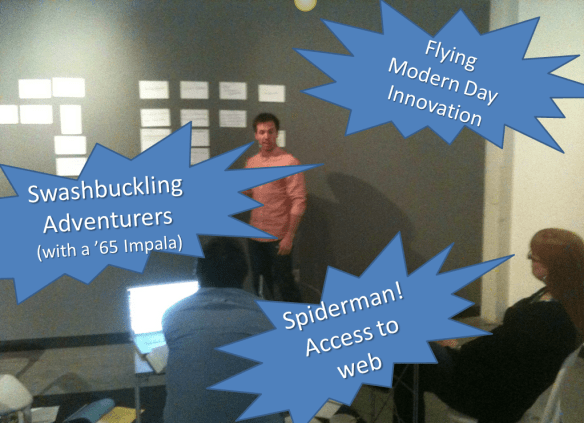
Throughout the work session, the team utilized powerful brainstorming by storyboarding on a tack-board wall. Disciplines that we would separate and segregate in schools were seemlessly engaged. No one uttered stuff like, “I am not a writer, so you’ll have to take it from here.” When drawings and sketches were needed, they were added to the cards and wall. Mistakes, errors, and failures were expected and taken for granted because they were prototyping – it’s just part of real work. No one handed them a text-book-style, neat-and-clean problem to solve. They began by defining the issue to be addressed. They identified the “problem” and worked to collectively reach a workable solution to the problem. They noted extractions they would need to make from previous and existing work – other projects. No one ever said, “that will never work.” But they did push certain ideas aside and rearrange the wall when a more exciting idea emerged. They encouraged me to participate and contribute rather than just sit, observe, and listen. They treated me like a co-pilot, not just a passenger along for the ride. They made me feel like a we. There was no sage on the stage, but there were mutual guides on the side. When creative obstacles emerged, they…joked. Metaphorically, in my opinion, they were mixing it up and mashing it up like my son JT. Consequently, new insights and possibilities emerged. When they needed to…they ate. The creative brain needs food, and there were no bells signaling that it was time for lunch. But they knew they needed brain food, as well as Brain Food. When a reasonable stopping place was located, they asked for evaluation and feedback from the Executive Director of Creative Intelligence. This trusted source never said, “Good job.” His feedback was precise, specific, detailed, and thought-provoking. There was no grade, but there was loads of assessment. Self-assessment and evaluation by the team all day long, and macro-assessment from the EDCI.
While I know I am overgeneralizing, I wonder about the gap that exists between my son’s natural mode of play and the seemingly natural way to work after college. Of course, there are parts of school that model and mimic childhood play and adult work (play?). But they are not enough. Education is about drawing out what is already there. It is like a sculptor revealing what lies within the chunk of stone. School seems too industrial, too assembly line, too departmentalized. School seems too content-delivery oriented rather than reveal-what-is-already-there oriented.
This morning, I completed my second read of Seth Godin’s Tribes. On page 137 of the hardback, Godin quotes Einstein, who said, “Imagination is more important than knowledge.” Godin continues:
Leaders create things that didn’t exist before. They do this by giving the tribe a vision of something that could happen, but hasn’t (yet). You can’t manage without knowledge. You can’t lead without imagination.
Creativity should not be segregated to art classes and fiction writing. Imagination should know no bounds. We need to unboundary the lines between departmentalized subjects. We need to combine pirate ships, Spiderman, 1965 Chevy Impalas, airplanes…English, math, science, and history. If it requires time travel, so be it. We need to lead. We need to close the swashbuckling gap.


 it's about learning