Temporary Move to Posterous

For a few weeks, I will be blogging more through my Posterous blog (and relatively less here). It feels a bit more mobile, and it’s quicker when using email over 3G to post (at least with what I have learned so far). If you are reading this from a browser pointed to It’s About Learning, a link to my Posterous can be found on the right column. The direct URL is http://boadams1.posterous.com/. When I post to Posterous, the post is auto-tweeted. This morning, I began this little blog experiment with a post about ski school and PBL.

#PBLCFT11, Lifelong Learning, and a Movie Trailer

Many schools have a line in their mission statements about “lifelong learning.” Without a doubt, lifelong learning is critical…absolutely invaluable. But do we really mean it? Are our schools structured to facilitate genuine lifelong learning – the way learning tends to look throughout most of life? Or are most, if not all, human beings just powerful, resilient learners who interact with their environments and adapt to the needs and demands of the situations we encounter – school, as well as the life that bookends school? Do schools model the patterns of real-life, lifelong learning? Or do schools model more of the efficiency standards of the industrial revolution?

Today, in the Center for Teaching Summer Institute, “PBL: Let’s Build Something Together,” we spent a bit of time discussing this notion of lifelong learning. (In the 5 hours of sessions today, we touched on it directly for just a few minutes…but it caught my attention.) Most agreed that lifelong learning tends to take the form of projects to engage and problems to solve.

As children and as adults, other than in the formal setting of school, does your learning tend to resemble sitting for lecture, taking notes, and testing on that recently acquired knowledge? Or does your learning tend to resemble messy, troublesome, challenging-to-decipher issues that grab your curiosity and demand your attention from multiple perspectives? Does lifelong assessment tend to look like standardized, bubble-in examination? Or does lifelong assessment tend to look more like performances and presentations made to interested audiences and decision makers? Does lifelong learning require isolated attempts – attempts where we are required to work alone? Or does lifelong learning require making connections, building on relationships, collaborating, and enlisting the help and support of others? Does lifelong learning insist on getting things right the “first time?” Or does lifelong learning accept the notion of prototyping based on the reality of “ready-fire-aim” tactics, as we learn from failures and make new, more-informed re-attempts? As one team member said today, “Is learning more about covering material, or is it more about uncovering developing understanding?”

I had a great day working with the fifteen, Atlanta-area educators who gathered to take on “PBL: Let’s Build Something Together.” (Tweets from the day are grouped and searchable by #pblcft11.) In a nut shell, we spent the vast majority of our day-one time in divergent brainstorming – generating a rich pool of potential projects for PBL. The exercises and methods we used seemed to mimic the way that most lifelong learning has occurred to me – engaging complex, challenging issues that don’t have answers that can be found on GOOGLE…muddling through complicated problems that demand collective thinking from people who are committed to collaboratively making hypotheses and testing what works and what doesn’t…accepting that success requires a great deal of trial and error and cognitive meandering.

Tomorrow, on day 2, we will concentrate on emergent and convergent thinking, as we narrow our focus onto one or two projects for which we will formulate framework plans…plans that we can use as a skeleton for putting more flesh on the bones during the upcoming school year. Ultimately, we will implement our team-designed project. We will learn so much more about PBL by actually DOING PBL. As you might expect, I am very excited about the possibilities!

PBL: Let’s Build Something Together

As I write this, it’s early Sunday morning. Tomorrow, on Monday, June 13, Jill Gough and I will begin Day 1 of co-facilitating “PBL: Let’s Build Something Together.” This course is a two-day (10 hour, 1PLU) summer institute through the Center for Teaching at the Westminster Schools. We have about 15 educators coming from 4-5 different Atlanta area schools. Primarily, our essential learnings – our fundamental desired outcomes – number “just” two objectives:

  1. I can brainstorm various possibilities for PBL (project-based learning).
  2. I can create framework plans for various PBL.
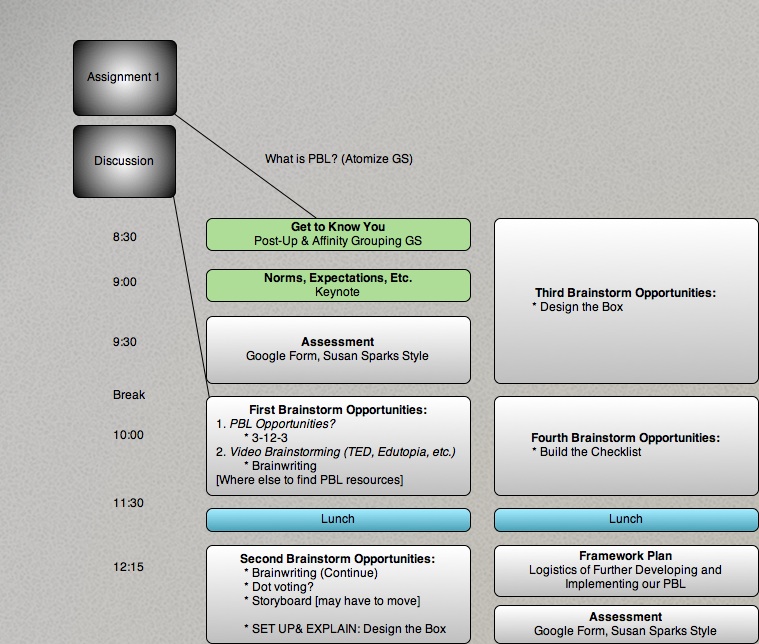
Here’s our Curio7 mindmap of how we are structuring the ten hours:
Whereas some people attend conferences, institutes, and workshops expecting a considerable amount of “sit-n-get” knowledge transfer, our participants will be sorely disappointed if they are wanting that typical educational conference experience. Jill and I know we will not “finish” what we are setting out to do. Monday and Tuesday will be mere beginnings.
.
You see…we really want to build something together. If we actually accomplish our essential learnings, these 15 Atlanta educators will leave committed to enacting and implementing a PBL-project in the first semester of 2011-12. We are going to learn PBL by doing PBL. Our project: build a multi-school PBL to try in the fall. So, potentially, we could have 4-5 schools putting a PBL idea into practice with students.
.
Imagine the possibilities there! We could continue to develop the project as a virtual lesson study. We could engage in instructional rounds and visit each other’s schools to observe how the project is implemented at each place.
.
Last week, at a learning opportunity at Trinity School, @gcouros challenged us all to think of ourselves as school people and lead learners. He asked us to think bigger than just our own individual classrooms. Shouldn’t we do the same for school vs schools?! Imagine what we can learn together.
.
I love being excited about something which is about to begin!

Great TED Talk Resource

Those who know me, or know of me from this blog, understand that I am a huge TED fan and devotee. TED is fundamental part of my personal learning plan. I watch a talk a day. Each time I am inspired and made even more curious.

Well, thanks to a history teacher…then, Steve Anderson…then, Peyten Dobbs, I was made aware of a nice resource for searching TED talks. Also, I loved the history teacher’s intro explanation to the resource. It seemed to bother him/her to list the talks by discipline, when so many talks are cross-disciplinary and integrated. Most things are in real life!

I just wanted to pass along the resource (with a bit of brief commentary). Happy browsing and searching.

Steven W. Anderson (@web20classroom)
6/7/11 10:12 AM
TED Demystified For Teachers: http://bit.ly/jPRkpE

http://www.historyteachersattic.com/2009/06/ted-talks-demystified-for-teachers/

Not until I am ready!

This morning, I watched a MacSparky screencast, from David Sparks, called “OmniFocus Ninja Tricks (Part 2 of 3).” OmniFocus is a high-powered project-management app that synchronizes among my Mac, my iPad, and my iPhone. I am a low-powered user, and I want to get better with this tool. (Since I was a middle schooler myself, I also always wanted to be a ninja. I had throwing stars, nun-chucks, etc.) A colleague referred me to the screencasts, and they are great.

Here is what makes this mundane news “post-worthy,” in my opinion, on a blog about learning. This morning was the second time I had watched the 52 minute screencast. I saw things that I had not even noticed were there the first time. Huge chunks of 8-12 minutes of features, and I missed them. What made the difference this time? In the interim between viewing-one and viewing-two, I had been using OmniFocus, so my scaffolding and “need to know” was better this time around. From using the app as a novice user, though, I was at a boundary of learning, and I was experiencing some frustrations. So I returned to a resource to learn more. As Vygotsky might say, I had reached a different ZPD (zone of proximal development). I needed some support to get to the next level, but now I wanted to get to the next level – I knew there was more to know, I wanted to know it, and I could not know it without help. Now, I have climbed the next rung of the user ladder for OmniFocus. “So what?,” you might say. Or “Why is Bo writing about OmniFocus?”

How many times are our students in such a situation? We teach something, but they are not really ready to learn it yet. Their scaffolding or “need to know” is not primed for learning yet, like a dry pump that cannot pull water. Yet the typical, traditional routine is to “teach, test, hope for the best.” We assign a grade and move on to the next unit or chapter. Time has been the constant, and learning has been the variable. Just look at the variation of grades as evidence (assuming grades are really measures of learning). Support has been a relative constant, too.

I am not disparaging any particular teaching method or assessment practice. I am merely realizing, from being a learner myself, what my students must feel almost everyday. I am glad that I have developed the sense of self-assessing my current ability with a tool like OmniFocus and seeking help, and I am glad that nobody tested me for a permanent grade after my first viewing of the show and my early forays into using the app. I am glad I got a second chance.

Our faculty is switching from Toshiba Tablets (PCs) to MacBook Pros and Airs. How many of them are experiencing this cycle of:

introduced to new –>

overwhelmed –>

try new thing –>

experience some success, some frustration –>

want to know more –>

seek help and support –>

learn it better after practice and a different “need to know” –>

realize that the lessons were there from the start, but I was not ready then.

Learning is the constant…time and support are the variables. It’s been the other way around for far too long. It’s about learning!