Emerging from my principal gestation

Pop quiz: When does learning begin? Answer: Before we are born. Science writer Annie Murphy Paul talks through new research that shows how much we learn in the womb — from the lilt of our native language to our soon-to-be-favorite foods. (“About this talk” description at TED.com, http://www.ted.com/talks/annie_murphy_paul_what_we_learn_before_we_re_born.html)

In her talk, Annie Murphy Paul discusses fetal origins and the idea that “our health and well-being throughout our lives is crucially affected by the nine months we spend in the womb” (Paul, near 1:45 in talk). She is not talking about the “Baby Einstein” movement. She is talking about gestation affecting our learning about the environment to which we are soon to be born.

At the literal surface, Paul’s TED talk is a powerful listen for educators, as we work to better understand the diversity of inputs responsible for any individual’s lifelong learning. As Paul spoke, I wondered quite a bit about the “nature vs. nurture” debates. But Paul’s TED talk has me wondering on an entirely different level, as well.

As I complete this, my ninth, year as principal, I am curious if a year of being principal is analogous to a month of gestation. If the metaphor works at all, then I am even more excited about what my next phase of life in education will be like, for I am soon to be born into a profound period of development as an educator. And I am eternally grateful for the care that Westminster’s womb has provided me. My gestation has provided deep learning about the educational environment into which I next will emerge, and learn, and grow. I wonder what that world will look like, smell like, sound like, and taste like. What an adventure.

Seeing Schools in the News

I am grateful for those who challenge and stretch my thinking. Often, a metaphor or simile, posed by another, helps me to consider the core and the edges of an issue. To compare “this” to “that,” if not overly done, helps me to understand a thing better.

Recently, I tweeted a blog post by Seth Godin. In response, @occam98 connected me to a Clay Shirky piece, “Institutions, Confidence, and the News Crisis.”

This morning, I finally made time to read the recommendation from John. Now, my mind is pleasantly tumbling (like a dryer, not a fall) about how education may be in a similar state to newspapers. I wonder about the similarities, the differences, the not-worth-comparings.

All of this seems to offer the grandmotherly option between Starkman and the FON crew — “You’re both right, dear. We need institutions and we need experiments.” Even given this hybridization, though, our views diverge: Plan A assumes that experiments should be spokes to the newspapers’ hub, their continued role as the clear center of public interest journalism assured, and on the terms previously negotiated.

Plan B follows Jonathan Stray’s observations about the digital public sphere: in a world where Wikipedia is a more popular source of information than any newspaper, maybe we won’t have a clear center anymore. Maybe we’ll just have lots of overlapping, partial, competitive, cooperative attempts to arm the public to deal with the world we live in.

What is education’s “plan A?” What is education’s “plan B?” What might the hybrid between them look like? In schools, do we need both institutions and experiments? Or “Maybe we’ll just have lots of overlapping, partial, competitive, cooperative attempts to arm the public to deal with the world we live in.”

“Fallor ergo sum” – St. Augustine, 1200 years prior to Descartes

Do we structure school in such a way that we truly promote and achieve that intricate balance between: 1) wanting to know and to understand and 2) keeping perspective that we have to be wrong quite a bit in order to gain deep knowledge and understanding?

By the time you are 9 years old, you have already learned, first of all, that people who get stuff wrong are lazy, irresponsible dimwits, and, second of all, that the way to succeed in life is to never make any mistakes. We learn these really bad lessons really well. And a lot of us…deal with them by just becoming perfect little A students…perfectionists…overachievers. – Kathryn Schulz, On being wrong TED Talk, near 7:00 mark, March 2011 (emphasis added)

Is the secret to great success never to be wrong? Of course not! I cannot imagine that even one teacher of children (or adults, for that matter) truly believes that we define “the successful” as those people who always get the right answer, or even as those who tend to get the right answer. Or do we? How do we view our “A students” versus our “C students? Perhaps I have my head in the sand. I don’t think so, though. Yet, I wonder if we people who help to structure the workings of school are ensuring that the fundamental pillars of school reflect this basic principle:

I thought this one thing was going to happen, and then something else happened instead. – Kathryn Schulz quoting Ira Glass of This American Life, On being wrong TED Talk, near 14:00 mark, March 2011

Do we overly penalize learners for their mistakes? Does the traditional, typical school currency – grades – serve best those at the core of the instructional-learning exchange? Do we allow for “returns” to be made after a transaction, or are “all sales final?” Do we allow for enough “do overs,” prototypes, iterative attempts, and second chances? Do we model our classrooms and learning spaces on the real-life tendency for all of us humans to be great mistake makers as we risk to know and to understand our world? Do we facilitate learners growing from “white belts” to “black belts” by awarding them with an average – “a grey belt?” As educators, do we understand the 10,000 hour theory? Are our scope and sequences reflectively cognizant of the 10,000 hour theory? Do we tend to sort and label, or do we tend to recognize that mistakes come with regret that should be embraced if we hope to grow from our errors?

If we have goals and dreams and we want to do our best and if we love people and we don’t want to hurt them or loose them, we should feel pain when things go wrong. The point isn’t to live without any regrets…the point it to not hate ourselves for having them….We need to learn to love the flawed imperfect things that we create and to forgive ourselves for creating them. Regret doesn’t remind us that we did badly; it reminds us that we know we can do better. – Kathryn Schulz, Don’t regret regret TED Talk, near 16:00 mark, November 2011

An Intro at the Conclusion

This morning, I had planned to work on my resume. It needs some updating, and I need a job, so I thought this morning would provide me a good opportunity to revise and edit my curriculum vitae. As I awoke from sleep, I even seemed to have some revision ideas on my mind. But then another thing happened instead.

As I sat to enjoy those first sips of morning coffee, I decided to check my Feeddler app – my way of organizing and reading my Google RSS Reader. In the queue was a new TED talk from Kathryn Schulz, the “wrongologist.” I love her work, so I thought I would watch her latest published talk while waking up with my coffee. Then, I would get to “work” on my resume. But then another thing happened instead. I was reminded of this powerful blog post by friend, colleague, and former student Peyten Dobbs. And I remembered the This American Life episode that I listened to during my Saturday afternoon walk with my dog Lucy.

I felt I had important threads dangling loosely in the wind of my thinking. I wondered if writing a bit would help me ground and weave some of those threads together. I puzzled over Peyten’s feelings expressed in her blog post, and I empathized about my own similar feelings from being a perfectionist-bent student of old.

So…do I now have all of these mysteries about grades and being wrong “all figured out?” No. But I am further down the path than I was when I awoke. Do I have revisions completed for my resume? No. If I were to need to “turn in” my resume to a teacher for grading, I fear I would receive an F or an incomplete. Yet, I engaged in some lifelong learning this morning about the nature of being wrong, the nature of regrets, and the structure of schools. I learned. But for that I will receive no formal grade. I may later regret that I don’t have a revised copy of my resume ready on Sunday, December 4. That’s okay. My regrets remind me that I can do better. And I tend to engage in super efforts to learn and grow and get better. Where does that go on my resume?

Curiosity and Connections – #edu180atl 11-29-11 cross-posted

Curiosity and Connections

This morning began like most mornings for me. I rise early so that I can read and write, mostly about educational ideas related to the future of schools and schools of the future. I began this practice years ago because I wanted to enhance my own knowledge and understanding so that I might better serve others on this dynamic path of school transformation in the 21st century. My formula is easy: maintain deep curiosity and make strong connections. The catalyst for the reaction, though, demands constant commitment and daily practice. Like I tell my two sons, ages seven and four, “If you want to get better at anything, you must practice.”

So, by 5:30 a.m., the time at which I am drafting this post, I already have two more hours of learning practice under my belt. I have made a field of mental Velcro so that I can be ready for connections of curiosity throughout the day. This Velcro is made of numerous “curiosity-connection hooks and loops” formed by the countless curiosities and connections pursued by others. I am indebted to others for sharing openly. For you see, my morning routine utilizes Kindle, Twitter, Google Reader, and the blog-o-sphere to connect me to curiosities and connections from vast numbers of amateur and professional educators around the world. Every morning, I am fortunate enough to enter the greatest faculty lounge on the planet wearing David Letterman’s Velcro suit!

Today, I feel Velcro-ly grateful for curiosity and connection practice!

_______________________________________________

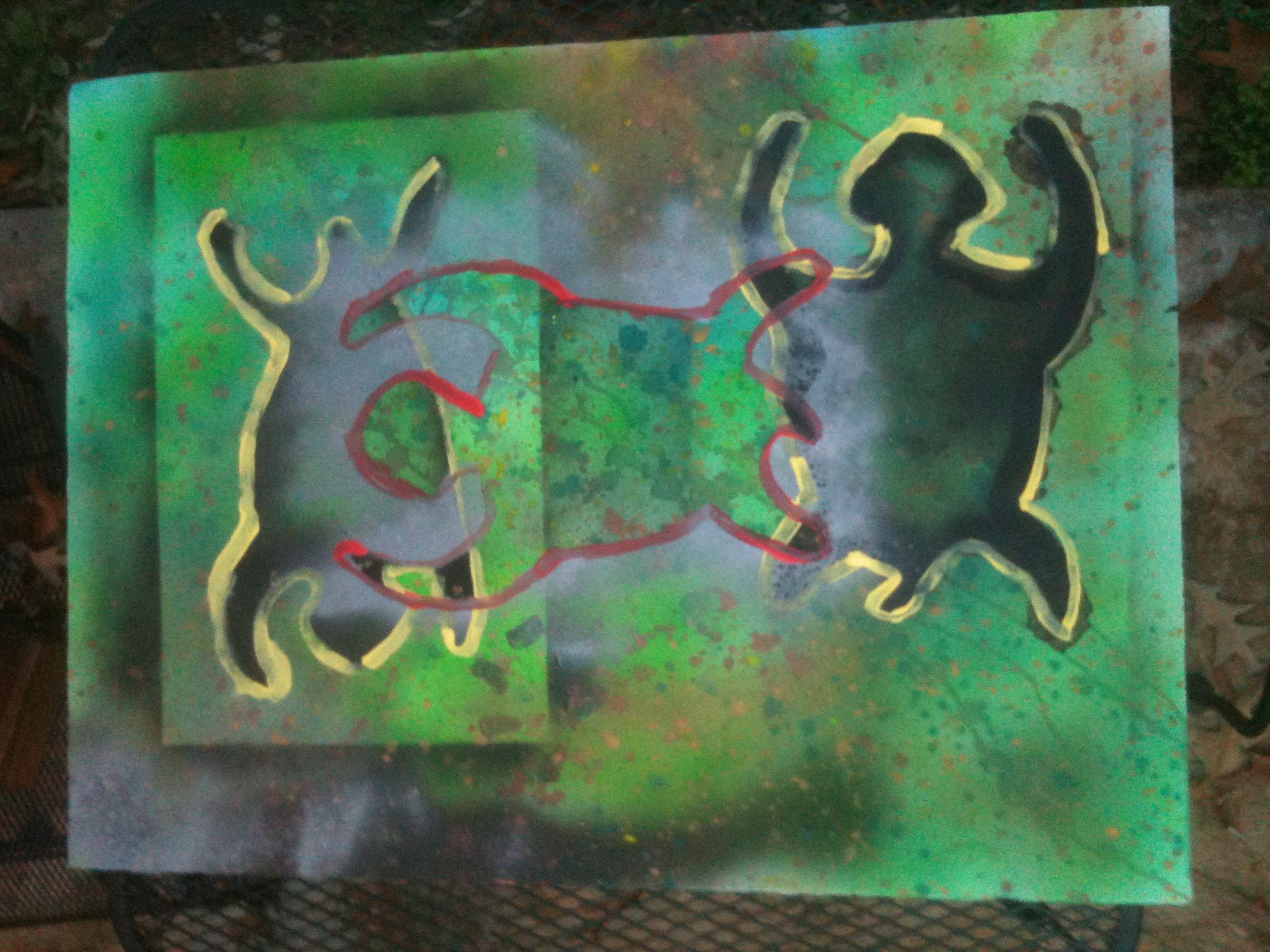
Bo Adams (@boadams1) is a learner first and foremost. Currently, he is the principal learner at The Westminster Schools Junior High School. The photo shows his older son’s recent artwork as he, too, pursues curiosity and connections.

[This post was created and posted originally for edu180atl (http://edu180atl.org/), on Nov. 29, 2011.]

Tear Down Walls and Grow an Open Garden

When we wisely tear down the walls that we can intentionally and unintentionally erect to surround our thinking and understanding, then we can grow our neural and cardio networks in ways that nourish our heads and our hearts. Axons, dendrites, and heartstrings flourish. When we make our mental garden wall-less, we can do amazing things with others…like construct a network of gardens that grow miraculously behind walls all over a city and a world.

What are we reaping and sowing today with our decisions? What walls are we tearing down? What open gardens are we growing? How might we spread our roots and our shoots?

Plant a seed. Provide water and open up to let the light in. Help grow those seeds planted by others. And let others in to fertilize the seeds that you are planting.

It’s about learning…it’s about growth!