Seeing Schools in the News

I am grateful for those who challenge and stretch my thinking. Often, a metaphor or simile, posed by another, helps me to consider the core and the edges of an issue. To compare “this” to “that,” if not overly done, helps me to understand a thing better.

Recently, I tweeted a blog post by Seth Godin. In response, @occam98 connected me to a Clay Shirky piece, “Institutions, Confidence, and the News Crisis.”

This morning, I finally made time to read the recommendation from John. Now, my mind is pleasantly tumbling (like a dryer, not a fall) about how education may be in a similar state to newspapers. I wonder about the similarities, the differences, the not-worth-comparings.

All of this seems to offer the grandmotherly option between Starkman and the FON crew — “You’re both right, dear. We need institutions and we need experiments.” Even given this hybridization, though, our views diverge: Plan A assumes that experiments should be spokes to the newspapers’ hub, their continued role as the clear center of public interest journalism assured, and on the terms previously negotiated.

Plan B follows Jonathan Stray’s observations about the digital public sphere: in a world where Wikipedia is a more popular source of information than any newspaper, maybe we won’t have a clear center anymore. Maybe we’ll just have lots of overlapping, partial, competitive, cooperative attempts to arm the public to deal with the world we live in.

What is education’s “plan A?” What is education’s “plan B?” What might the hybrid between them look like? In schools, do we need both institutions and experiments? Or “Maybe we’ll just have lots of overlapping, partial, competitive, cooperative attempts to arm the public to deal with the world we live in.”

“Fallor ergo sum” – St. Augustine, 1200 years prior to Descartes

Do we structure school in such a way that we truly promote and achieve that intricate balance between: 1) wanting to know and to understand and 2) keeping perspective that we have to be wrong quite a bit in order to gain deep knowledge and understanding?

By the time you are 9 years old, you have already learned, first of all, that people who get stuff wrong are lazy, irresponsible dimwits, and, second of all, that the way to succeed in life is to never make any mistakes. We learn these really bad lessons really well. And a lot of us…deal with them by just becoming perfect little A students…perfectionists…overachievers. – Kathryn Schulz, On being wrong TED Talk, near 7:00 mark, March 2011 (emphasis added)

Is the secret to great success never to be wrong? Of course not! I cannot imagine that even one teacher of children (or adults, for that matter) truly believes that we define “the successful” as those people who always get the right answer, or even as those who tend to get the right answer. Or do we? How do we view our “A students” versus our “C students? Perhaps I have my head in the sand. I don’t think so, though. Yet, I wonder if we people who help to structure the workings of school are ensuring that the fundamental pillars of school reflect this basic principle:

I thought this one thing was going to happen, and then something else happened instead. – Kathryn Schulz quoting Ira Glass of This American Life, On being wrong TED Talk, near 14:00 mark, March 2011

Do we overly penalize learners for their mistakes? Does the traditional, typical school currency – grades – serve best those at the core of the instructional-learning exchange? Do we allow for “returns” to be made after a transaction, or are “all sales final?” Do we allow for enough “do overs,” prototypes, iterative attempts, and second chances? Do we model our classrooms and learning spaces on the real-life tendency for all of us humans to be great mistake makers as we risk to know and to understand our world? Do we facilitate learners growing from “white belts” to “black belts” by awarding them with an average – “a grey belt?” As educators, do we understand the 10,000 hour theory? Are our scope and sequences reflectively cognizant of the 10,000 hour theory? Do we tend to sort and label, or do we tend to recognize that mistakes come with regret that should be embraced if we hope to grow from our errors?

If we have goals and dreams and we want to do our best and if we love people and we don’t want to hurt them or loose them, we should feel pain when things go wrong. The point isn’t to live without any regrets…the point it to not hate ourselves for having them….We need to learn to love the flawed imperfect things that we create and to forgive ourselves for creating them. Regret doesn’t remind us that we did badly; it reminds us that we know we can do better. – Kathryn Schulz, Don’t regret regret TED Talk, near 16:00 mark, November 2011

An Intro at the Conclusion

This morning, I had planned to work on my resume. It needs some updating, and I need a job, so I thought this morning would provide me a good opportunity to revise and edit my curriculum vitae. As I awoke from sleep, I even seemed to have some revision ideas on my mind. But then another thing happened instead.

As I sat to enjoy those first sips of morning coffee, I decided to check my Feeddler app – my way of organizing and reading my Google RSS Reader. In the queue was a new TED talk from Kathryn Schulz, the “wrongologist.” I love her work, so I thought I would watch her latest published talk while waking up with my coffee. Then, I would get to “work” on my resume. But then another thing happened instead. I was reminded of this powerful blog post by friend, colleague, and former student Peyten Dobbs. And I remembered the This American Life episode that I listened to during my Saturday afternoon walk with my dog Lucy.

I felt I had important threads dangling loosely in the wind of my thinking. I wondered if writing a bit would help me ground and weave some of those threads together. I puzzled over Peyten’s feelings expressed in her blog post, and I empathized about my own similar feelings from being a perfectionist-bent student of old.

So…do I now have all of these mysteries about grades and being wrong “all figured out?” No. But I am further down the path than I was when I awoke. Do I have revisions completed for my resume? No. If I were to need to “turn in” my resume to a teacher for grading, I fear I would receive an F or an incomplete. Yet, I engaged in some lifelong learning this morning about the nature of being wrong, the nature of regrets, and the structure of schools. I learned. But for that I will receive no formal grade. I may later regret that I don’t have a revised copy of my resume ready on Sunday, December 4. That’s okay. My regrets remind me that I can do better. And I tend to engage in super efforts to learn and grow and get better. Where does that go on my resume?

Curiosity and Connections – #edu180atl 11-29-11 cross-posted

Curiosity and Connections

This morning began like most mornings for me. I rise early so that I can read and write, mostly about educational ideas related to the future of schools and schools of the future. I began this practice years ago because I wanted to enhance my own knowledge and understanding so that I might better serve others on this dynamic path of school transformation in the 21st century. My formula is easy: maintain deep curiosity and make strong connections. The catalyst for the reaction, though, demands constant commitment and daily practice. Like I tell my two sons, ages seven and four, “If you want to get better at anything, you must practice.”

So, by 5:30 a.m., the time at which I am drafting this post, I already have two more hours of learning practice under my belt. I have made a field of mental Velcro so that I can be ready for connections of curiosity throughout the day. This Velcro is made of numerous “curiosity-connection hooks and loops” formed by the countless curiosities and connections pursued by others. I am indebted to others for sharing openly. For you see, my morning routine utilizes Kindle, Twitter, Google Reader, and the blog-o-sphere to connect me to curiosities and connections from vast numbers of amateur and professional educators around the world. Every morning, I am fortunate enough to enter the greatest faculty lounge on the planet wearing David Letterman’s Velcro suit!

Today, I feel Velcro-ly grateful for curiosity and connection practice!

_______________________________________________

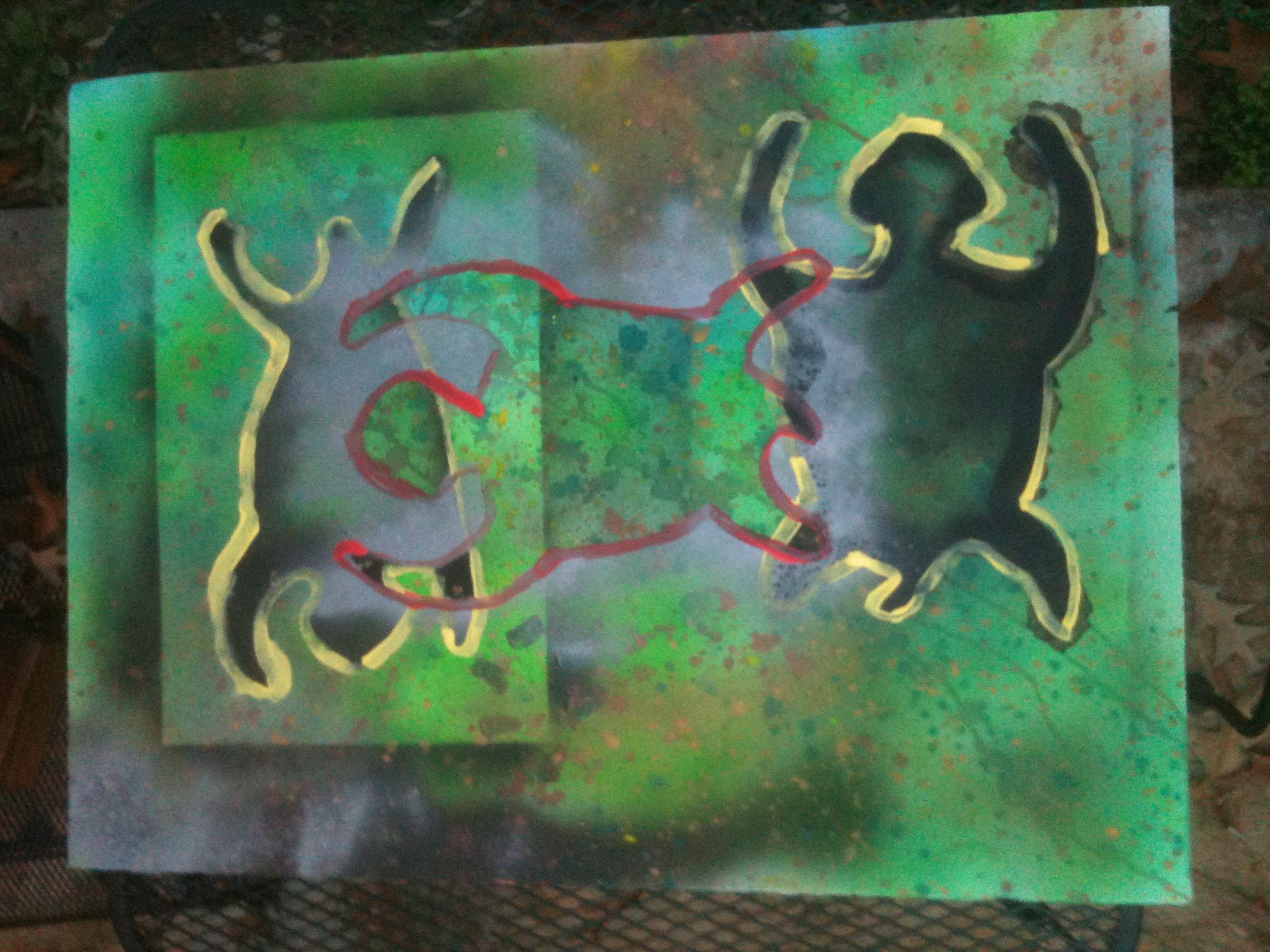
Bo Adams (@boadams1) is a learner first and foremost. Currently, he is the principal learner at The Westminster Schools Junior High School. The photo shows his older son’s recent artwork as he, too, pursues curiosity and connections.

[This post was created and posted originally for edu180atl (http://edu180atl.org/), on Nov. 29, 2011.]

Connections, Frontiers, Oxytocin, Empathy, and Walls…Say What?!

Connect! Relate! Become interdependent! What if these pursuits had been immortalized as the motto of the American Dream? I wonder where we might be as a whole culture by now, if we had as much focus on relationship and connectivity as we seem to have on getting ahead and achieving at all costs.

This morning, as I engaged myself in my typical a.m. routine of learning, I watched a few TED talks, I studied a few resources on PBL (project-based learning, problem-based learning, place-based learning, etc.), and I immersed myself in my Feeddler RSS to catch up on some coveted blog reading. Among all of that, two pieces of that learning web really called out to me. Perhaps they were like the chief anchor points on my learning web – the foundations on which the web stands when possible learning meals go by.

From the Paul Zac TED talk embedded below, along with the @occam98 blog post linked below, I am reminded and pre-minded of the power of human connection. Actually, as I write, another chief anchor point comes to mind – Steven Johnson’s Where Good Ideas Come From.

Empathy, trust, morality…they may originate from those moments and places of collision. May we be careful of the walls and fences that we build to prevent these critical collisions. [See Robert Frost poem below, too!]

Learning Web Anchor Point #1: Paul Zac: Trust, morality — and oxytocin

Learning Web Anchor Point #2: Blog Post from Quantum Progress

Reaching Out to Dispel the Myth of the Wild West Internet

Learning Web Anchor Point #3: Steven Johnson’s RSA on Where Good Ideas Come From

Some Dew on the Learning Web: Mending Wall, Robert Frost,

Mending Wall
SOMETHING there is that doesn’t love a wall,
That sends the frozen-ground-swell under it,
And spills the upper boulders in the sun;
And makes gaps even two can pass abreast.
The work of hunters is another thing:          5
I have come after them and made repair
Where they have left not one stone on stone,
But they would have the rabbit out of hiding,
To please the yelping dogs. The gaps I mean,
No one has seen them made or heard them made,   10
But at spring mending-time we find them there.
I let my neighbor know beyond the hill;
And on a day we meet to walk the line
And set the wall between us once again.
We keep the wall between us as we go.   15
To each the boulders that have fallen to each.
And some are loaves and some so nearly balls
We have to use a spell to make them balance:
“Stay where you are until our backs are turned!”
We wear our fingers rough with handling them.   20
Oh, just another kind of outdoor game,
One on a side. It comes to little more:
He is all pine and I am apple-orchard.
My apple trees will never get across
And eat the cones under his pines, I tell him.   25
He only says, “Good fences make good neighbors.”
Spring is the mischief in me, and I wonder
If I could put a notion in his head:
“Why do they make good neighbors? Isn’t it
Where there are cows? But here there are no cows.   30
Before I built a wall I’d ask to know
What I was walling in or walling out,
And to whom I was like to give offence.
Something there is that doesn’t love a wall,
That wants it down!” I could say “Elves” to him,   35
But it’s not elves exactly, and I’d rather
He said it for himself. I see him there,
Bringing a stone grasped firmly by the top
In each hand, like an old-stone savage armed.
He moves in darkness as it seems to me,   40
Not of woods only and the shade of trees.
He will not go behind his father’s saying,
And he likes having thought of it so well
He says again, “Good fences make good neighbors.”

Learning to See & Seeing to Learn #Coaching #DBL

My oldest son, PJ, is seven. He loves art, and he sees himself as an artist. According to Dan Pink, in A Whole New Mind, many children grow out of identifying themselves as artists. I hope and pray that PJ always sees himself as an artist. I believe that visual communication and design will only increase in importance as PJ grows up and inherits this world. No matter what he becomes professionally, I believe design and visual communication will be critical as our professional communities address the issues and problems of society.

I possess great hope that PJ will continue to identify as an artist. I possess this hope because PJ has a coach, also named PJ (so I will call her “PJ2”). My son PJ asked if he could take art lessons this year. Thanks to my wife and a good colleague, we were able to find an art teacher – PJ2. PJ2 comes to our home on Tuesdays, and she coaches my son PJ in “learning to see and seeing to learn.” I love this! She is helping him understand the shapes and forms of things. She helped him see the circles, ovals, rectangles, and frowny faces in the frog that my son PJ drew at his first lesson. My son PJ knows circles and rectangles, so he believes that he can do this drawing thing. He is learning to draw what he sees by looking at the whole, breaking it down into parts, and reproducing a creative whole of his own.

At his second lesson, PJ drew this bear and fish. My wife and I are trying hard to follow Carol Dweck’s advice in Mindset and praise the specific, repeatable behaviors that are helping PJ enact his seeing, drawing, and learning. We are trying hard not to say things like, “Wow, you are such a great artist.” It’s really hard not to say such things. I mean look at what he is drawing! A proud dad, I am.

But, I think I am even more proud as an educator than I am as a dad. We all have this capacity within us. We may not all have the interest or passion that lasts, but I believe we all have the capacity. PJ2 is “simply” teaching my son PJ to see what is in front of him. She is coaching him to transform a piece of blank paper into something from the future – his drawing. She is drawing out of him what is already there. She is coaching him to see this capacity in himself. She is practicing educare – to draw forth what lies within. She is coaching him in design thinking.

Recently, a colleague of mine who lives and educates in New York sent me this “Personal Best” article by Atul Gawande from The New Yorker. I am meandering through the article because it is so rich and full of wisdom about COACHING and the teaching profession – all professions, really. I am fascinated that she sent me this article at this moment in time. She and I do not converse or exchange messages at any regularity. But, at the time in which my son PJ is receiving coaching in art, JB sends me this article about coaching and the critical need for more coaching across the board.

I hope you will make time to read the article from The New Yorker, and I hope to write more about learning to see and seeing to learn. For now, I am merely recording some emerging thinking at the crossroads of an article and my son’s personal experience.

Coaching seems the key ingredient. In the article, Gawande describes coaching as “outside eyes and ears.” These coaching insights help us to see the future of what we can do and become. We need coaches. We need to be coaches. Coaches may be the central ingredient to schools making the transformation that faces us now in this 21st century. Coaching can help us see what is possible. Coaches can guide our processes of learning to see and seeing to learn. Coaching is more akin to what I hope to do next professionally.

May we all retain the childish belief that we are artists. May we all work diligently to repeat endlessly that word which Robert Fulghum described as the first real verbal magic of childhood: “LOOK!” May we lead from the future to transform blank canvas into beautiful works of art. The capacity to do so is in us all – if we will learn to see and see to learn.

Thanks to the visionaries and coaches!