AP, PBL, EL

As a middle school principal who does not face the direct pressures of the AP debate, I realize that I may possess a “too-simple” understanding of the discussion. However, I admire the dialogues that a few colleagues of mine are precipitating on their blogs: Quantum Progress and Experiments in Learning by Doing. Addtionally, I found the recent New York Times article on AP to be fascinating. I sent the following email to the PLC (professional learning community) facilitators at my school because I think the article illuminates two important discussions about PBL (project-based learning) and EL (essential learnings – the process of deciding “What students need to learn”).

If you have not read the NYT piece on AP, then here is link to it. I have pasted in two quotes from the article that I think are interesting in relation to the discussion about 1) PBL (project-based learning), and 2) ELs (essential learnings).
 

A committee of the National Research Council, a part of the National Academy of Sciences, called attention to these problems in 2002. It criticized A.P. science courses for cramming in too much material and failing to let students design their own lab experiments. It also said the courses had failed to keep pace with research on how people learn: instead of listening to lectures, “more real learning takes place if students spend more time going into greater depth on fewer topics, allowing them to experience problem solving, controversies and the subtleties of scholarly investigation.”

And to the delight of teachers who have gotten an early peek at the plans, the board also makes clear what will not be on the exam. Part or all of at least 20 of the 56 chapters in the A.P. biology book that Mrs. Carlson’s class uses will no longer need to be covered. (One PowerPoint slide explaining the changes notes sardonically that teachers can retire their swift marches through the “Organ of the Day.”)

Achievement-Action: #20minwms

When I logged into iGoogle this Saturday morning, I was greeted by this image:

Achievement is certainly preceded by action. Yesterday, on Friday, I was inspired by the ACTION a sizeable handfull of teachers took when they embarked on the “20 minute experiment.” Explained more fully in the permalink above, Jill Gough encouraged a number of us to engage in an experiment that would synthesize: 1) some of David Souza’s brain research on primacy and recency, 2) formative assessment, and 3) tweeting as a means of forum discussion. Among several others, a ninth-grade physics teacher agreed to participate and became immediately involved. He provides a summary of how he implemented the experiment at Quantum Progress. Throughout the day, participating teachers would take a brief “commercial break” 20 minutes into class and ask students to summarize what they had learned so far. Together the class would craft a 140-character tweet to summarize their learning, and they would post to the teacher’s Twitter account with the hashtag #20minwms. As the tweets appeared, we could all see what was being learned in the participating classes. We even received a spirited and curious inquiry about what we were doing from a Director of Teaching and Learning at a neighboring school. As the day progressed, the number of involved teachers grew – a snow ball was born!

Can you imagine the potential of this process to serve as formative assessment for teachers and students? To connect the learning that occurs between and among classes? To break down the walls that exist between classes? To serve as a window into learning for parents? To archive an essence of what was happening during a day of school? To…

It is about learning, isn’t it?! It takes action, it requires some risk taking, and it certainly is fun when we do it together!

GOOGLE and the JHS

Recently, I have been struck by the number of people who are talking about Google’s “philosophy” of encouraging engineers to take up to 20% of their at-work time to pursue projects of their own. Here are a few of the hits produced if one Googles the topic:

According to many of the stories, some of Google’s greatest innovations have been born from this 20% time. Rather than assuming the typical hierarchy of organization would provide vision and mission to “require” a workplace of innovation, the admin and management merely provide encouragement for an attitude of “bottom-up” leadership (I hate that term and what it implies). The admin and management simply encourage the professionals to pursue personal interests and they provide time for that pursuit to happen at work. As I read the blogs and article linked above, I became intrigued by the idea of “grouplets.” Rather than individuals pursuing personal projects, engineers were banding together to work collaboratively with this 20% time.

At Westminster, in the Junior High School (JHS) in particular, we have been on a multi-year journey to restructure professional development. We are using the professional learning community (PLC) model and principles to create a new infrastructure for teachers (our “learning engineers”) having the opportunity to work collaboratively together. We have taken a bit of an aggressive approach, and we believe that job-embedded time must be created for such collaboration.

Typically, teachers carry a five-class student course load. For example, a math teacher, in the past, would have five sections of student classes. In the more recent history, we have transitioned one of those periods to be a PLC period. In essence, we have created something akin to Google’s 20% time. One of five sections, transitioned to serve as a PLC period for teacher collaboration, equates to “20% time.”

Through the PLCs, teachers are innovating! Just having a guaranteed time to discuss all of the complexities of teaching and learning is such a positive development. However, much more than discussion is happening. With these four hours per week (we have a rotating schedule and every period meets four times per week), teacher teams are re-exploring writing as thinking, formative assessment ideas, second-chance testing, four-point rubric development, technology integration, content understanding in various fields, and the list goes on.

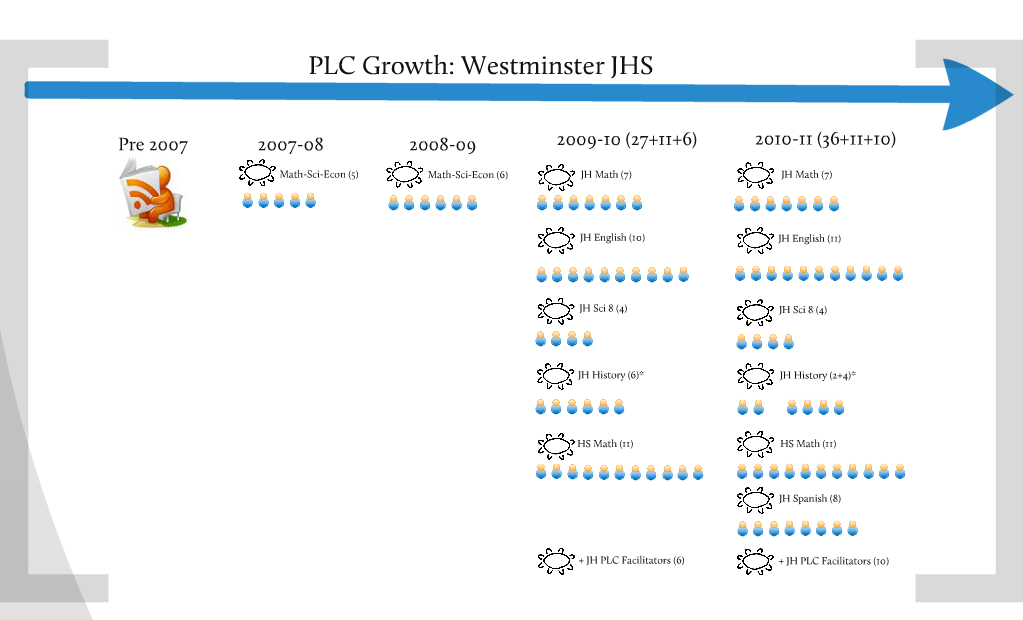
But I wonder if the 42 (of 74) teachers currently involved in formalized PLCs (we plan to work toward 100% integration for ALL teachers) see their PLC period as this Google-esque 20% time. I believe some do, for sure. But do all of them? Have I exercised my leadership in such a way that it is obvious and communicated clearly that PLC time can be for assessing student learning and creating innovations for enhancing that learning?

So many opportunities, so many possibilities! By striving to “democratize” the work day for careful study of student learning and possible educational innovations, don’t we increase the likelihood for better teaching and learning? In fact, without the 20% time in schools for the commited, motivated teachers who strive for their own continued learning and that of their students, will we really improve education, in any considerable ways, during this second decade of the 21st century?

Here’s to a New Year’s resolution for “20% time” in our schools…for the countless, dedicated teachers who simply need time to collaboratively explore, discover, innovate, and educate!

Figure 1: Formalized PLC Growth at Westminster, 2007-2011

“Only Connect…”

“Only connect…”

Before family awoke this morning, I read a few tweets and blog posts. These three are swimming in my mind still – weaving themselves together in ways that make me wish I already had developed the writing skills necessary to articulate the picture which exists in my mind.

Three tweets/blog posts:

Bob Ryshke on “Disruptive Innovations and Creating a Culture of Innovation”

Nancy Flanagan on “Digging Out”

Bill Ferriter on “One Tweet CAN Change the World”

For me, the tapestry created by weaving these three thought-provokers together can be summarized with the E.M. Forster quote, “Only connect…” For me, the most critical educational innovation to be realized in the 21st century is for administrators and teachers to work together to make possible the opportunities needed for educators to connect. Educators must be learners and must model learning, and our educational structures must be innovated to foster and promote connected learning among the adults in the buildings. We must dig out of antiquated, isolated structures that keep teachers, the lead learners, separated. We must share and we must find educators who are sharing. We need to think together. We need to connect. Our students deserve our best selves, and WE are smarter than ME.

Only connect…

A school infrastructure that allows – no, PROMOTES – connected learning among the adults is a school infrastudcture that can guide students to learning that matters greatly in the 21st century. How do we expect to facilitate 21st-century-skill development in our students if our teachers don’t live in an environment – in a mindset – that facilitates 21st century skill development?

INNOVATE for teachers and administrators to enjoy job-embedded time to learn together – to CONNECT – and I would be willing to guarantee that endless other innovations will follow. Motivation is NOT the issue for teachers…TIME is the issue. Let’s make time for lead learners to learn together…to connect.

Connect. Only connect…

One Step at a Time

With the gracious permissions of two extraordinary teachers, who also serve as co-facilitators of our middle school math PLC, I am pasting in a recent e-mail thread that transpired between the three of us, as well as one other teacher who teaches on the Algebra I team. As a school, we are making thoughtful transitions toward student learning that involve more real-life problem solving, project-based learning, and balanced assessment. Often the journey is difficult, challenging, and frightening. This journey forces us to reconsider some habits that we have developed as educators in our twenty-years careers. However, we are not alone, and we don’t have to “change everything,” especially not all at once. We can take one step at a time, and we can do so arm-in-arm with our colleagues.

Quick Cartoon “Commercial Break”

>>> JG 11/15/2010 1:49 PM >>>

Please watch when you can and let’s talk about it.
Conrad Wolfram: Teaching kids real math with computers
http://www.ted.com/talks/conrad_wolfram_teaching_kids_real_math_with_computers.html

>>> DD 11/16/10 11:51 AM >>>

It’s a great talk. I agree with most of what he said. My problem is I was trained the way he says we are inadequately teaching. I don’t know how to do what he says to do. I think you need to understand math a lot more than I do to see most real world connections. I have been hearing this idea a lot; but where is the curriculum? Where are some books that will help guide me to teach this way? If that isn’t on its way, then I guess I need to go back to school or get a new job. It is as daunting as if someone said I needed to take someone’s Latin class over and teach it.

I would like to discuss it in PLC.

>>> JG 11/17/2010 1:02 am >>>

Reading Dan Meyer’s blog offers good ideas:
http://blog.mrmeyer.com/

If you have not seen his TEDNYed talk, Dan Meyer: Math class needs a makeover, it offers a way to use our current books.
http://www.ted.com/talks/dan_meyer_math_curriculum_makeover.html

>>> Bo Adams 11/17/2010 5:16 AM >>>

DD,

I respect your thoughts on this, probably more than you even might realize. However, I truly believe that any journey, any journey at all, begins with one step. Just one step can start the path. You have already made MANY steps toward the type of teaching that Conrad describes. In fact, you have been doing it for years. With the support of the PLC structure, I think your Algebra I team has made MANY steps toward this journey.

As a runner, I travel a sinusoidal curve in my training. When I am at a low point, and I am trying to make a run of significant distance, I often pick a short-term point in my vision – maybe a street sign, maybe a telephone pole. I just tell myself to “get to that point.” Then, I pick a new point. Often I feel like Donkey (no comment from any of you necessary) when Shrek was coaxing him across the rickety-old bridge that separated Princess Fiona’s castle-of-captive from the other side of a lava-filled gulf. Donkey made it with encouragement, ONE STEP AT A TIME. He did not have to jump the entire gulf in one fell swoop. [Sorry to mix metaphors!, but I did call myself an ASS!]

SHRINK THE CHANGE. Just pick one thing during one class to try. 20 minutes worth. You do this type of “action research” all the time! You are used to it. You just have to pick the next step in your journey’s path. And you have lots of support in your team and in me!

Bo

>>> DD 11/17/2010 11:10 am >>>

That was a great suggestion. It seems simple but I need to remember that when I start to feel overwhelmed. One step at a time.

>>> Bo Adams 11/17/2010 11:29 AM >>>

How would you two feel if I put all of the below in my “It’s About Learning” blog? I could remove your names, or leave them if you don’t mind. I think these emails make for a good story that could help support others.