“If you would like to help us design school…” #MVPSchool #MVIFI

I love my school for so many reasons. Just this morning, I received an email that provided me with yet another reason. The email was sent to the entire Upper School student body, and I was copied. It was an email rich in design thinking. It was an email full of trust that honors the wisdom of the “student.” It was an email full of promise for the depths of design – at the intersection of creativity and functionality.

Design thinking is people-centered problem solving. It is fundamentally concerned with and connected to the users of the things being designed. It is full of empathy and creative, critical thinking applied to real-world issues and challenges.

The most ambitious school leaders are serious about the design of “school.” How could one not be in our current era – to continuously think, design, and act for the best learning experiences for our learners. To give anything less than such critical attention would be unthinkable. Even if one determined to leave school “as is,” it would be superb if such decision making stemmed from thoughtful research and design, rather than status quo or de facto operations.

So, here’s the email. What a glorious invitation. How grateful I am that such is commonplace where I work and learn!

All,

I hope you all had a great weekend.

If you would like to help us design school for the “Experiment” and “Produce” phases of the projects, we need your ideas and help.

I invite you to join me either for lunch Wednesday or for breakfast Friday (on me) to discuss how we might best design the school day to position you for success.

Click here to sign up. [active link in original email]

There are only 50 available slots this week, and there will [be] more opportunities in the near future.

Enjoy your day,

Tyler S. Thigpen

@tylerthigpen

Head of Upper School

Mount Vernon Presbyterian School

The Cardboard Challenge @K4MVPSchool #MVPSchool

mvcitybox

Today, Lower School students at Mount Vernon Presbyterian School participated in the Cardboard Challenge, inspired by Caine’s Arcade.

People from 41 countries took part – more than 78,900 participants. Only two organizations in the state of Georgia (U.S.A.) flexed their scissors, spread their tape, and exercised their design muscles for the Cardboard Challenge. Thanks to collaboration among the faculty at Mount Vernon, and thanks to the creative confidence of our students, the Mustangs were in that number!

Mary Cantwell (@scitechyedu) set up a time-elapse camera to record the coordinated, staged efforts of five grade levels working in 45-minute shifts. So, we should be able to see the action from start to finish before too long.

Here’s the message Mary sent to invite the architects and engineers:

The DEETS:

Challenge: Students will be challenged to imagine and create the metropolises of the world! (decided we needed more than just ATL)

Time: 45 min blocks of building/play time; Sign Up Here [link removed] if you want to participate

Do B4 Arriving: Partner/Trio groups – have them research famous/interesting buildings/structures from around the world, plan out what they want to build, sketch it (with boxes in mind), and arrive on the CityBox party with a Plan of Action

AND/OR The HR selects a city together – plans out what they will build to represent different aspects of the city.

AND/OR The HR decides to create and build a fictional city/town and plans out all they want and need in this city (could be connected to a novel study, a story being studied, a SS moment in history)

Show Up. Respect what has already been created. Stake out your space. Get your boxes, imagine, create, play.

Mary Cantwell

People, Needs, Empathy

Center for Design Thinking

What an amazing sight to see the buildings take shape and form! At carpool this afternoon, I asked my typical question to a bunch of the students: What was the most incredible thing you did and learned today?

Usually I get a myriad of responses. Today, though, they ALL talked about their buildings – the Coliseum, Hancock Building, Notre Dame, Hippodrome, and the Taj Mahal, just to name a few. Zach even explained to me how he built the Burj Khalifa – the tallest skyscraper in the world!

This slideshow requires JavaScript.

Change the World… Change School

From “Young People Are the Geniuses Who Change the World,” Angela Maiers, Switch & Shift: Human Side of Business, 7/28/2013 [HT Angél Kytle]

At Choose2Matter, our opening line in speaking to young adults is “You Are a Genius, and the World Needs Your Contribution.” Next, we tell them they can change the world.

Why do we say this?

Because studies show that, at the age of five, 100% of students believe they can, and will, change the world. When I visit with first-graders, they always confirm this by enthusiastically charging the stage en masse when I invite them to share their genius and tell me their ambitions for changing the world.

By the age of 9, only half of students believe they are geniuses who can change the world.

By the age of 16, just 2% of students believe they are geniuses who can change the world.

When I visit high schools, I see something very different than I do in elementary schools. The genius is still there, but it’s buried under years of schooling. How? I’ve actually had educators and parents comment on my posts that we shouldn’t tell students they can change the world, because it sets unrealistic expectations. My response: unrealistic for whom?

An incredible post that then highlights nine young people who are changing the world. One of the people is Jack Andraka, whom I spotlighted on my own blog before. And there are eight more.

Correction. There are THOUSANDS more! MANY THOUSANDS!

A few more of the many – all whom I’ve met thanks to TEDxAtlanta:

Brittany Wengerpost and TEDxAtlanta Profile and Talk

Brittany Wenger, a high-school senior, is well on her way to making the diagnosis of breast cancer less painful and more accurate.

Clare O’ConnellTEDxAtlanta Profile and Talk

At age 20, Claire O’Connell is a co-founder of EyeWire, an online game / “citizen science initiative” that’s helping to map the human brain by mapping the connections between retinal neurons.

Hannah SalwenTEDxAtlanta Profile and Talk

Kevin Salwen is a writer and entrepreneur. With his 15-year-old daughter, Hannah, he is co-author of The Power of Half. The book is the story of a eureka moment by Hannah that resulted in the Salwen family’s commitment to reduce their consumption by half — started by selling their house and moving into one half its size.

School is not just preparation for real life. School is real life. And real life could be school.

Einstein said, “It’s a miracle that curiosity survives formal education.” Survives.

How might we enable curiosity to THRIVE in formal education?

By helping school become more about the “business” of real-life, relevant work. There are armies and armies of young people who care and want to change the world. A few will demonstrate the initiative to do so in spite of the rigidity of an industrial-age school system. But how many more might be activated, inspired, and motivated IF school were structured to nurture such inherent passion for wanting to make the world a better place – while the learners are IN school?

Recently, at our school, Mount Vernon Presbyterian School, faculty T.J. Edwards (@TJEdwards62) and Mary Cantwell (@SciTechyEDU) have invited and enlisted others in our ranks who might want to work on OpenIDEO’s Creative Confidence Challenge.

What if we ALL participated?!

#RipplesInAnEndlessPond

#ItsAboutLearning

#ItsAboutMakingADifference

= = = = =

Related Posts:

Make learners conform to the room, or make the room conform to the learning? #EdSpace

$9.99

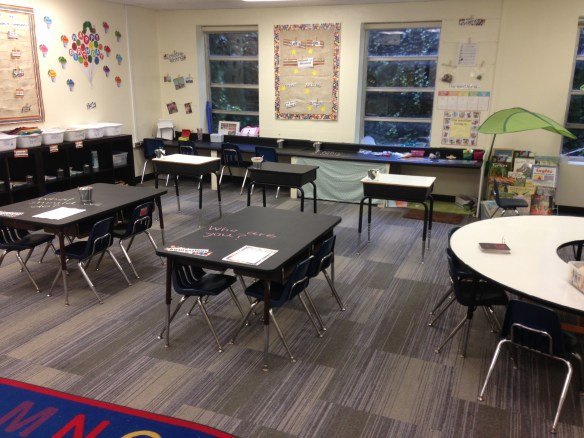
That’s what a small can of chalkboard paint cost at a hardware store nearby. With several cans of chalkboard paint and a few cans of whiteboard paint, a lower school teacher transformed the learning environment for the student learners coming to her soon.

2013-08-12 09.01.34

Instead of students “getting in trouble” for writing on the desks, Miss F altered the typical “classroom” environment so that desk writing was not only permissible, but encouraged and fun.

For 1st graders. Learning to write and express themselves through writing.

When the student learners gathered in the room for the first time, during a recent orientation day, there was much writing and drawing on desks! They owned their learning environment with those acts of defiance turned and transformed into acts of creativity.

And should the student learners tire of sitting, there are standing-level desks and exercise balls to bounce on while one learns. A far cry from “Sit still!”

What an act of transformation. To reverse the typical paradigm. Instead of expecting students to bear the lion’s share of conforming to the rules of the room, the rules of the room were re-conformed to promote the desired dispositions and learning explorations of the student learners!

And with such a flip in conformity expectations, transformations are made possible. And deep relationships forged.

2013-08-12 11.09.55 = = = = = = = = = = 

Recent, incredible resources on space re-design:

“8 Tips and Tricks to Redesign Your Classroom,” Edutopia, August 6, 2013, by David Bill (@DavidSBill) and The Third Teacher+ (@TheThirdTeacher)

Being called and curious. Being an explorer. Widening our options.

“Certainly to enter a world of terror, you should not be pushed by someone. You should be called. You should be curious. You should have the heart of an explorer.” — Philippe Petit, high-wire artist (from here)

In Dan and Chip Heath’s newest book, Decisive, they illuminate a process for making better decisions. It’s called W.R.A.P.

W = Widen Your Options

R = Reality-Test Your Assumptions

A = Attain Distance Before Deciding

P = Prepare to Be Wrong

On the Heath Brothers’ site, one can register and gain access to some great resources. One of them is a one-pager summary of the WRAP process.

For “W” —

Screen Shot 2013-08-01 at 5.56.14 AMIn looking for “analogies from related domains,” I often turn to TED and NPR. Recently, I listened to the TED Radio Hour feature called “To The Edge” – a curation of talks about exploration.

Many people talk about “fear of the unknown” and our “V.U.C.A.” world (Volatile, Uncertain, Chaotic, Ambiguous). While the future of schooling is not a “world of terror” in any way, shape, or form, in my opinion, I wonder if some view it that way, even if subconsciously.

As for me, I feel called. I feel curious.

I am an explorer.

And I am grateful to be a member of a team that believes in systemic exploration – driven by curiosity – to generate increasingly better models of school-based learning and education.

I learn a lot about my role and my calling and my curiosity by approaching educational innovation as an explorer.

How might we enhance the manner in which we systemically explore innovation in schools? 

One idea (among many) – BE an explorer! Encourage systemic exploration and nurture methods and manners to explore educational enhancement AS a school team and community.

Most, if not all, schools highlight the explorers and inventors in world and U.S. history, mathematics, science, etc. How many of us are practicing exploration and invention, as an organization – intentionally, purposefully? How are we creating time and space for exploration and invention?

Here’s to being called out on that high-wire, to that summit, for that row across the ocean. (You’ll just have to listen to To The Edge, if those references make you… curious.)