If school is supposed to prepare students for real life,
then why doesn’t school look more like real life?
For more than a decade, this question has lived at the heart of my research and practice as a professional educator. While I worked at Unboundary, we created a Brain Food devoted to exploring this question.
A number of educators and school transformation agents connect to this question through an entire branch of educational practice known as “authentic learning.” At the end of January, #EdChat Radio featured the topic of authentic learning on an episode. And Dr. Brett Jacobsen, of Mount Vernon Presbyterian School and the Mount Vernon Institute for Innovation (where I work), recently interviewed Dr. Yong Zhao for his podcast “Design Movement,” and much of their conversation connects with this topic of authentic learning.
Given the habits formed by decades of industrial-age, delivery-based pedagogy, though, educators must explore and experiment with different structures in order to make room for more authentic learning – learning that is meant to serve a greater purpose than only a grade in a grade book and a future locker-clean-out session in late May or early June.
Exploring such new structures can be challenging for schools. In fact, some structures point to entirely different paradigms for schools – like “giving an education” rather than getting an education, taking a course, or whadya-get-on-that-test assessment.
Some school people imagine such paradigm shifts would lack structure – that it would be too free form, loosey-goosey, or soft-skills heavy. This is really a false set up for thinking about the structural-shift needs of schools in transformation. How “loosey-goosey, really, is your project work and real-world problem solving in your career and life?
As Tony Wagner says in Creating Innovators, it’s not a choice between structure and no structure to allow for more authentic learning. It’s a choice to build a different structure for School 3.0 – one that allows for student-learners to explore their passions and real-world purposes while engaged in challenges that exist in the world and yearn to be defined and solved. Structures that empower learners to engage in more authentic learning flows.
But how do educators make such shifts and create different structures? I believe one way we do this is to explore avenues and portals to empower students to engage in real-world problem solving. Instead of only organizing the curriculum – the track of learning – around subject-siloed disciplines, at least part of the curriculum could be organized around exploring and venturing into authentic, real-world problem solving as organizers of product-and-process-oriented work.
In my own life and work, I’ve explored opening such portals through #fsbl and #Synergy. Much of this work involves immersing oneself and other learners into the Innovator’s DNA traits – observe, question, experiment, network, and associate – through the methodology of observation journaling and curiosity-curated curriculum.
Of course, other ways exist to open those portals and explore into those worlds of authentic learning and real-life problem solving. Here are but a few inspirations and possible ways in…
#GoExplore
Resources for engaging in real-life solution seeking:
Open IDEO is an open innovation platform for social good. We’re a global community that draws upon the optimism, inspiration, ideas and opinions of everyone to solve problems together.
DoSomething.org is the country’s largest not-for-profit for young people and social change. We have 2,439,780 members (and counting!) who kick ass on causes they care about. Bullying. Animal cruelty. Homelessness. Cancer. The list goes on. DoSomething.org spearheads national campaigns so 13- to 25-year-olds can make an impact – without ever needing money, an adult, or a car. Over 2.4 million people took action through DoSomething.org in 2012.
Choose2Matter is a call to leadership and an accelerator to connect individuals and communities with a conscience. It combines technology, innovation and mentorship to solve problems that matter. It’s an important opportunity for business, brands, and communities to join forces in the causes and issues most important to those they lead and serve.
What has been inspired by students, has led to the official launch and creation ofCHOOSE2MATTER – a crowd sourced, social good community.
I’m on an adventure – to explore the limits of design’s ability to solve social problems, big and small. To do this I attempted to solve 50 problems in 50 daysusing design. I also spent time with 12 of Europe’s top design firms.
InnoCentive is the global leader in crowdsourcing innovation problems to the world’s smartest people who compete to provide ideas and solutions to important business, social, policy, scientific, and technical challenges.
The TED Prize is awarded to an extraordinary individual with a creative and bold vision to spark global change. By leveraging the TED community’s resources and investing $1 million dollars into a powerful idea, the TED Prize supports one wish to inspire the world.
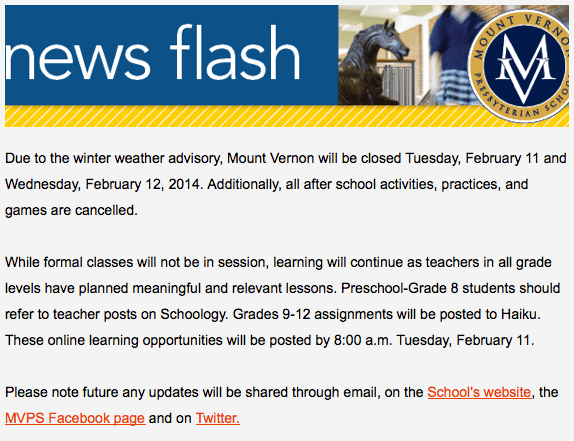
If you’re connected to a school in Atlanta, GA, and if your school name is on some local news channel today with the word “Cancelled,” are you considering it a…
#Snowcation, or a
#Snopportunity?
It’s fascinating to me how many schools have discussed for years such topics as “21st Century Education,” “Blended Learning,” “Virtual Learning,” “Online Learning,” “Digital Learning,” “Connected Learning,” etc., yet when a would-have-been-in-school-anyway Tuesday turns into a snow day, so many at the school see the day as a day off from school-connected learning.
Perhaps it’s due in some way to the language one’s school uses. For sure, a #Snowcation communicates a very clear cultural expectation about the relevancy of school-connected learning when the school people don’t actually meet in the same physical space because of some winter-weather occurrence. On the other hand, to say that “learning is open” even if school is closed communicates an altogether different way of believing. As Peter Block said, “All change is linguistic,” and a school community’s language – even in the seemingly small moments – can either promote the status quo or dynamism.
Perhaps it’s due in some way to the culture of innovation that’s been created and nurtured (or not) at one’s school. I mean, after all, a snow day is a day to kick the feet up and forget about school, right? Because that’s the way it’s always been. Or it could be an opportunity – a #Snopportunity – for a school that’s deeply invested in leading into the future of education — to “ooch” (as the Heath Brothers describe it in Decisive) some possibilities and prototypes for school-connected learning, even when the school community is not gathering at the same physical campus for the day.
Of course, when a school regularly practices design thinking and iterative prototyping, it becomes relatively easy to see a snow day as a chance for extraordinary research and experimentation – all in the “ordinary” way that the school usually approaches windfall chances to learn and create and enhance common practice. Such has become a part of the school’s (Innovator’s) DNA.
And for a school that not only pays attention to the research and development of educational practice, but also contributes to it, it comes as no shock or surprise that the future of education is about learning flows and not just the physical campuses of school houses. So, when a snow day occurs, such a school sees and seizes opportunities to further a deepening understanding of how school and learning can be brought even closer together as ever-eclipsing Venn circles.
I feel genuinely blessed to serve at such a school. And I feel an obligation and responsibility to share our practices – the practices of an entire community of professional learners, innovators, and extraordinary educators.
Sharing Mount Vernon’s Practice
Systemic Communication from Division Heads & Directors of Teaching and Learning
High-value communication and collaboration happen regularly within and among the divisions at Mount Vernon. And the educators act as a team, moving strategically together. So, when the decision was finalized to close the school campuses for Tuesday and Wednesday, the Division Heads and Directors of Teaching and Learning distributed communiques to the faculty. Below is one such message from our Upper School Dean of Academics and Director of Teaching and Learning.
On Feb 10, 2014, at 5:10 PM, Emily Breite wrote:
Hello everyone,
I trust you have seen the news that Mount Vernon’s buildings will be closed tomorrow and Wednesday in the interest of safety. However, as Tyler outlined in his earlier email, we will still treat these days as learning days with the expectation that our students be demonstrating their learning and that we be available to support them as they do so.
Instructions for Faculty and Students:
1. Students will continue with learning exercises and assignments that teachers have posted on haiku by 8 am on Tuesday morning at the latest. Those can be due virtually while we are away or can be due when we return to school. Given that most of the ice is expected on Tuesday evening (from what I hear), it may make sense to have some work due to you by the end of the day Tuesday.
2. For each day that we are away from the building, teachers will hold two face-to-face sessions through Google Hangouts for 5-10 minutes for each of their preps at some point before noon to communicate about the learning plan for each day and to answer student questions. Holding two sessions will allow us to handle the capacity of Google Hangouts (15 people can hangout together at a time) and minimize conflicts for students.
You could also break this up into 5-10 minute chunks over four hours, if that works better for your situation. Obviously this will be a bit of an experiment and we will not be giving students official absences or tardies, but I do think we need to make sure students know that this sort of virtual interaction is the expectation and to follow up if they do not engage. (Again, if there are widespread power outages, hangouts may not be possible.)
If you have a special situation that would prevent you from being able to engage with students for 5-10 minutes a few times each day, chat with your Head of Grade and me about a solution. One idea might be to make a little video (capture is one app you can use) to give students an overview of what they’ll be doing and then being accessible via email. A little bit of face-time is the goal.
Below is Mikey’s how-to video for facilitating Google Hangouts and he sent a few from Trey just a few minutes ago.
Thank you for all of your efforts to help us make use of these days. Stay safe!
Emily
Google Hangouts
Even before the above messages were fully crafted and sent, other internal communications at Mount Vernon were bouncing around to provide support and coordinated understanding around our approach to this #Snopportunity.
For example, as mentioned in Ms. Breite’s message, our Director of IT and our Creative Director established resources for faculty wanting to capitalize on Google Hangouts:
Team,
In case of inclement weather, Google Hangouts On Air are a great tool for connecting with students virtually. I have created three video tutorials around Hangouts On Air and a video on the general philosophy of Hangouts and the classroom.
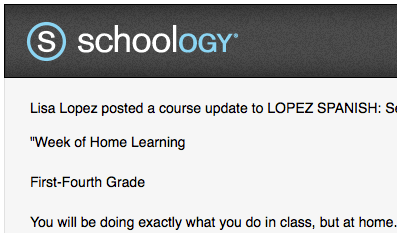
Because Mount Vernon regularly employs the MiddleburyInteractive program to create a blended learning environment for world language instruction, student learners were able to engage various elements of their language acquisition, just as they do when they are in the school house.
Screenshot of a small portion of a thorough Schoology post from a Spanish teacher.
Learning Management Systems (LMS) – Haiku, Schoology & Orchestration
In a recent leadership podcast from Andy Stanley, Stanley details the importance of striving for clarity in the face of complexity. One way Stanley explains that a complex organization can promote clarity is to “orchestrate and evaluate” – to routinize certain processes and procedures while being diligent and committed to constantly evaluating and bettering those routines.
For my sons, in first and third grades, school-connected learning at home (a.k.a. “homework”) benefits from the routine of Schoology. (As noted above, the Upper School uses an LMS called Haiku.) Each week, long before Monday, my sons’ teachers post the week’s homework outlines and expectations. Because of this technology-enhanced routine, we could continue on today, even during our #Snopportunity.
Third Grade
We are a School of inquiry, innovation, and impact. Grounded in Christian values, we prepare all students to be college ready, globally competitive, and engaged citizen leaders… Even on snow days! As you have heard, school is closed, but learning remains open! We are excited to share some learning opportunities for you and your child to enjoy together.
Literacy
Reading: Read your fantasy book and log your reading. You should be reading a minimum of 30 minutes each day. Read with your pencil in hand to help process the story’s information. Jot down major ideas, happenings, plot twists, character strengths, etc. as you read. Bring your notebook back to school to share with your reading partner.
Writing: Write out loud! “Story tell “ your final totally made up fairy tale to a parent, sibling or friend. Remember to use your storyteller voice thinking about what your characters are saying and doing. Plan through the beginning, middle, and end of your story. Use your parent as a writing partner! What feedback can you glean from them?
Spelling: The students have a prefixes study guide in their homework folders. They should be reviewing the meaning of a morpheme, prefix and base word. They should also review our weekly red words (iron, honest, honor, guess, guest, guard). Complete the Prefix Word Hunt with your family. Brainstorm words that begin with dis, un, pre and in/im. Please bring the word hunt back to school to share with your classmates.
Math
Continue to explore division:
review math facts and complete Practice 8-2 (check handouts from backpack)
Complete the Daily Spiral Review for 8-3 (check handouts from backpack)
Please continue to work on multiplication and division facts with flashcards, iXL and other sites like www.iknowthat.com.
Complete: iXL F.3, F.5 (Multiplication 2s and 4s), G.5, G.6 (division facts to 12 and division patterns)3, F.5 (Multiplication 2s and 4s), G.5, G.6 (division facts to 12 and division patterns)
Design Thinking Challenge (Snow Jam emergency car kit)
Finish either making your “low resolution” prototype or drawing. Remember to add length measurements so we can get the right scale. Bring in drawings and/or prototypes.
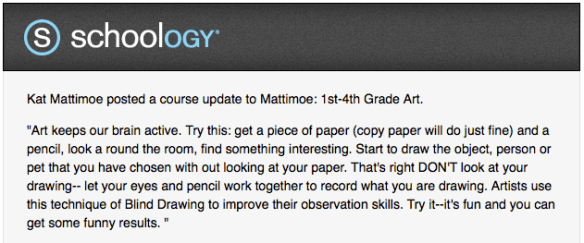
And because the faculty are well-practiced in connected learning, they are accustomed to online-enabled interactions with the children. For example, when the art teacher Ms. Kat posted this #Snopportunity for drawing, I so enjoyed watching my email notifications “light up” with the conversation threads happening among Ms. Kat and her students as they traded stories and coaching about what they were drawing around their houses.
Twitter
Of the 145 faculty and staff at Mount Vernon, about 120 are users of Twitter. So, a snow day does little, if anything, to deter the connected learning and communication among our community of educators. By searching the hastag #MVPSchool, you can see some of the interactions and exchanges that have happened as collective habits of minds engaging this #Snopportunity. As another example, you could peruse a Storify that details another #CarpeOpportunity moment two weeks ago during the snow and ice that hit Atlanta during the last days of January.
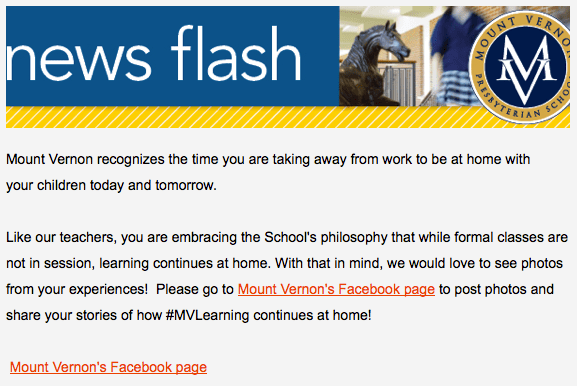
These are but a few of the ways that Mount Vernon calls on its Innovator’s DNA to take advantage of a #Snopportunity. In closing, it’s also worthwhile to see how our Communications Team encourages school-connected learning at home to be shared and showcased among our community…
The letter to parents quoted below came from Mount Vernon Presbyterian School‘s Lower School Division Head, Shelley Clifford. I’m so fortunate that she is my sons’ principal.
Dear Mount Vernon Families,
In the spirit of starting with questions, what do you hope for your child to learn this semester? The Lower School teachers returned on January 6 and reflected upon this question. How might we intentionally use the 94 remaining days of this school year to inspire and encourage our children to pursue their unique passions and gifts? Specifically in the month of January, Lower School will focus on the Mount Vernon Mindset, Innovator.
Innovators explore and experiment in a climate of change. They build resilience through risk-taking and setbacks. Innovators create unique ideas with value and meaning. Kindergartners will practice their empathy and innovation skills by embarking on their first Design Thinking Project. Be sure to ask your Kindergartner about the Gingerbread Challenge. Second graders have already begun exploring the essential question, “How does learning about inventors and inventions affect our outlook on the world and help us be creative thinkers and innovators?”
All students are engaging in visible thinking routines, long-term projects, and discoveries that focus on habits of an innovator. These habits include: starting with questions, engaging in observations, and thriving from collaboration with others.
Regular practice of these skills builds curiosity, so much so we would like to join you in celebrating your child’s sense of wonder as you encourage him or her to observe and experiment at home. Embrace the endless “Why?” questions, and make associations between the strange and the familiar. Finally, collaborate with your learner and encourage him or her to collaborate with other people who may have different perspectives.
If you would like to explore one of our favorite resources on this topic, check out The Innovator’s DNA; here is a link to the book.
Today, the Upper School parents at Mount Vernon Presbyterian School (where I work, learn, serve, and play) received a letter from Head of Upper School Tyler Thigpen, and I am quoting a significant section of the letter below, with his permission, as something like a guest blog post.
To give just a bit of context, the Upper School students at Mount Vernon experience (and share voice in the iterative implementation of) a very purposefully researched, designed and orchestrated transdisciplinary program. Using MVPS’s developed model of design thinking – DEEP (Discover, Empathize, Experiment, and Produce) – faculty and students focused on discovery and empathy phases in September, October, and November. Then, in the first week of school in January, students engaged in a mixture of content/context workshopping, vigorous presentation production, and iterative pitching to convince expert panels to approve further work on the projects into the experiment and produce phases. Pitches were evaluated on ten comprehensive criteria, and projects were also rated by degree of difficulty.
Okay, now onto the guest-blogging-by-way-of-parent-letter…
Dear Upper School Family,
Happy New Year!
I have been itching to share with you the deep learning, college preparation, and marketplace training that have already occurred this year.
Last week, thanks to an innovative plan crafted collaboratively by both students and teachers, Upper School students positioned themselves to leverage content and skills from their classes todesign and pitch capstone projects aimed at real-world impact.
They developed creative solutions, honed their presentation abilities, and used constructive criticism to correct previous knowledge and improve ideas. Examples of diving deep in search of learning outcomes in some of their classes included: students writing algorithms, researching flora and fauna, learning profit maximization, understanding search engine optimization, and performing comparative analyses.
Students received pointers from visiting professionals such as the SVP of Business Operations at Turner Broadcasting, SVP of Communications & Investor Relations at First Data, VP of Marketing at Popeye’s, VP of Financial Planning & Analysis at Manheim, Chief Development Officer at Metro Atlanta YMCA, Councilman at City of Sandy Springs, and numerous others.
The learning that is taking place is truly remarkable.
Colleges appreciate when students come equipped to learn how disciplines overlap and how humanistic and scientific approaches can be applied to real-world issues and challenges. Both emphases were front and center last week. About this approach, a Wake Forest University faculty leader writes:
“Mount Vernon’s innovative move, allowing students and curriculum to cohabit in a learning environment, should serve as a model for all schools. The difference between knowing about and knowing is profound. When students engage the realities of their study–the good, bad, and the ugly– the result is ownership; students become actors who come to believe they can act. The point of education is to sanction agency for students to win their future. Hats off to Mount Vernon.”
– Dr. Allan Louden, Communication Studies Department Chair, Wake Forest University, and Director of United States Grant for the Ben Franklin Transatlantic Fellows Institute
From the private sector, another professional comments,
“Mount Vernon’s transdisciplinary approach focuses on building strong critical thinking and problem solving skills that will better prepare students to compete in a global marketplace.”
– Joanne Burke, Banker, Goldman Sachs; and Member of Board of Overseers, Boston Symphony Orchestra
Lastly, one of last week’s panelists remarks,
“Thank you so much for inviting me to be a part of such an exciting experience! Not only was it meaningful to me because I witnessed tremendous growth in the students…but it was also incredible to see students tackling problems that exist in the world outside MVPS, offering significant and relevant solutions. I am impressed with the level of thoughtfulness and detail students put into their projects. Thank you again for allowing me to join!”
In my career I cannot remember seniors, during their final semester of high school, spontaneously celebrating success by running down a hallway and high-fiving classmates because of a school project. But that is what happened.
Levels of engagement, relevance, and challenge are high, and I look forward to sharing more updates as the process evolves.



 it's about learning