Real-World Impact: Guest Post @TylerThigpen #MVPSchool #MVIFI #MVImpact

Today, the Upper School parents at Mount Vernon Presbyterian School (where I work, learn, serve, and play) received a letter from Head of Upper School Tyler Thigpen, and I am quoting a significant section of the letter below, with his permission, as something like a guest blog post.

To give just a bit of context, the Upper School students at Mount Vernon experience (and share voice in the iterative implementation of) a very purposefully researched, designed and orchestrated transdisciplinary program. Using MVPS’s developed model of design thinking – DEEP (Discover, Empathize, Experiment, and Produce) – faculty and students focused on discovery and empathy phases in September, October, and November. Then, in the first week of school in January, students engaged in a mixture of content/context workshopping, vigorous presentation production, and iterative pitching to convince expert panels to approve further work on the projects into the experiment and produce phases. Pitches were evaluated on ten comprehensive criteria, and projects were also rated by degree of difficulty.

Okay, now onto the guest-blogging-by-way-of-parent-letter…

Dear Upper School Family,

Happy New Year!

I have been itching to share with you the deep learning, college preparation, and marketplace training that have already occurred this year.

Last week, thanks to an innovative plan crafted collaboratively by both students and teachers, Upper School students positioned themselves to leverage content and skills from their classes to design and pitch capstone projects aimed at real-world impact.

They developed creative solutions, honed their presentation abilities, and used constructive criticism to correct previous knowledge and improve ideas. Examples of diving deep in search of learning outcomes in some of their classes included: students writing algorithms, researching flora and fauna, learning profit maximization, understanding search engine optimization, and performing comparative analyses.

Students received pointers from visiting professionals such as the SVP of Business Operations at Turner Broadcasting, SVP of Communications & Investor Relations at First Data, VP of Marketing at Popeye’s, VP of Financial Planning & Analysis at Manheim, Chief Development Officer at Metro Atlanta YMCA, Councilman at City of Sandy Springs, and numerous others.

The learning that is taking place is truly remarkable.

Colleges appreciate when students come equipped to learn how disciplines overlap and how humanistic and scientific approaches can be applied to real-world issues and challenges. Both emphases were front and center last week. About this approach, a Wake Forest University faculty leader writes:

“Mount Vernon’s innovative move, allowing students and curriculum to cohabit in a learning environment, should serve as a model for all schools. The difference between knowing about and knowing is profound. When students engage the realities of their study–the good, bad, and the ugly– the result is ownership; students become actors who come to believe they can act. The point of education is to sanction agency for students to win their future. Hats off to Mount Vernon.”

– Dr. Allan Louden, Communication Studies Department Chair, Wake Forest University, and Director of United States Grant for the Ben Franklin Transatlantic Fellows Institute

From the private sector, another professional comments,

“Mount Vernon’s transdisciplinary approach focuses on building strong critical thinking and problem solving skills that will better prepare students to compete in a global marketplace.”

– Joanne Burke, Banker, Goldman Sachs; and Member of Board of Overseers, Boston Symphony Orchestra

Lastly, one of last week’s panelists remarks,

“Thank you so much for inviting me to be a part of such an exciting experience! Not only was it meaningful to me because I witnessed tremendous growth in the students…but it was also incredible to see students tackling problems that exist in the world outside MVPS, offering significant and relevant solutions. I am impressed with the level of thoughtfulness and detail students put into their projects. Thank you again for allowing me to join!”

In my career I cannot remember seniors, during their final semester of high school, spontaneously celebrating success by running down a hallway and high-fiving classmates because of a school project. But that is what happened.

Levels of engagement, relevance, and challenge are high, and I look forward to sharing more updates as the process evolves.

Tyler S Thigpen

Head of Upper School

Mount Vernon Presbyterian School
Snow and ice days cause wailing and gnashing of teeth in School 3.0

As I breezed the Twitter stream awhile today, I noticed a number of people from various reaches of the United States hailing that their school had already been announced CLOSED on Jan. 6 due to inclement weather – snow and ice!

Just one example:

Well well my former Michigan co-workers already have school closed for tomorrow. They r deep n snow! Their bragging has begun lol [emphasis mine]

Like you maybe, I’ve heard about strange rituals like children wearing pajamas inside out and flushing ice cubes down the toilet to encourage the elements to delay or cancel school.

So, of course, I cannot help but wonder:

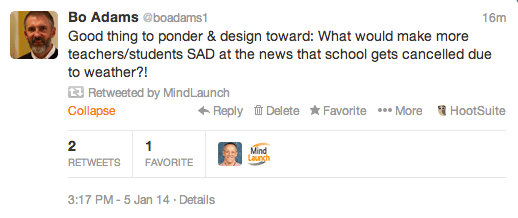
What would make school so great as a learning-and-engagement community that teachers and students would actually be sad, devastated even, when school was canceled for inclement weather?

Screen Shot 2014-01-05 at 3.34.39 PM

We should design for that emotion! For that desired user experience!

And if school canceled simply provides more time for people to do other things that get neglected “due to” their professional/school lives – hence the excitement about the cancelation, then we could learn from those insights, too! But I imagine that’s not all that’s at stake. How ’bout you?!

[Selfish blogger’s note: I so wish hundreds…thousands of people would fill the comments with examples of what school would/could be like that would make them sad if it got canceled due to weather. And then I wish we would make those schools happen more!]

+ + + + +

RELATED POST FROM THE PAST:

CHANGEd: What if schools factored in experiment days like snow days? 60-60-60 #6

PROCESS POST: Contemplating innovation, homework, practice…and their intersections. An Example. Iteration Three.

A Peek Into Contrasting Homework Assignments

Homework, Option 1

  • In your algebra book, in chapter 7, section 4, do the odd problems. Be sure to show your work. If the assignment takes you longer than 45 minutes of singularly concentrated effort, stop where you are at three-quarters of an hour of working.
  • For social studies, read chapter 12, section 3, and respond to the three “Thought Questions” on page 192.
  • [more like this from your subject-organized classes]

Homework, option 2

[Underlying assumption: the below example is more scaffolded due to the type of academic and school environment that the student learners are used to, and because of the timing of where we are (in the hypothetical scenario) in the traditional school year – early in the cycle. As capacity builds, learners would be less directed and more self-sufficient.]

  • EQ: What is beauty?
  • Observe: As you go through the next 10 days, record in your observation journal instances of your thinking related to our current priority essential question. If appropriate and responsible, take pictures of things you find beautiful and make some notes about why. Ask others what they think, too. Because we are near the beginning of this experience together, I can suggest that the VTR (visible thinking routine) “See, Think, Wonder” might be one way to frame your ethnography notes. Of course, you can devise your own strategy (and you’ll be asked to do this more and more as you practice your Innovators DNA skills); if I, or some other mentor/peer, can help with your observation-strategy plan, let me/them know. Ask questions. We’ll share and review our “Game Plans” and “Gantt Charts” in two days, so we can see various strategies and plans.
  • Question:
    • Record the questions that arise for you as you detail your observations. I don’t want to overly constrain your thinking by suggesting specifics now, but let someone know if you feel yourself in some unresolved struggle about “What kinds of questions should be arising for me?”
    • In relation to your subject-organized classes, tag at least some of your questions by the department name(s) for which those questions seem particularly connected. For example, “What percentage of the population finds this painting beautiful?” might suggest a “Math” tag for a statistics portion of your emerging project.
  • Experiment:
    • Of course, you’ll be experimenting with your observation-strategy plan.
    • Also, use your observation notes to scan for trends and patterns. What hypotheses on beauty seem to emerge for you? Begin to outline – in big-picture terms – the experimental methods you might use to test your hypotheses. If it helps, pretend you are on staff with Myth Busters, like we’ve talked about during our f2f time together.
  • Network & Associate:
    • Suggestion 1 (if needed) – read and comment on the observation-journal entries posted by some of the others in this learning cohort.
    • Suggestion 2 (if needed) – find connections in your independent reading and link to nodes in your learning web on this EQ.
    • Suggestion 3 (if needed) – explore the playlist “6 TED Talks on beauty” and/or listen to the TED Radio Hour episode “What is beauty?
    • What are your suggestions regarding networking and associating with this EQ?

What are your thoughts, reader?

#PuttingOurPracticeWhereOurPurposeIs

+ + +

Related Posts in This Thinking Path:

PROCESS POST: Contemplating innovation, homework, practice…and their intersections. +Awe. Iteration Two.

We have a responsibility to awe.

What if the molten foundations of K12 “homework” – if we must give it – were poured into and formed by the molds and casts of the Innovator’s DNA verbs?

  • Observe
  • Question
  • Experiment
  • Network
  • Associate

How might we better nurture our learners’ responsibility to awe? Our own responsibility to awe?

[Hat tip to David Cannon for the video!]

What’s our balance like, as educators…as schools, for utilizing homework to “go through the motions” vs. “inspire awe” at our condition as humans? How might we rebalance our scales?

#PuttingOurPracticeWhereOurPurposeIs

+ + +

PROCESS POST: Contemplating innovation, homework, practice…and their intersections. Iteration One.

The Balance (mini)Series

PROCESS POST: Contemplating innovation, homework, practice…and their intersections. Iteration One.

There is much talk of “innovation” in schools and education these days. (There’s much talk of innovation in just about every sector and industry.)

I wonder if we – those of us in schools – are really facilitating the experiences that student learners need to practice, to be and to become innovators.

Now, upon a great deal of my research and study about innovation, when I hear the word innovation, I think about the five traits and characteristics outlined in The Innovator’s DNA: Mastering the Five Skills of Disruptive Innovators.

And, I also think about homework. Yep, homework.

Innovators DNA - 5 Skills Slide

What if we simply assigned those five verbs as homework for our student learners?

  • Observe
  • Question
  • Experiment
  • Network
  • Associate

What if the student learners came to school each day with stories and inquiries about how and what and whom they…

  • Observed
  • Questioned
  • Experimented with
  • Networked, and
  • Associated?

What if these organizers were the strands by which learners weaved their archives and documentations via their eportfolios? What if more of the time in school ignited from the fuses and sparks generated by these verbs and developing habits of mind?

How might we facilitate the engagements, the curiosities, and the pursuits that compel learners to be and become innovators….by, well, practicing the five skills of innovation?

How might we homework our way to better learning and to enhanced schooling?

How might we educate for the innovation we expect and need in our world?

Could it be that simple?

#PuttingOurPracticeWhereOurPurposeIs