Ban the average. Design to the edges. Nurture talent.

Most days, at some point in the day, I am prompted to think about a Sir Ken Robinson quote that goes basically like this:

School should concentrate on identifying “How are you smart?” instead of concentrating on “How smart are you?”

This morning, as I watched Todd Rose’s TEDxSonomaCounty talk “The Myth of Average,” I was again reminded of Sir Ken’s challenge to all of us school people. As Rose detailed a U.S. Air Force issue and used it as an entry analogy for school, I pictured, among other things, the traditional school report card, filled with subject-area course titles and numerical averages listed to the right of each.

I am increasingly uncomfortable with that progress monitoring construct. At the very least, shouldn’t our progress reports disaggregate the averages and make visible the essential criteria, traits, and characteristics that we say we hold dear in a person’s learning and schooling. If content knowledge or mastery is a critical component in one’s school, then by all means report on it. But don’t skew the report by boiling together all of the dials and gauges that belong as separate meters on the proverbial dashboard. If work ethic, as represented by certain observable traits, is a critical component, then give it it’s own dial on the dashboard. And let the previously mentioned content knowledge component be a truer indicator of that unencumbered domain. And if classroom participation and collaboration are critical components, then allow them to be visible well beyond wondering what that “Math….88” means, in all it’s jumbled complexity, on a semi-annual report card that may have actually outlived its usefulness, given our more modern means of communication, digital exchange, and 2.0 capabilities.

Yesterday, I was privileged to be in a professional learning session with Jeff Moore of Moore Leadership and the Striver Quotient. Moore explained that Strivers feel an almost continuous sense of “incompleteness” – that they find it reasonable to be in an “uncomfort zone” as they strive to make things better and to make themselves better. Also, yesterday, I was blessed to be a part of the Innovation Diploma team as they worked through their Gallup Strengths Finder results, as individuals and the collective team (see here and here), with Ed Psychologist and Strengths Coach Elizabeth Payne.

Those threads of striving and building strengths are wonderfully tangling together for me with Sir Ken’s quote, Todd Rose’s ban-the-average-and-design-to-the-edges message, and my near 40-year history with the traditional report card. What if we designed progress monitoring systems – whole, coherent systems – that more fully demonstrated what we value in learners and want to make visible for further striving and strengths finding?

Moore also shared that Strivers are motivated by a purpose that transcends winning. Well, I’d love to work the progress monitoring system with a team of other strivers who see the immediate and critical need to ban the average and design to the edges – for the benefit of helping all of our learners see more fully how they are smart, rather than worrying about how smart they are.

A 21st century framework for designing student success and demonstrating student mastery requires Mount Vernon to develop a [v]igorous, relevant, and innovative learning and assessment map for each student…. (from Mount Vernon Presbyterian School’s (i)Plan17)

=====

Hat tip to Lawrence Smith, at St. Paul’s School, for sending me the Todd Rose TEDx talk and sparking this morning’s reflective writing for me.
What if we used adventure and curiosity as more of what we call school?

Fabien Cousteau opens his TED talk, “What I learned from spending 31 days underwater,” with these words:

I have a confession to make. I am addicted to adventure, and as a young boy, I would rather look outside the window at the birds in the trees and the sky than looking at that two-dimensional chalky blackboard where time stands still and even sometimes dies. My teachers thought there was something wrong with me because I wasn’t paying attention in class. They didn’t find anything specifically wrong with me, other than being slightly dyslexic because I’m a lefty. But they didn’t test for curiosity. Curiosity, to me, is about our connection with the world, with the universe. It’s about seeing what’s around that next coral head or what’s around that next tree, and learning more not only about our environment but about ourselves.

What if we celebrated adventure and curiosity (even more) as a fundamental component of the schooling part of education and learning? What if we moved the needle from thinking that “something is wrong” with a child who drifts in his attention to exploring what it is that might capture his curiosity?

Fabien Cousteau offers an amazing talk of accomplishing three years of science through 31 days of dedicated PBL. How might we backwards design from such adult projects and ventures to design opportunities and make room for such adventure and curiosity exploration in that learning segment we call school?

Three views into the potential and power of project-driven learning. #iProject #iVenture

My dream is to build the world’s first underground park in New York City.

I always knew as a kid that I wanted to make a difference, and to somehow make the world more beautiful, more interesting and more just. I just didn’t really know how.

Dan Barasch: A park underneath the hustle and bustle of New York City

My dream is _______________________.

What a powerful sentence starter. What a powerful action starter. If we only treated it that way more often. What a profound entry point into an endless supply of worthwhile projects. And not the kind of “dessert-at-the-end” style projects that are all too common in schools when the “important content” has already been “covered.” But the kind of projects that serve as the meal and the fundamental sustenance on which the nutrients of interdisciplinary topics are baked in and intentionally made part of the main course. (On a brief aside, this makes me think that we might need “nutrition labels” on projects — like those nutrition labels on our cereal boxes and cans of food. But in this case, the learner would progressively include what learnings are contained in his or her project.)

People from all over contact me to talk about project work. I think more than a few struggle with seeing what others view as robust and vigorous projects. So, I look for examples to show people. Dan Barasch’s TED talk is just one such example. And it’s an excellent six minute view into how dreaming can materialize into a vibrant project of inquiry, innovation, and impact.

When Dan shares his vision and work on the Lowline, I also see the potential for almost any high schooler or middle schooler to showcase similar stories of their dreams and projects. Maybe they would’t have the 3D computer renderings of the proposed space, and maybe they wouldn’t have the solar arrays built for a pilot installation. Or maybe they could. With partnerships of internal and external experts. If not, they could be coached and supported to produce comparable and lower-resolution prototypes, sketches, concept drawings, etc.

So many possibilities to dig into one’s dreams. And as an integral part of schooling.

As this blog post was bouncing around in my head waiting for me to put it in writing, I re-watched October Sky with my family.

I was reminded of how Homer Hickam’s project started with an observation of Sputnik, a curious spark about rocketry, and a teacher who did not let her lack of knowledge about rocket science allow her to say, “I can’t do this — I don’t know anything about rocketry and it’s not part of our curriculum.” Still, Homer’s project, at least how it was portrayed in the movie, was mostly confined to time outside of school and the project work only “counted” in school thanks to the science fair possibility.

But what if that work had actually been a fundamental part of Homer’s schooling? And not simply confined to “Science” class, but originated in a project-block such that the subject-areas were allowed to weave together as they naturally do, unbridled by the typical boundaries of 55-minute, subject-narrow periods.

At the risk of seeming like this post is “all over the place,” I also remembered Dolphin Tale as my family watched October Sky last Friday night and visions of the Lowline project connected in my mind. Dolphin Tale is another “based on a true story” movie that shows how a student struggling with typical school finds a project that lights his heart and mind on fire. I first saw the movie on Oct. 1, 2011. I know because I walked out of the theatre and had to quickly record a blog post by phone.

Why do so many project ideas seem to happen outside of school? Why can’t they BE school? At least a part of school.

So, here are three examples that I believe help many people visualize the power of project-driven, transdisciplinary learning. I hope they help you see the potential of drawing this form of working and learning into our next iterations of school.

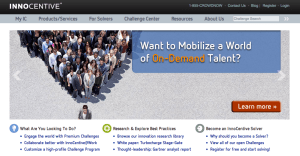
Project Idea #4: Grab a challenge on Innocentive

Innocentive is like a matchmaker for problems and solvers. If you’re looking to make a difference (or just looking for an interdisciplinary project), the innocentive site (https://www.innocentive.com/) can provide a ready-made “bug list” of challenges that are looking for creative solutions…and creative solution seekers.

On the landing page, one of the top level menus is “Challenge Center.” Once you’re in the center, you can use various filters and tabs to narrow a search. 

Another bonus — many of the challenges come with solution “rewards.” For instance, a past TSA challenge posted a $15,000 prize. (Hat tip to @LauraFlusche of MODA.) So, a school full of innovators might just find an additional source of income, in addition to doing good work for the good of others.

Screen Shot 2014-08-29 at 3.42.12 PM


=====

I am writing a series of blog posts about project ideas that could happen within a school – projects that could both transform school and, ultimately, transform us beyond school. This is my fourth part in the series. I’d love to know what you think.

More on Project Ideas:

https://itsaboutlearning.org/category/project-ideas/

School 3.0: Partnering for Mutual Learning and Problem Solving – CDC and MVPS

For awhile, I’ve used the term “School 3.0.” When I do, a number of people ask me what I mean by that.

School 1.0: the “traditional” or industrial-age model of school where information transfer from teacher to student is the dominant and defining characteristic. Verbs such as “deliver” and “cover” are used a lot. The currency is grades on a 100-pt scale (in recent half century).

School 2.0: the “21st century movement” in schooling where some number of “Cs” dominate the conversation (communication, collaboration, creative thinking, etc.); information exchanges in two directions and phrases such as “student-centered” are heard frequently. Technology enables some pull-based education. School works to model more of how the world learns outside of school. The currency of school 2.0 leans much more towards learning, and SBG is at least practiced by several progressive thinkers, if not the entire faculty.

School 3.0: the next wave (hopefully) of school transformation. Learning is deeply contextual and relevant. PBL (with a capital P) dominates the mode of work as “schools” (placed-based collections of teacher-learners, student-learners, and parent-learners — more like schools of fish than mere school buildings) are partnered with community organizations, civic leadership, and for-profit and not-for-profit business to address real-world challenges and opportunities. Shifts thinking about school as merely “preparation” for something later and recognizes that people of all ages learn by doing and desire to be positive forces of change in their worlds. The currency is the stuff that matters — the challenges and opportunities for social and capitalistic improvement, betterment, and innovation.

Well, on Friday, August 22, 2014, I spent a full day in School 3.0

Mary Cantwell (@scitechyedu) was invited as the Director of the Center for Design Thinking at The Mount Vernon Institute for Innovation to facilitate two half-days of professional learning and implementation of design thinking with Atlanta’s Centers for Disease Control and Prevention. Particularly, Cantwell was asked to work with the CDC’s National Center on Birth Defects and Developmental Disabilities (@CDC_NCBDDD) through the Open Idea Lab.

Additionally, Mount Vernon’s Inaugural Innovation Diploma Cohort was also invited to co-facilitate and participate in the partnership to address three SHI (Strategic Health Initiatives): 1) pregnancy and safe Rx drug use, 2) ADHD overmedication versus behavior therapy, and 3) blood clotting. Director of the iDiploma Meghan Cureton (@MeghanCureton) and I collaborated with the twelve student learners (freshmen, sophomores, and juniors at #MVUpper) in the cohort. Also, colleagues James Campbell (@theRealJamCam) and T.J. Edwards (@TJEdwards62) rounded out the team of educators and agents of @MVIFI.

On Friday, “school” for us involved significant collaboration with three CDC SHI teams to employ design thinking to advance our understanding of and to address the strategic health initiatives that the CDC_NCBDDD focused on during its time in the Open Idea Lab that day. Teen agers and doctors and educators and research scientists were bound up together in SHI teams doing the work of learners, problem-solvers, professionals, engaged citizen leaders, design thinkers, difference makers, etc. Everyone brought strengths and limitations to the tables. Everyone drew on the contributions that others offered.

Progress was made Friday. On three SHI. And on School 3.0.

Read about more of the details in one or more of these posts by my colleagues – those young and old not as young: